





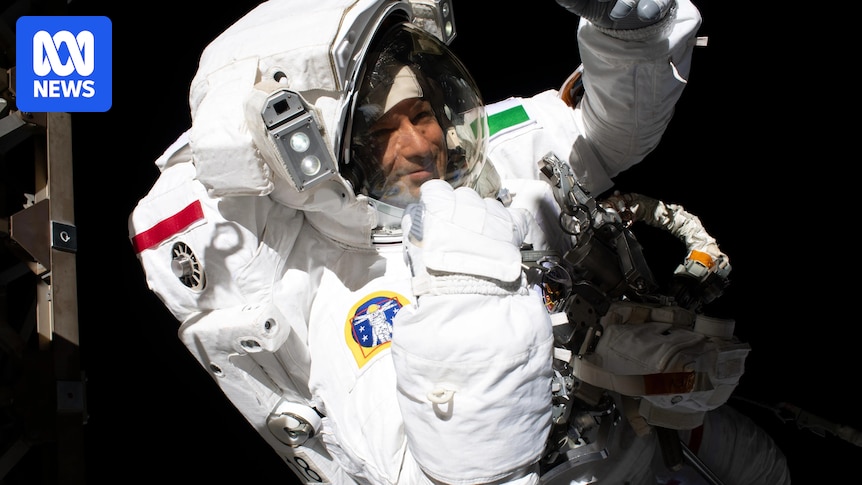
For more than 25 years, astronauts have been staring back in awe at the world from the International Space Station. But on January 12, 2020, Luca Parmitano was devastated by what he saw staring back.
Luca Parmitano captured the Black Summer bushfires from space. (Supplied: Luca Parmitano)
“I was watching those billowing clouds from 400 kilometres away. I was thinking of how much beauty, how much nature was going away, disappearing,” he told ABC Radio National Breakfast.
As the Black Summer bushfires ripped through the east coast of Australia, Mr Parmitano, who was serving as International Space Station commander at the time, captured the scale of the destruction: a blanket of ash and smoke, stretching the length of the vast continent.
“I’ve been lucky enough to go to Australia,” he said.
“I spent a week in Adelaide working with the Australian Space Agency. Such a beautiful environment, friendly people, wonderful culture. And it was devastating to think about the bushfires.
“I took those pictures and documented it [the fires] to give people a blunt reality check. This is what is happening, and we are a big part of what’s causing it to happen.
“My heart went out to you and your beautiful country.
“I feel a responsibility to share those ideas so that people become aware that we have to act, and there are ways that we can act. There are small things that we can do, but a lot of small things, even as individuals, can make a big difference. But finally, we can also choose who are our leaders and who do we want to represent us to take those values.”
Mr Parmitano says space exploration offers an opportunity for the world to unite amid the increasing global turmoil of conflicts and climate change.
Luca Parmitano has completed two long-duration missions to the International Space Station. (Supplied: ESA/NASA)
“I always like to say that when we get on the news, we bring the good news,” he said.
“And we are blessed to be able to do that. We still bring the good news. We still bring one unifying dream. Exploration, science, technology for all.”
Artemis III crew prepares for new phase
In June Mr Parmitano was selected as the first European Space Agency (ESA) astronaut assigned to the NASA Artemis program, which aims to return humans to the surface of the moon in 2028.
“It was emotional, it was overwhelming,” he said. “It still is overwhelming. I am humbled by all the interest that’s being generated.”
Luca Parmitano will pilot the next Artemis mission. (Supplied: NASA, B Stafford)
A trained military pilot of more than two decades, Mr Parmitano has spent almost as much time in the air as he has on the ground.
But nothing could have prepared him for the call-up to NASA.
“To be honest, it was absolutely not on my horizon,” he said.
“I wasn’t thinking about a Moon flight or an Artemis flight. I was not contemplating an assignment on these early missions … it really came as a wonderful, wonderful shock.“
Next year’s Artemis III mission will not fly to the Moon or land on the surface, but instead orbit Earth while practising docking the Orion capsule with two lunar landers.
Mr Parmitano was overcome with emotion when he accepted the role as Artemis III’s pilot and dedicated the moment to his family.
The Artemis III crew will launch in 2027. (Supplied: NASA, R Markowitz)
“My daughters are veterans of space flight. They’ve been there through two missions, lots of travelling back and forth across three continents and the ocean. They see me disappear for weeks at a time, months in orbit,” he said.
“This is going to be a sprint compared to what I’ve done before, both in the training and in the execution, so they’re excited. They are now much more aware of what it means to be an astronaut. And especially after Artemis II, they are much more in tune with everything that’s going to happen.
How astronauts prepare for space
Space isn’t the only frontier Mr Parmitano has explored.
As a “cavenaut” and “aquanaut” for the ESA, he’s used to feeling “comfortable with the uncomfortable” and plans to use those skills in his upcoming mission.
Luca Parmitano is also a certified “cavenaut” at the European Space Agency. (Supplied: ESA)
“There are two ways that you can train for complex operations,” he said. “One is a simulation, the other one is an analog. In a simulation, you can create extreme complex situations knowing that you are safe. You can crash onto the surface of the Moon and be blown to smithereens, and then you open the door and you walk out.
“But when you go into an analog … now the risk is real. You create an environment where you have to operate at the top of your capabilities and also test your limits with your crew. So being underwater for two weeks or being in a cave for 10 days … the complexities and the risk is real. Those environments prepare you to sharpen your tools.”
Mr Parmitano says he’ll be relying on the work of his crew mates to complete the mission successfully when the Artemis III mission launches in late 2027.
“They are amazing. We already know how we operate, how we relate, our values, what we share, what we have in common, our differences. And that experience will come very useful in the next few months,” he said.
He will be joined by three US astronauts: Commander Randy Bresnik and mission specialists Frank Rubio and Andre Douglas.
Artemis II crew (from left) Andre Douglas, Luca Parmitano, Randy Bresnik and Frank Rubio. (Supplied: NASA/Bill Stafford)
“We have one crew member that is a rookie, Andre Douglas, but who has already spent hundreds of hours getting ready for the Artemis II flight. His experience in the spacecraft is incommensurably higher than mine,” Mr Parmitano said.
“Then we have a comrade [Commander Randy Bresnik] who has two space flights on two different machines, a long duration mission with spacewalks, and then thousands and thousands of hours on aircraft as a test pilot, but also as part of the development team.
“Then we have Frank Rubio, who has the longest individual mission on orbit, over a year. He has been put through the grinder to really test his capabilities and his limits. Fantastic inspiration.”
Luca Parmitano is a veteran of two space missions. (Supplied: ESA/NASA)
As a test pilot in the Italian Air Force and a veteran of two previous space missions, Mr Parmitano was a natural fit to round out the team.
“I come in with my diverse background. I’m a test pilot for fixed-wings, but also rotary wings. I have extensive experience on helicopters other than airplanes. I’ve been constrained in a very small environment for relatively long times.
“My experience underwater and underground in a constrained environment, under stress with a small crew, I think will be an asset in managing the small volume of the Orion in the weeks that come.“
The sky is not the limit
The announcement of the next Artemis crew comes two months after Artemis II’s record-breaking trip around the Moon — surpassing the distance record of Apollo 13. It was a mission that captured the hearts and minds of millions across the globe, as mankind ventured to the moon and beyond.
One in six Australians watched the Artemis II launch in April this year, according to YouGov, with more than 30 million people tuning in worldwide.
NASA’s Artemis II Moon rocket lifts off from the Kennedy Space Center on April 1. (AP: Chris O’Meara)
The Artemis II mission offered a bright spark in a grim global news agenda and a life-affirming shot of perspective. It’s a feat Mr Parmitano is hoping his mission will be able to build on.
“I know that the camaraderie that we can show in our crew of Artemis III is going to be at least as good,” he said. “We’re all excited. We all want to do well. And we believe that we have a fantastic mission in front of us. It’s complex, it’s difficult, it’s challenging.
“But at the same time, we are what brings the human in human space flight.“
Loading…
With the prospect of the next human Moon landing two years away, it’s not unreasonable for Mr Parmitano to hope he could be part of that historic spaceflight. It could be the greatest adventure of his career yet.
But the seasoned astronaut isn’t letting the possibility distract him from the mission at hand: Artemis III.
“I have a wonderful mission in front of me on which to focus,” he said. “That’s already a wonderful privilege. But then at the same time, why put limits on what is possible?
“I’m young enough to have plenty of years in front of me. I’m also allowed to dream and I like to dream big.”