







A critical piece of the “defining technological achievement” of the 20th century will be at the centre of Powerhouse Parramatta’s opening exhibition.
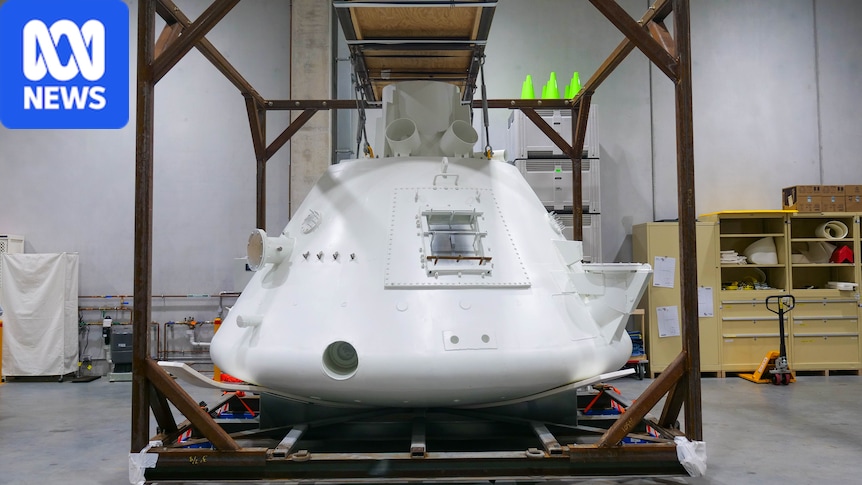
Weighing 4.5 tonnes, boilerplate #1224 was a test command module used for the Apollo space program that landed the first humans on the Moon in 1969.
The boilerplate was subjected to 102 ignition tests to make sure the spacecraft was safe for the astronauts to travel in after the fatal Apollo 1 fire that threatened to derail the entire Moon mission.
In 1967 a fire broke out inside the command module during a test while the three astronauts were inside. It was later found to be caused by a spark in a wire that ignited the 100 per cent oxygen environment.
Three astronauts perished in the Apollo 1 fire. (Supplied: NASA)
If the lessons from Apollo 1 were not learned, humans would not have made it to the moon in 1969, according to Smithsonian National Air and Space Museum (NASM) historian Teasel Muir-Harmony.
“The boilerplate #1224, in particular, was used to figure out how to make the spacecraft safe,” she said.
“What we really needed is to have a mixture of nitrogen and oxygen, which is a less flammable environment.
“It more closely mimics the air composition on Earth … and this is something that we continue to do to this day.”
The boilerplate was tested repeatedly. (ABC 702 Sydney: Declan Bowring)
The lessons from Apollo 1 also came in handy during the Apollo 13 mission when an oxygen tank exploded, forcing astronauts to reduce the spacecraft’s power and live in a lunar module.
The oxygen tank’s ignition would have been far more intense without the Apollo 1 lesson, Dr Muir-Harmony said.
The boilerplate is being loaned to Powerhouse by the NASM and is the first such item to have made it to Australian shores.
Powerhouse Museum conservators are looking to bring the boilerplate to its test-era glory. (Supplied: NASA)
Boilerplate #1224 will be central to Task Eternal, a space exploration-focused exhibition of 850 items.
Dr Muir-Harmony hopes visitors will see the importance of perseverance and testing as they pertain to space exploration.
“When the Apollo 1 fire happened, many people wondered if that would be the end of the space program,” she said.
“The response instead was, ‘No, we’re going to ensure we figure out what the problems were and fix those problems.'”
‘Monumental’ Pacific journey
A custom-built, steel-framed cage and cradle were used to ship the boilerplate from the US to Australia.
After the 43-day journey it was carefully unpacked at the Powerhouse’s Castle Hill premises in Sydney’s north-west.
Karen Rosenthal says it’s “fantastic” to see such a rare object in Australia. (ABC 702 Sydney: Declan Bowring)
“It was a monumental effort to bring the boilerplate to Sydney,” Powerhouse conservator Karen Rosenthal said.
She says the conservation team are trying to bring the boilerplate back to its testing era look by repainting it and reinstating the original NASA logo.
“It’s such a rare object — a large piece of space technology that we don’t see here in Australia. So it’s been really fantastic,” Ms Rosenthal said.
A reminder of Australia’s role in lunar exploration
Australia played a critical role in communicating with the Apollo missions and beaming the live television broadcast of Apollo 11.
“It’s a fun fact, but people in Australia were able to watch the Moon landing before everyone else, because the feed came to Australia first,” Dr Muir-Harmony said.
Lunar exploration was back on screens this year when the Artemis II mission flew around the Moon in April, marking the first lunar fly-by in more than 50 years.
Jaklyn Babington says the boilerplate will take pride of place in the exhibition. (ABC 702 Sydney: Declan Bowring)
Now the Powerhouse will be bringing a piece of lunar mission history to Australians in the flesh, the exhibition’s curator Jaklyn Babington said.
“It places Australian audiences in direct contact with one of the defining technological achievements of the 20th century,” she said.
“Apollo boilerplate #1224 is one of the largest objects in the exhibition and it lies at its very centre.”
A parachute used in the Apollo 17 mission will be on display. (Supplied: Smithsonian National Air and Space Museum)
Task Eternal will also feature a parachute from the Apollo 17 mission, the last lunar landing mission, and a rock sample box used on the Apollo 15 mission.
Astronaut John Glenn’s customised camera will also be featured. It was used to take the first human-captured colour photographs of the Earth from orbit during the 1962 Friendship 7 mission.
John Glenn’s camera will feature in the exhibition. (Supplied: Smithsonian National Air and Space Museum)
Task Eternal will also feature tan eight inch wafer etched with messages destined for deep space that were recorded by members of the public last year as par of the HUMANS project.
Powerhouse Parramatta will open before the end of the year and will host five exhibitions, including a nostalgic collection focused on Western Sydney’s shopping malls.