
For 143 years, ancestral remains from a remote Polynesian island sat in the collection of the Australian Museum. Today, they are “finally going home”.
The remains of people from Rapa Nui, also known as Easter Island, were removed from sacred burial sites during a European naval expedition in 1882.
Seventeen of the members’ remains and a sample of human hair were purchased by the museum in Sydney the following year.
The Rapa Nui Council of Elders credited the Australian Museum and government for “doing the right thing”. (ABC News: Floss Adams)
For over a century, they were within the natural science and culture institution which holds more than 22 million objects and specimens in its collection.
On Thursday, the ancestral remains began a long journey home, accompanied by a Rapa Nui delegation.
The repatriation will be overseen by the Chilean government, given the island is a special territory of Chile.
Custodian documents were signed on Wednesday at a formal farewell ceremony at the museum, the room filled with the sounds of a Fijian farewell song, the ukulele and a ceremonial exchange by delegates.
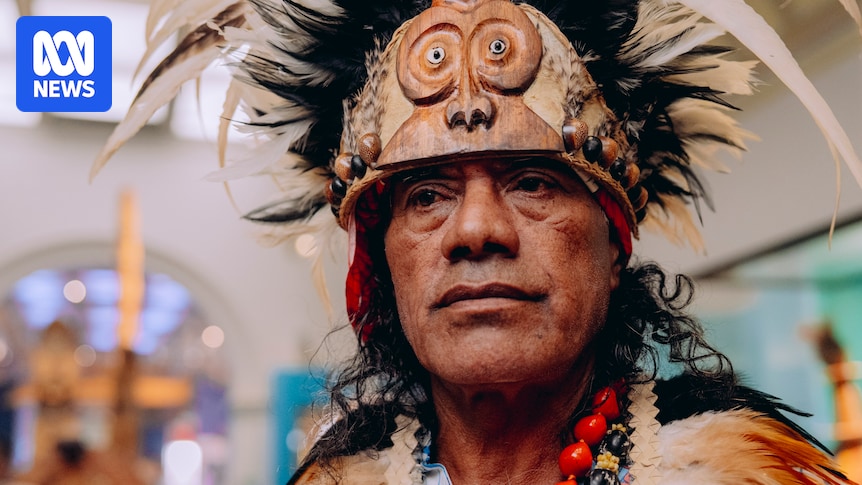
Delegates came from Rapa Nui. (ABC News: Liam Patrick)
A ceremony took place at the museum. (ABC News: Liam Patrick)
On Thursday, the ancestral remains began the long journey home. (ABC News: Liam Patrick)
Director and chief executive of the Australian Museum, Kim McKay said it was a special moment, not only for Australian history, but for “our wonderful brothers and sisters from Rapa Nui”.
“It’s significant for us, but really more significant for the community,” she said.
“On behalf of the Australian Museum, I offer an unreserved apology,” Ms McKay told the audience at Wednesday’s ceremony, her voice trembling with emotion.
“We acknowledge that our institution took part in the purchase of human remains, remains taken without consent from resting places that were never meant to be disturbed.“
Tensions from past collecting practices
Kim McKay acknowledged the former wrongdoings of the museum. (ABC News: Liam Patrick)
Ms McKay noted the influence of colonialism, where both the naval expedition and the museum at the time had viewed Indigenous ancestors as objects of study rather than as people.
She too acknowledged the need to address archaic museum collecting practices of the past.
Laura McBride is a Wailwan woman and holds the role of director, First Nations at the Australian Museum.
“My own ancestors and objects were taken from Country, so I truly understand the tensions created from the legacy of past collecting practices,” she said.
“I know how therapeutic it can be when new relationships are made that enable us to address the mistakes of the past and move towards healing.”
Laura McBride spoke about the process of moving towards healing. (ABC News)
A lengthy and structured process was behind the repatriation, with it being two years since the museum’s Pasifika team first engaged with Rapa Nui descendants.
There is no legally binding law that compels Australian institutions or individuals to repatriate ancestral remains; rather Australia instead typically undergoes repatriation efforts through voluntary agreements, policy, and ethics.
This is in contrast to the United States, which is legally compelled to repatriate Native American ancestral remains and cultural items, primarily enforced via a specific federal law.
Father Francisco Nahoe expressed his thanks to all involved in the repatriation. (ABC News: Liam Patrick)
Father Francisco Nahoe, the North American repatriation coordinator for the Rapa Nui Council of Elders, credited the Australian Museum and government for “doing the right thing”.
“They and all of Australia with them are looking squarely into the face of that unflattering history and asking the practical question, ‘How do we do what is right now?’
“It is not easy to do that. But for your efforts you have gained the respect of the Rapa Nui people.”
‘They are our grandparents’
The delegation thanked everyone involved in the reparation process “from the bottom of our hearts”.
Council president Uncle Carlos Paoa painted a picture of the lives the deceased lived before their remains were removed from burial sites.
They were leaders of their tribes and important people within their community, he said.
Uncle Carlos Paoa shared insight into the Rapa Nui people. (ABC News: Liam Patrick)
Uncle Carlos said there were 36 tribes who lived on Rapa Nui awaiting the repatriation.
“It is a very important event for all the clans on the island. From each of these areas, humans remains were taken away all those years ago,” he said via a Spanish translator.
“Our Ivi Tupuna are not just human remains. They are not objects. They are our grandparents, our great grandparents — our ancestors’ caring, spiritual, protective energy.”