





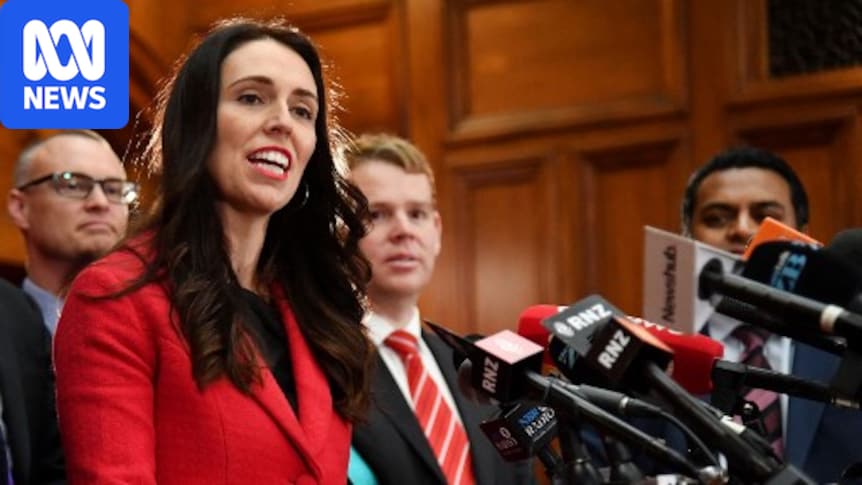
Jacinda Ardern is calling for more empathy in politics.
Since stepping down as New Zealand’s Prime Minister in 2023, Dame Jacinda has been warning against divisive and authoritarian leadership in favour of compassionate and values-driven governance.
She says that a tendency towards strongman leadership is missing the mark with voters.
“Often we hear discussion about authoritarianism now, more often than we’d hear about something like empathetic leadership,” she told Sarah Kanowski on ABC Conversations.
“That is not where I believe the public are.
“If the public were in the same place, then we wouldn’t be seeing all of the multitude of surveys that tell us that people feel disenfranchised, or that they feel that they’re not represented by their politicians anymore.”
Throughout her five years in the top job, Dame Jacinda gained recognition for her compassionate leadership style, particularly in her unifying response to the Christchurch terrorist attacks.
In 2017, aged 37, Jacinda Ardern became New Zealand’s third female PM. (AFP: Marty Melville)
Dame Jacinda — who, after ending her time in office, was appointed to dual Harvard University fellowships for her leadership — says voter behaviour across Western liberal democracies reflects a growing disconnect between the public and the political system.
Her comments come as Australian polls this year have shown a surge in support for One Nation and its leader Pauline Hanson after sitting on the political margins for the best part of 30 years.
“I take [it] as a sign the fact that you see people voting for parties that are often on the fringes of the mainstream,” she said.
“The majority of those who are doing that are often not voting for the ideology.
“They’re just voting against the status quo because they don’t think it serves them anymore.
“All the signs actually point to people wanting something different than what they’re getting now. But, mostly, the options that people have don’t always capture empathetic leadership.”
Humanity during crisis
Dame Jacinda says she chose to lead with vulnerability in the wake of the 2019 terror attacks on two Christchurch mosques where 51 people were murdered.
“My instinct in the end was just actually to share how I felt,” she said.
“Even if I wanted to stand in front of everyone devoid of emotion, I physically couldn’t.
“I want to lead like a human first and a politician second.“
Dame Jacinda said she had clear purpose in her first address after those attacks: not to inflame fear, not to respond with inaccuracies, and most of all, not to hand the perpetrator any kind of victory.
“I felt so angry that someone thought they could try and manipulate the New Zealand public to respond in a particular way, that part of the way they designed this horrific attack was to try and get people to react violently,” she said.
“And I was so desperate to deny him that. But ultimately that was for New Zealanders to deny, and that’s what they did.”
Choosing unity over division in the wake of the attacks, Jacinda Ardern was recognised around the world. (AFP: Dubai’s Public Diplomacy Office, Sanka Vidanagama/AAP: Mark Baker/Getty: Carl Court)
Dame Jacinda says she initially believed effective leaders needed to avoid showing emotion in order to demonstrate strength and courage.
But she says that belief was slowly “chipped away” during her five years in office.
“If you’re in front of a camera often enough, and you’re in emotional situations often enough … your own response is going to come through,” she said.
“And my conclusion was … that’s a good thing.
“If we want to rebuild people’s trust and confidence in politics, and we want to bring a bit more humanity in — which I think should be the goal — then we should allow ourselves to be human too.”
During a press conference the day after the attacks, Jacinda Ardern was unabashed in showing emotion. (AFP: Marty Melville/Office of Prime Minister NZ)
Dame Jacinda found herself in a vulnerable position just weeks into her prime ministership when, after an extended struggle with fertility, she learnt she was pregnant.
While navigating a new role as Prime Minister, she announced the news to the public.
Dame Jacinda held her breath, anticipating a swathe of criticism, but she says she was met with a “beautiful” response.
“I remember getting a letter quite early on into my pregnancy where someone wrote to me and said, ‘I fell pregnant at the same time as you and I was terrified of telling my boss until I heard on the radio that you were pregnant. And when I heard that, I felt like everything was going to be OK.'”
Jacinda Ardern, pictured at Buckingham Palace while meeting with Commonwealth heads of government, made international news for being “the pregnant PM”. (Pool via Reuters: Daniel Leal-Olivas)
What came next was the pressure to juggle the top job with societal expectations of motherhood.
“I remember thinking, ‘I have to prove this is possible,'”
she said.
“But you almost end up in this impossible bind where you’re trying to prove that you’re still working as hard and [are] as competent, and so you probably overcompensate a bit.
“But at the same time, particularly once baby arrives, you need to show that you’re being a good and competent mother as well.
“And those two things would butt up against each other all the time.”
What was also important to Dame Jacinda was demonstrating that flexible, family-friendly workplaces are achievable.
“You can create all the policies in the world, but unless you’re role modelling something and showing that it’s OK, then someone might personally still feel like it’s difficult,” she said.
Jacinda Ardern and Clarke Gayford’s newborn daughter was dubbed by many New Zealanders as the country’s “royal baby”. (AAP: David Rowland)
After a desperate mother approached her in the supermarket saying “I don’t know how to do it”, the former PM realised she needed to be more transparent about her experiences.
“Somehow my example didn’t make her feel better, it made her feel worse,” she said.
“Like, ‘I can’t even wash my hands — this woman’s running the country.’
“And so I said to her: ‘But I don’t do it on my own. I have support, and I have help.'”
She pointed out that her partner, Clarke Gayford, was — and is — the primary caregiver.
“So every opportunity, I would talk about that because, yes, women can have very fulfilling careers and operate at the highest level. And yes, they, at the same time, could be mothers and caregivers. But they should not do either of those things on their own and without support.”
Jacinda Ardern attended her first UN General Assembly with her three-month-old and her now-husband. (Reuters: Carlo Allegri/AFP: Don Emmert)
A fresh start
While Dame Jacinda was praised internationally for her leadership style, she navigated criticism on home soil.
Amid declining approval polls and online threats towards herself and her family, she abruptly finished her time in office in 2023. She said she no longer had “enough in the tank” to do the job justice.
Graffiti on the street in Auckland reads #ResignJacinda — a call often made by New Zealand’s anti-lockdown movement. (ABC News: Luke Bowden)
In her valedictory speech she stood by her leadership style and her belief that vulnerability does not equal weakness.
“You can be anxious, sensitive, kind and wear your heart on your sleeve,” she said.
“You can be a mother, or not, an ex-Mormon, or not, a nerd, a crier, a hugger – you can be all of these things, and not only can you be here – you can lead.”
Since signing off as PM, Dame Jacinda, Gayford and Neve, now eight, have been travelling overseas.
“We’re just having an adventure,” she said.
It was announced in March that they would settle in Australia, but Dame Jacinda rejects any notion that the move across The Ditch is a slight against her home country.
The move is a fresh start that’s still relatively close to home.
“There’s something about being able to have a little bit of distance from something that was all-encompassing in our lives,” Dame Jacinda said.
“Because in a way, that period was all about my time in office. And this is my family’s time.”
Stream Jacinda Ardern’s full Conversations interview from 11:00am today on ABC Local Radio or via the ABC listen app.