




The US and Iran have officially signed an agreement to end their months-long war, sending a collective sigh of relief through global economies this week.
But across Tehran and other Iranian cities, news of the agreement sparked protests, rather than relief.
Hardline supporters of the regime mobilised against the country’s negotiators, Foreign Minister Abbas Araghchi and parliamentary speaker Mohammad Bagher Ghalibaf.
Video posted to social media showed people protesting in Tehran ahead of the agreement. (Reuters: Social media)
Videos posted by Saberin News, a social media channel with suspected ties to Iran’s Islamic Revolutionary Guard Corps-Qods Force, show infuriated demonstrators chanting “Death to Araghchi, the shameless infiltrator”.
Other protesters were seen burning pictures of the Iranian officials alongside images of US President Donald Trump and Israel’s Prime Minister Benjamin Netanyahu.
While the protesters do not represent all Iranians, this religiously conservative faction of the population views any co-operation with the US as shameful capitulation, a message that has been drilled into them for decades by their own clerical leaders.
And some analysts say the US’s status as Tehran’s enemy is crucial to the image Iran’s government wants to project to its people, which could be complicated by a peace deal.
Friday prayers and the ‘lunatic in charge’
Across Tehran, the anti-American propaganda is everywhere.
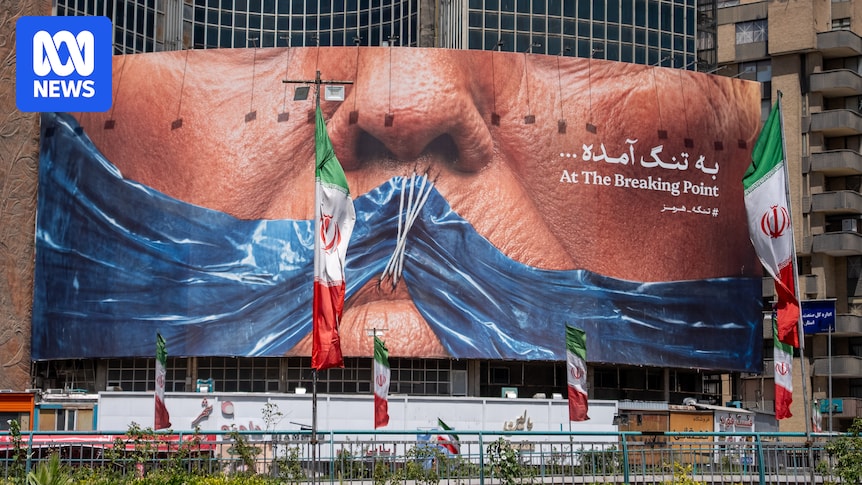
A giant billboard at Valiasr Square, a busy hub in the centre of the city, depicts Trump’s mouth stitched shut and covered by tape shaped like the Strait of Hormuz.
In place of commercial billboards, Tehran’s regime has erected propaganda aimed at the US and Israel. (ABC News: Daniel Pannett)
The old American embassy on Taleqani Street is now the US Den of Espionage Museum.
In front of it, a series of giant posters line the street with reminders of darker moments in US history: the bombing of Hiroshima, the African American slave trade, and the mistreatment of Native Americans are depicted among other events.
The former US embassy in Tehran is now the “US Den of Espionage Museum”. (ABC News: Daniel Pannett)
Even in religious spaces, the anti-American message is spread.
At a recent Friday prayers in Tehran University, which the ABC visited while on a reporting assignment in Iran, the Imam railed against Mr Trump in front of tens of thousands of worshippers.
“His disgraceful death will be delivered by one of [sex offender Jeffrey] Epstein’s own victims, inshallah,” the Imam said in English.
“Let me tell the American people and their elites, with this lunatic in charge, your superpower downfall is coming faster than you think.”
Thousands attend Friday prayers at Tehran University, separated by gender. (ABC News: Daniel Pannett)
This eco-chamber of anti-Americanism is not new. Some of the murals in Tehran are decades old and were painted just after the 1979 revolution that ushered in the current Islamic Republic.
‘America is not innocent in this’
Iran’s hostility towards the US goes back decades, even pre-dating the country’s revolution.
“America as the main enemy was always part of the ethos of this Islamic Republic … they inherited it from the Cold War times,” said Derya Göçer, the chair of Middle East studies at the Middle East Technical University in Ankara, Türkiye.
Iran’s hostility towards the US goes back decades, even pre-dating the country’s revolution. (ABC News: Daniel Pannett)
Since then, the US has done little to dispel its image as Iran’s greatest nemesis, according to Dr Göçer.
A key example she points to is the 1953 coup, during which the CIA helped topple Iran’s democratically elected prime minister, Mohammad Mosaddeq, and cemented the absolute rule of the pro-Western Shah, Mohammad Reza Pahlavi.
This coup is widely considered the direct catalyst for the 1979 Islamic Revolution, which led to hardline clerical leaders ultimately taking the reins of power in Iran.
“This was followed by many rounds of American intervention into Iranian politics, and then many rounds of sanctions that crippled the Iranian economy,” Dr Göçer said.
“So I think the United States played its own role in it.
“America is not innocent in this.”
Even now, Mr Trump appears to be leaning into Iran’s caricature of the American “infidel” by threatening to end its civilisation and resume bombing the country if a peace agreement is not reached.
But there is another, more Machiavellian purpose behind the regime’s decades-long demonisation of the US. As long as Iranians are directing their wrath at Washington, they are not directing it at their own autocratic government, according to Dr Göçer.
“The mobilisation against the United States as an enemy was important in this war to … suppress domestic opposition against the regime. The Iranian Islamic republic is very skilled at that,” Dr Göçer said.
“This war helped to re-enliven the regime. It gave it a new breath that it was actually looking for because its strength had diminished due to economic and social pressures.”
War followed brutal crackdown on protesters
Those pressures reached a boiling point at the start of the year after tens of thousands of people marched across the country to protest skyrocketing inflation and the plunging value of the currency against the US dollar.
Protesters march through downtown Tehran in December. (AP: Fars News Agency)
What started out as calls for economic reform quickly escalated into demands for human rights and political reform.
Security forces responded with a brutal crackdown. More than 6,400 people were killed in a matter of days, according to US-based Iranian human rights group HRANA. They are still investigating the cause of death of more than 11,000 others.
Now, with a potential peace deal in place, Iranians will no longer have the distraction of the war and their great enemy America.
“I think that’s why there is this debate between different conservative factions in Iran today, because some conservative factions see this potential deal undermining the regime itself, and they want constant war,” Ms Göçer said.
“An intentional restart of this war would be more for the security of the regime, and to prolong its life versus the security of the nation.”
Other observers, including Nos Hosseini, a spokesperson for the Iranian Women’s Association in Australia, believe the deal has just “emboldened” the regime.
“On one hand we see … a potential end [to] a conflict between the West and Iran,” she told ABC News Channel.
“But we don’t see — and we will not see — an end to the conflict between the Iranian regime and its citizens”.
The late supreme leader Ayatollah Ali Khamenei reportedly once said Iran “needs enmity with America”. (WANA via Reuters: Majid Asgaripour)
The economic conditions and the public anger that led to the mass demonstrations earlier this year have only worsened under the conflict.
As the dust settles on the war and America retreats out of the region, analysts say Iranians may once again focus on the enemy within.