









The head of an Ontario company behind a Hamilton data centre proposal says the best way to address the environmental impact of such facilities is not to stop their development, but to build them better.
“Done right, I think it’s a great opportunity for Hamilton,” Milfred Hammerbacher, CEO of s2e Technologies, told CBC Hamilton Tuesday.
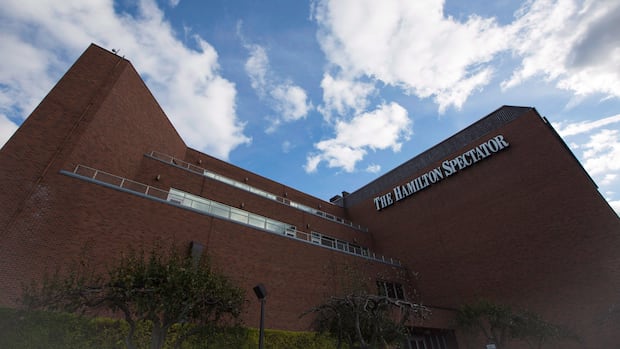
In December, McMaster University announced it was exploring working with St. Jacobs, Ont., company to turn the former Hamilton Spectator building at 44 Frid St., into “an innovation hub with a modern data centre.”
McMaster Innovation Park acquired the building in 2020. The university said the project “could support emerging research and business computing needs, including artificial intelligence.”
The growth of AI has increased demand for the physical places that store, process and run data and software. At the same time, protests against such projects have been growing across the country — including in Hamilton — driven by concerns about how much land, electricity and water these facilities consume.
A week after hundreds of people protested a proposed data centre on Hamiton’s waterfront, Coun. Nrinder Nann (Ward 3) called for a moratorium on such facilities until the city develops local guidelines. A motion to bring that about is scheduled to come to the city’s planning committee on June 16.
Hammerbacher said he’s followed the protests in Hamilton, heard people’s fears and empathized. “I could have been right there with those folks, actually.”
S2e started as a solar energy company, Hammerbacher said, and he’s long been concerned about the environment.
“Forty years of work could go down the toilet if we don’t be smart about building these data centres,” Hammerbacher said, referring to advancements in clean energy. “The reason we got into it is because we thought there’s got to be a better way to do this. We’re not your normal data centre company, I don’t believe.”

The organization behind a data centre proposal for Hamilton’s waterfront says its proposal to the federal government is still going ahead. The Digital Research Alliance of Canada is proposing to build, own and operate a “National AI Compute Facility” on former industrial land owned by Slate Asset Management. Slate recently applied to section off a portion of that land to begin development of a larger project but was denied after hundreds protested the potential data centre.
A McMaster University spokesperson told CBC Hamilton Thursday that the university won’t share any information about the proposal until it concludes the “due-diligence” phase of the project with s2e on June 30.
In a December news release, McMaster emphasized “no final decisions have been made,” and said the company would “assess community and stakeholder needs, environmental and regulatory requirements, and technical and financial feasibility,” before preparing a formal proposal.
It said a final decision would require approval from the university’s board of governors.
Hammerbacher told CBC Hamilton his team has interviewed McMaster researchers about their computing needs, talked to McMaster Innovation Park about hosting space in the facility, and met with neighbouring businesses.

S2e CEO says good design can mitigate environmental concerns
Overall, Hammerbacher said, s2e could use several technologies to mitigate the environmental impacts of a Frid Street data centre.
For example, he said they could use a closed-loop glycol cooling system to minimize the need for water.
And for power, he said, the centre could use a mix of virtual power purchases from off-site solar farms and store energy during off-peak hours to reduce what it draws from the local grid. For backup power, he said the company is looking into fuel cells instead of carbon-emitting natural gas generators.
The company is also looking into capturing waste heat produced by a data centre and using it to power heat pumps in the surrounding area.
Fresh Air13:36What are AI data centres, and why isn’t everyone on board with them?
The federal government is pushing to build data centres in this country. They will increase Canada’s computing power and AI adoption, but they come with some serious concerns. Shion Guha is a computer science professor at the University of Toronto. He gives us an overview of the pros and cons of building AI data centres.
Ian Borsuk, who directs Environment Hamilton, said he hopes s2e and other potential data centre developers have the best intentions, but would like to see them put their environmental commitments in writing.
“Private companies and government agencies have said that they can do a lot of things,” he told CBC Hamilton Sunday. “We have a very long history of being told things can get better and then they don’t.”
Borsuk said he’s keen on Nann’s motion to create a local data centre framework. Through that, he said, companies could be required to sign community benefits agreements and comply with specific local rules around water and energy. Without rules, he said, companies could be incentivized to pick profits over the best interests of communities.
As data centre projects rapidly advance, Borsuk said, “I think it’s very reasonable for folks in the community to say ‘Hey, hold on. Let’s pump the brakes here a little bit and at least put together a framework of what would make these facilities acceptable.'”
Data centre could take year-and-a-half to set up if approved
Hammerbacher said he’s excited about the possibility of working on a high-profile project with a university. He said there’s a “tremendous opportunity to grow jobs,” and to fuel important biomedical research.
“AI is a scary thing,” Hammerbacher said, but “What’s the alternative? If we outlaw AI data centres in Canada tomorrow, is it going to stop the problem?”
He noted McMaster has an Artificial Intelligence Advisory Committee overseeing the use of the technology, something he thinks is “healthy.”
If the project gets the green light this summer, a data centre could be operational in the former Spectator building within a year to 18 months, Hammerbacher said.