








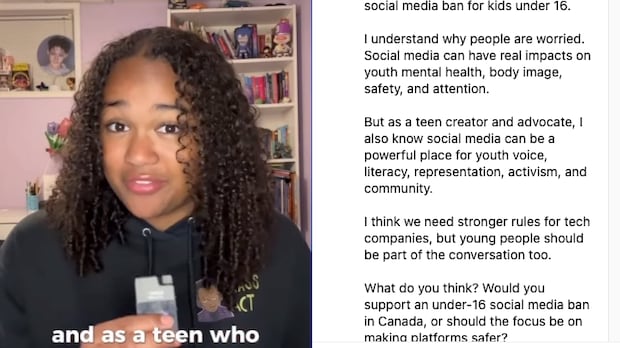
A teen content creator who has spent years promoting books to kids online says the Canadian government should focus on how to better protect young people from the harms of social media, before imposing an outright ban.
“Social media can be a powerful place for youth voice, literacy, representation, activism, and community,” 17-year-old Hamilton resident Ainara Alleyne said Wednesday on her prolific Instagram channel AinarasBookshelf.
“For a lot of young people it’s where we learn, organize, create,” she said, adding that the government needs to get more input from young people on the issue.
Alleyne was reacting to the federal government’s introduction of a bill that would restrict access to social media for Canadians under 16, unless companies can show they’ve made their platforms safe.
Alleyne, who is also a CBC Kids reporter, said she understands the motivation to protect kids from online harms. “I understand people are worried,” she said. “Social media can seriously affect young people, especially girls… [the] harmful content and addictive scrolling, those are all very real.”
But instead of the question being “should kids be banned?,” Alleyne said, “the better question is how to we protect young people without silencing them?
“Young people should be part of the conversation before adults make decisions about our digital lives,” added Alleyne, who has been a Junior Librarian in Residence at the Hamilton Public Library.
She has also interviewed authors including Lawrence Hill, who wrote The Book of Negroes and children’s book Beatrice and Croc Harry, and Jerry Craft of the New Kid series. Her channel features authors and books that centre characters who are Black, Indigenous, people of colour, differently abled and other underrepresented minorities.
Alleyne also said social media platforms should be held responsible for making sure young people are safe. “I think we need stronger rules for tech companies.”

Bill comes amid pressure to address addictive features
Ottawa has been under pressure from parents and advocates to address social media’s addictive features and limit access to predatory and dangerous content. Psychologists say design features such as infinite scroll are impacting teens’ self-esteem and mental health.
On Wednesday, Culture Minister Marc Miller introduced his long-awaited online harms bill in the House of Commons, saying, “we need basic protection in place so every child in this country can be safe.”
Bill C-34, the Safe Social Media Act, would force social media services — defined as traditional social media platforms, live-streaming services and adult content services focused on user-shared content — to restrict accounts to people 16 years old and above.
However, services could seek an exemption if they implement what the government called adequate safeguards to protect children. The exemption wouldn’t apply to platforms offering adult content.
The bill doesn’t lay out how the platforms will verify users are at least 16.
The government said the bill was informed by consultations with “victims and survivors, civil society organizations, Indigenous partners, experts, industry, and Canadians.”
With the new legislation, social media platforms will have to quickly remove content that sexually victimizes a child or re-victimizes a survivor and non-consensual intimate images. They will also have to “apply labels to synthetically-generated content,” the government said in a press release.
The maximum penalty for a violation would be either $10 million or three per cent of the company’s gross global revenue — whichever is greater. Companies could face multiple penalties for repeated violations.
‘There needs to be a balance,’ says Hamilton dad
Alleyne’s dad, Shani Alleyne, said a full ban on social media for kids under 16 could actually be a disservice to young people.
He thinks they should be able to learn gradually about online safety in a protected environment, such as the existing teen accounts on Instagram, which restrict messaging from strangers, filter out adult content and set usage limits.

He said without a safe version, many children who still want to use social media will find their way into its unsupervised areas.
“It’s basically the wild, wild west at that point. It’s better to give you an intro; better they give you a junior version, even if it’s just watered down.”
He told CBC Hamilton social media has provided community for his daughter, especially during the pandemic, and it helped her find an audience for her content, which led to a TV show and guest-speaker gigs.
He also noted its value in activism and counter-government protests across the world, saying in many places and circles, it is the main way people organize.
“There’s a need for it, but if it’s just about making money and hypnotizing children to be future clients, then there needs to be a balance,” Shani said. “The heavy lifting should be the companies because they’re the persons who made the predatory algorithms in the first place.”