







Listen to this article
Estimated 5 minutes
The audio version of this article is generated by AI-based technology. Mispronunciations can occur. We are working with our partners to continually review and improve the results.
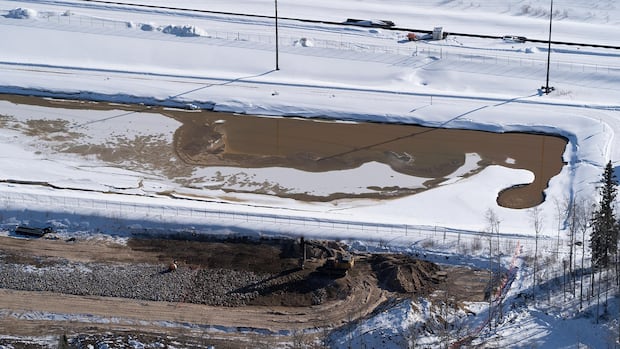
Imperial Oil will pay $120,000 in penalties after nearly 5.2 million litres of oilsands wastewater overflowed in 2023 from a storage facility in northern Alberta.
At the Alberta Court of Justice in Fort McMurray, the company pleaded guilty on May 29 to releasing industrial wastewater from its Kearl site into the surrounding area without authorization. Eight other charges in connection to the spill were withdrawn.
According to an agreed statement of facts, the wastewater did not enter tributaries that feed the nearby Firebag River, instead freezing outside the Kearl open-pit oilsands mine 70 kilometres north of Fort McMurray, Alta. The statement says the spill occurred because sensors designed to detect an increase in liquids did not account for sediment that had accumulated in recent years.
“We sincerely regret that this incident occurred and have taken actions to investigate and implement changes to prevent reoccurrence,” said Lisa Schmidt, a spokesperson for Imperial Oil, in a statement to CBC News on Thursday.
“No water from this overflow entered any rivers and there continues to be no indication of adverse impacts to local wildlife. We continue to share monitoring data with local Indigenous communities and provide site tours of the area.”
The pond stores surface water runoff, precipitation and “a small amount of industrial wastewater,” Schmidt said. It also stores silt and sediment from the surrounding area. Court documents state the water is reused in the production process.

Indigenous communities downstream from Kearl were outraged to learn of the overflow. The company was fined $50,000 in 2024 for a separate wastewater spill that happened at the Kearl site in May 2022.
Chief Allan Adam of the Athabasca Chipewyan First Nation said in a Friday interview with CBC News he is not happy with the court’s decision.
Similar incidents in the future should have harsher penalties for the leadership of oilsands companies, he said.
“The corporation should be charged, pay hefty fines, maybe $10 million and the president of the corporation should receive jail time of 10 years,” Adam said.
“That will change the mindset of everybody.”
Some members of the First Nation, which is based in the Fort Chipewyan area, believe industrial pollution of the nearby water sources has caused elevated cancer rates in the community. A 10-year federal study into the issue was announced in 2024.
Sediment increase, sensor confusion led to overflow
The statement says the incident was first reported at Kearl, after staff detected a storage pond had overflowed on Feb. 4, 2023. It is believed the overflow started on Jan. 30 of that year and lasted 24 hours, said the statement.
The pond’s electronic monitoring and control system was based on an active storage volume lower than the pond’s total capacity. However, sensors were designed to determine if water levels were above the pond’s full capacity, despite the pond not actually being at full capacity.
This configuration created confusion about the pond’s actual water levels. Some operations staff felt the water levels reported by the sensors “did not reliably reflect water level in the pond,” according to the statement.

Before the spill in 2023, Imperial tackled the concerns toward the alarm system by having water levels physically inspected twice a day, while pumps would reduce rising water levels. The statement says this system worked without incident for eight years.
The pump was turned on by staff to lower water levels on the morning of Jan. 28, 2023. The high-level alarm went off 21 minutes later, and again during the early hours of Jan. 29, 2023. The statement of facts says the sensors were calibrated to send an alarm “well below capacity levels.”
On Jan. 31, 2023, the operator manually operated the pumps again at 8:57 p.m. The company contacted the Alberta Energy Regulator on Feb. 4 after staff found overflowing wastewater had frozen to the ground.
Court documents state that since the 2023 incident, Imperial Oil has spent about $2 million on remediating the impacted area and has also improved its alarm systems, maintenance cycles and inspection procedures.
The pond has been dredged three times since the incident and sediment retention traps were installed in 2024. Pumps are now activated automatically.
Of the total fine issued to Imperial, $118,000 will go toward a creative sentencing project, which the energy regulator said must benefit “Alberta public lands, Indigenous traditional territory within Alberta, wetlands or surrounding ecosystems.”