








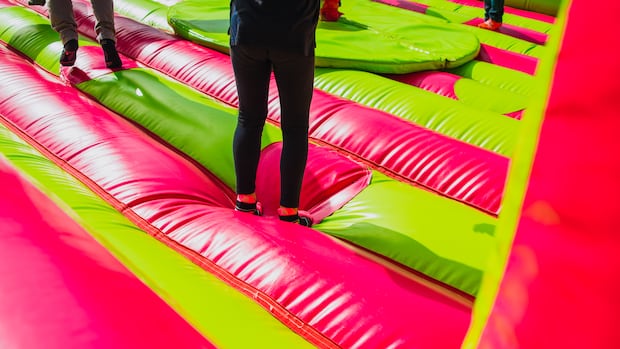
The tragic death of a three-year-old girl after a bouncy castle was swept up by the wind in Montreal is raising questions about the safety of the devices and the lack of regulation.
The toddler, identified by her father as Ava Ciampini, was among 11 people injured when an inflatable structure, set up in a park in Montreal’s LaSalle borough, was blown away Sunday afternoon.
Around the time of the incident, gusts of wind of 50 km/h were reported by Environment Canada.
Despite the popularity of inflatable games at parties and festivals, CBC News has confirmed the Quebec government has no regulations governing their rental.
The regulatory gap exists despite a number of weather-related bouncy castle incidents across the globe.
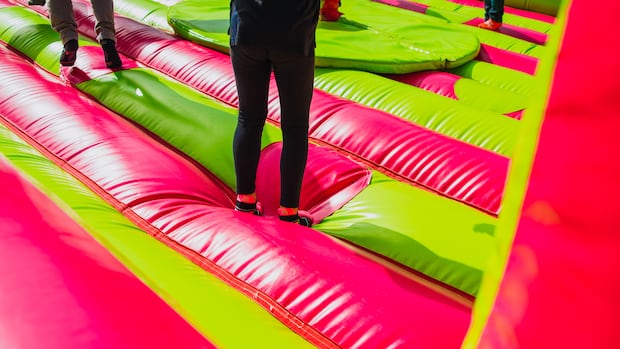
The death of a Montreal toddler after a gust of wind sent a bouncy castle flying into the air isn’t necessarily a freak accident. Similar incidents have occurred hundreds of times around the world, leading some to call for stricter rules governing their safe installation.
Hundreds injured in wind-related bouncy castle incidents
John Knox, a professor of geography at the University of Georgia in the United States, specializes in research on wind hazards and tracks weather-related bounce house incidents around the world.
Data made available by Knox on the website Weather to Bounce shows that in the past 26 years, more than 500 people have been injured in such incidents and 33 have died, including two deaths so far this year.
Knox warned that people often underestimate how poorly anchored bounce houses can “become flying objects” in winds that aren’t particularly strong.
According to Knox, winds as light as 32 to 40 km/h are enough to blow inflatable structures away, whereas anything above that would be enough “to launch,” he said.
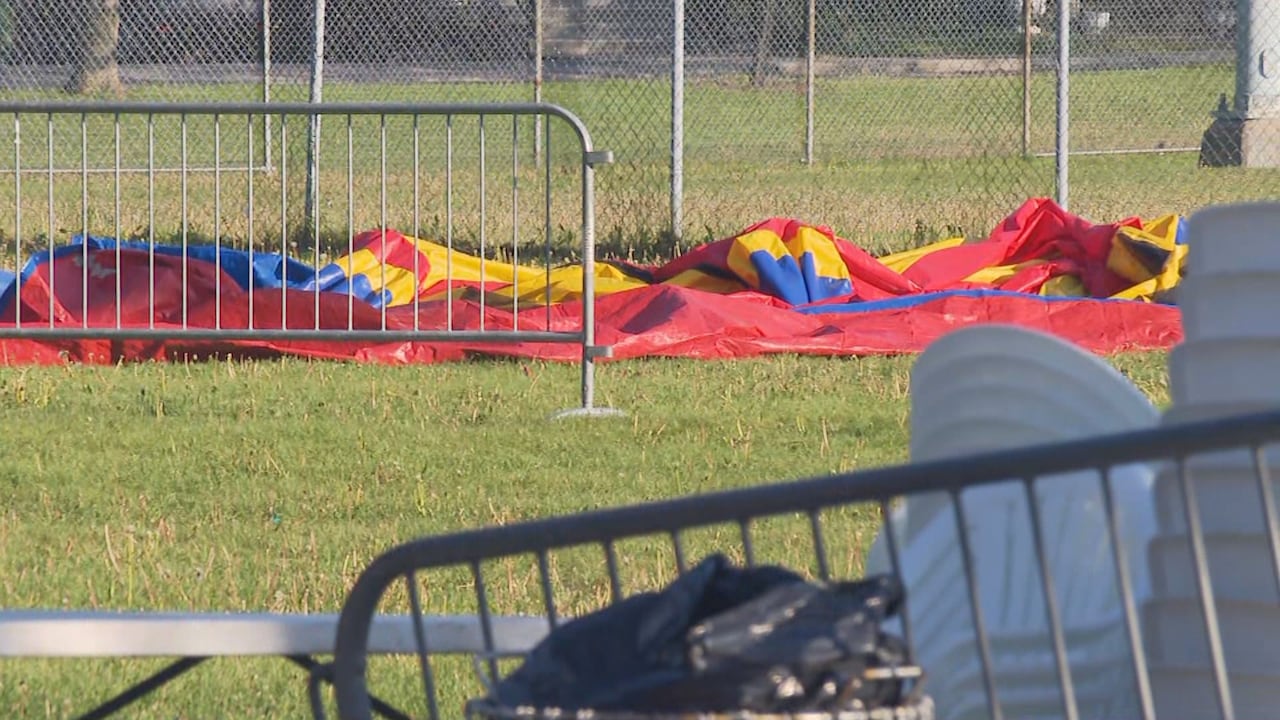
Knox added injuries can occur not only from falling out of a structure that has been swept up by the wind, but also from being hit by one, or having it hit power lines when it’s airborne.
Jerome Goulet, a partner at Quebec-based rental company Proludik, has 33 years of experience in the inflatable games industry. While his team installs the structures for most large-scale events, he said, some clients choose to handle setup themselves.
When securing the equipment, Goulet noted that details like stake length and the angle of insertion are critical to safety.
“The purpose of anchoring a structure is really to keep it in place and give us time to intervene if a gust of wind comes along, and not to just leave it as is when the wind picks up,” he said. “It really allows us to have a few extra minutes to tell the children to get out and deflate the structure.”
Inflatable games in Quebec not regulated
A study by researchers at Toronto Metropolitan University found inflatable structures were responsible for 42 per cent of amusement-ride injuries recorded in a U.S. injury surveillance database in 2010 — a higher proportion than any category of mechanical ride.
The study’s lead author, Kathryn Woodcock, told CBC in an email that safety incidents with inflatables take many forms, including bumps, bruises, fractures and falls.
In Quebec, the building authority known as the Régie du bâtiment du Québec is responsible for regulating amusement games and rides in the province — but inflatable games are exempt.
Ontario and New Brunswick do have some regulations for inflatable amusements, but across North America it’s really a patchwork, according to Knox.
“In our research, we dug into the regulations for each state in the United States and it was all over the map. Some states had stringent regulations, some states had no regulations,” he said.
Lizzy’s Law
The state of Nevada now has some of the strictest regulations after adopting Lizzy’s Law in January.
The law is named after nine-year-old Lizzy Hammond, who died in 2019 after the bouncy castle she was playing in was swept into a power line by 27 km/h winds.
Her mother, Wendy Hammond, was initially hesitant to let her daughter play inside after friends had previously suffered broken bones in similar structures. She relented after seeing it secured by small stakes.
“Those little stakes are what keep it from walking along the ground as the kids bounce. It was never meant to hold it down,” she said, noting she only discovered the true mechanics of the structures while researching her daughter’s death.

When authorities told her that no criminal charges could be filed because no laws had been broken, Hammond’s grief turned into advocacy.
“It just became a fight for how do we keep other kids safe?” she said.
Through the Lizzy Hammond Foundation, the family lobbied for years until the law passed.
“Now that we have this law in place, it gives me some comfort to know we’re able to educate parents about the proper use of them,” Hammond said.
The legislation requires operators to properly weight and anchor inflatable devices, inspect equipment before use, and monitor wind speeds to ensure operations cease if gusts exceed 24 km/h.
The Régie du bâtiment du Québec declined CBC’s interview request about the rules for inflatable amusements, while the domestic security minister’s office referred all questions back to the building authority.
Meanwhile, Montreal police and coroner Martine Lachance are investigating Ava Ciampini’s death. Following her investigation, Lachance may issue recommendations to prevent similar fatalities.