





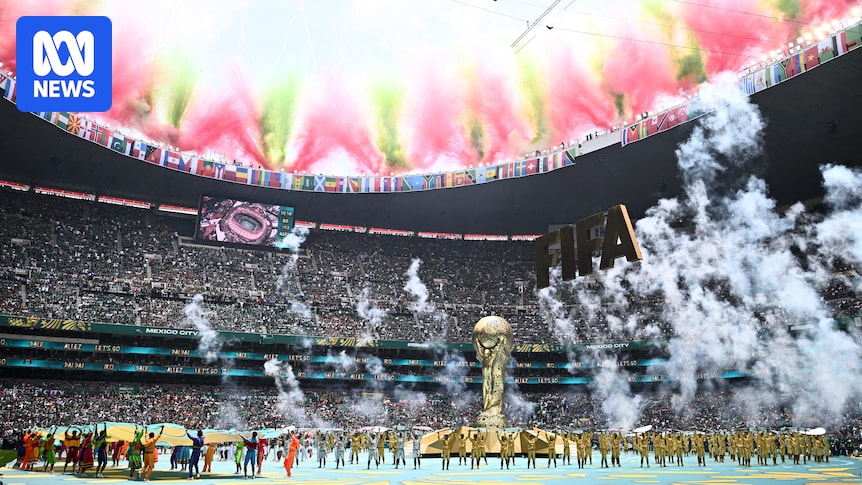
The 2026 FIFA World Cup is up and running, launched by a colourful opening ceremony and comprehensive win for Mexico.
Here are the quick hits from the opening day of the tournament.
Short and sweet, Mexico’s opening ceremony delivers
The festivities began in earnest at the Estadio Azteca in a riot of colour and sound and Latino style mixed with indigenous culture.
Local singer Lila Downs welcomed the world to her home, saying, “Mexico receives you with smiles from our heart, we are a nation of diversity, heritage and pride.”
Shakira performs during the World Cup opening ceremony in Mexico. (AP: Eduardo Verdugo)
She added that “football carries the same heartbeat” and a bevvy of local and international artists got everyone’s pulse racing with an up tempo collection of hits that had the 80,824 spectators up and dancing along.
Many of the artists may not be overly familiar to Australian audiences, but plenty who did hear them will have frantically been looking them up.
Maná, Los Ángeles Azules, J Balvin and Danny Ocean all set the tone before Italian tenor Andrea Bocelli and South Korean star EJAE of KPop Demon Hunters fame sung the official tournament anthem, which will either become a delightful ditty or annoy the hell out of anyone who has to listen to it repeatedly over the next six weeks. Time will tell.
Tyla and Alejandro Fernández were given the honour of singing the national anthems, Tyla getting slightly out of sync with the backing for her rendition of Nkosi Sikelel’ iAfrika, while Fernández forwent any risk of that by going a capella, the rousing backing of over 80,000 Mexicans singing the Himno Nacional Mexicano creating enough excitement for all before this World Cup finally kicked off.
‘Hydration breaks’ leave fans feeling short-changed
As at every World Cup, FIFA has introduced a number of rule changes and new initiatives for this tournament.
The most highly publicised, and criticised, of these has been the creation of “hydration breaks” in the middle of each half, in which play stops for 3 minutes for players to have a drink and receive instructions from the manager.
South African players and coaches during a hydration break. (Getty Images: Jose Breton)
It was nominally introduced to combat instances of extreme heat throughout the summer tournament, but has been applied as a blanket policy across every game, no matter the temperature.
Fans got their first taste of this during Mexico’s game against South Africa, which was played on a drizzly, 24-degree afternoon, and were pretty unanimous in their distaste, mostly due to what was used to fill the time for viewers at home.
SBS joined many international broadcasters in cutting to a commercial break during the stoppages. US broadcaster Fox was criticised for missing a portion of play as the ad break extended too long.
Haiti forced to change jersey due to ‘political message’
Haiti has been forced to change the design of its World Cup jersey after it was deemed too political by FIFA.
The jersey originally included a depiction of the final battle of the Haitian War of Independence in 1803 on its front. The image was rejected during FIFA’s approval process.
Hannes Delcroix wearing the Haitian jersey banned by FIFA. (Getty Images: Leonardo Fernandez)
Kit manufacturer Saeta said in a statement it would comply with the ban even though the design “was not intended as a political statement,” but rather as a “tribute to the men and women who contribute every day to Haiti’s future”.
Haiti gained independence in 1804 and is widely regarded as the world’s first independent nation founded by formerly enslaved people after a successful slave revolt.
Similarly, the International Olympic Committee required the removal of an image of Haitian founding father Toussaint Louverture from Haiti’s opening ceremony uniforms for the Milan Cortina Winter Games, ruling that it violated Olympic rules barring political symbolism.
Want to feel old?
Do you remember where you watched the 2006 World Cup final? Or how you felt when Tim Cahill scored Australia’s first ever goal against Japan in Kaiserslautern?
One person who certainly does not is Mexican rising star Gilberto Mora who, when he came on as a substitute against South Africa, became the first player born after that tournament to play at the World Cup.
Gilberto Mora is the youngest player at the 2026 World Cup. (Getty Images: Tom Weller)
Mora is the youngest player at the 2026 World Cup at 17 years and 240 days, and the sixth youngest to ever play at a men’s World Cup.
For the record, Australia’s youngest player at the 2026 World Cup, defender Lucas Herrington, is the 10th-youngest overall at the tournament at 18 years and 279 days.
Banned referee awarded showpiece UEFA Super Cup job
Somali referee Omar Artan, who was barred by the United States from the World Cup, has been picked to handle the showcase UEFA Super Cup game in August.
European football body UEFA said Artan would referee the game between Champions League winner Paris Saint-Germain and Europa League winner Aston Villa.
Omar Artan will referee the UEFA Super Cup. (Getty Images: Ulrik Pedersen/NurPhoto)
“Football is made to connect people and UEFA wants to show its respect to Omar and his outstanding officiating skills,” UEFA president Aleksander Čeferin said in a statement.
Artan got a hero’s welcome returning to Somalia, days after he was refused entry in Miami and questioned for 11 hours by US authorities despite being picked by FIFA for World Cup duty.
US officials claimed Artan had connections to terror organisations, though without providing proof.
The 34-year-old referee was judged the best in Africa last season and worked the decisive game in the continent’s Champions League final last month.
ABC/AP