






When baseball legend Babe Ruth’s jersey sold for nearly $35 million two years ago, it broke the record for the most expensive piece of sports memorabilia in history.
Diego Maradona’s ‘Hand of God’ jersey fetched $13.5 million, and earlier this year, one of Sir Don Bradman’s baggy greens got its highest price yet, $460,000.
Unlike the Panini stickers, which fans feverishly trade in their millions during a World Cup, these items are not mass-produced or easily attained.
And that is the way Ghana coach Carlos Queiroz likes his World Cups served, rare.
“The number of teams that can qualify for this competition can turn it into something vulgar and ordinary,” he said after Ghana’s 2-1 loss to Croatia yesterday.
“When so many teams can qualify, is the value still rare? That would seem debatable to me, but it is only my opinion.”
Ghana made it to the Round of 32 thanks to being one of the best third-placed teams. (Getty Images: MB Media)
Despite the loss, Ghana still progressed to the knockout stage as one of the eight best third-placed teams in the new world order of the expanded 48-team tournament.
You could say Queiroz is old school. He is managing in his sixth World Cup and, at 73, became the oldest man to lead a side to a win at the tournament.
But he is not alone in his criticisms, which started before the tournament kicked off, and reached a crescendo in a confusing, if not wildly entertaining end to the group stage.
Entertaining chaos
The traditional round of 16 has been replaced by a round of 32, meaning many teams that ordinarily would be on their way home at this point are still living their World Cup dream.
Some of the final group games fell flat, positions already decided, no high stakes, with teams willing to settle for a draw.
Jordy Bos was overjoyed after the Socceroos secured second spot in their group following a 0-0 draw with Paraguay. (Getty Images: Matt McNulty/FIFA)
That was the case with Paraguay, which seemed content to take the point against the Socceroos, knowing it would likely be enough to advance in third.
But the format has also produced some extraordinary scenes, typified by the bedlam in Kansas City in Algeria and Austria’s 3-3 draw.
For half an hour of that game, with scores at 2-2, enough to send both through to the next stage, it deteriorated into a dull display, seemingly a gentleman’s agreement in place.
Then Algeria scored in stoppage time to send Austria packing, before the Europeans hit back and revived their campaign.
Riyad Mahrez put Algeria ahead 3-2 late, before Austria struck back to equalise. (Getty Images: Michael Steele)
In the meantime Iran was out, in, then ultimately out of the tournament.
Was this high-quality, World Cup-winning football? No, but it was pure drama and excitement.
A record nine of ten African teams made it to sudden death football, well and truly smashing the previous record of two.
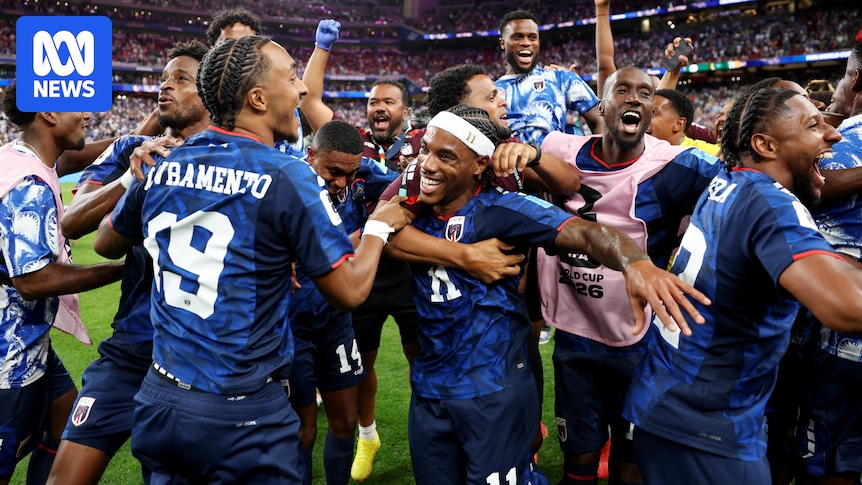
And one of those nations, Cabo Verde, has provided the greatest underdog story of this tournament so far, delighting its tiny population and millions more new followers worldwide.
Not every match has been a winner; there have been some blowouts, some tepid displays, and some classic group-stage survival football played, which has diluted some of the quality.
The expanded format also meant some of the groups were watered down, with teams making it out that might not normally progress, whether in second or third spot.
And not every game in the round of 32 will be box office, highlighted by the David and David match-up of South Africa and Canada to kick off the stage, which was not particularly lively, until Canada’s last-gasp winner.
But that can still be the case in a smaller tournament, and we have also seen some of the greats of the game, like Lionel Messi, Kylian Mbappé, Erling Haaland, and even the maligned Cristiano Ronaldo, turn up the star power to blinding wattage.
In the end, whether or not the expanded format is a winner is a moot point.
There are no sliding doors here to see if this group stage would have been better with fewer teams or different rules.
And it is extremely unlikely FIFA will revert to a smaller tournament. The extra games, and therefore broadcast, marketing, and ticketing revenue, are just too lucrative to turn down.
“Where we used to talk about football, it is now moneyball,” Queiroz said.
He might not be wrong, but will he be converted into a believer if Ghana can pull off a win over Colombia?
It might not be a Babe Ruth jersey, but if it is a Panini sticker that completes the set, that can be just as valuable.