







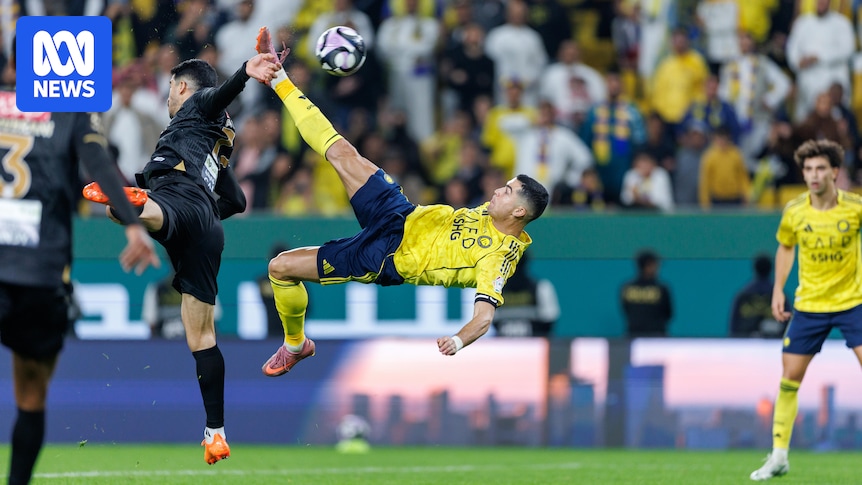
If anyone were to be the poster boy for defying Father Time, it would be Cristiano Ronaldo.
The 41-year-old Portugal forward is renowned for his impeccable fitness regime, and attention to detail in his physical and mental preparation.
And he’s always happy to flaunt the rewards of that discipline.
One of many times a shirtless Ronaldo has celebrated scoring. (Getty Images: Power Sport Images)
Only seven players over 40 have ever played at a men’s World Cup. At this year’s extended tournament, that number will be matched.
There are others just as close to the mark, with Argentine legend Lionel Messi to turn 39 during the group stage.
In a testament to their longevity, Ronaldo, Messi, and Mexico’s goalkeeper Guillermo Ochoa, 40, will appear at a record-breaking sixth men’s World Cup.
And some of the other 40+ headline acts rank amongst their country’s, if not the sport’s, all-time greats including Croatia’s Luka Modrić, and Germany’s Manuel Neuer and Bosnia and Herzegovina’s Edin Džeko.
Thank you, sports science
The most common reason given for extending careers is simply sports science.
A somewhat vague, catch-all term, but one that can provide some interesting insights.
Luka Modrić guided Croatia to a third-place finish in Qatar 2022. (Reuters via TPX Images: Dylan Martinez)
Lyndell Bruce is a professor of Sports Science and director of Sport at Deakin University.
“Over time, as always, we have an increased understanding of physiology, training methods, skill developments, and they’re all improving,” Professor Bruce said.
“And sports scientists are getting better at understanding those and then prescribing training, recovery, nutrition, alongside coaches and all the other support staff that work around an athlete.
“So each of the sports science disciplines is really starting to contribute and improve athlete performance, which then means that athletes can play for longer periods of time.”
Professor Bruce says the emergence of artificial intelligence has been a key factor in more recent advances, with the processing of large data sets helping in individualising programs.
But longevity does not necessarily equal quality, at least not at previous levels.
Socceroos legend Mark Schwarzer told ABC Sport Daily that Lionel Messi’s game has evolved, but is still a key contributor for the defending champions.
The crowning glory of Lionel Messi’s career, winning the 2022 World Cup. (Getty Images: Tom Jenkins)
“Physically, I’m not sure whether Messi will be able to do 90 minutes three times in a row in the group stages at the levels that we’ve expected in the past,” he said.
“He’s not someone to track back anymore. He walks a lot after he loses possession or the game breaks down.
“His influence still has been huge, and he’s an unbelievable player and still within a certain area, ball at his feet, he’s still gonna be very difficult to deal with.”
Schwarzer does not see Ronaldo having the same influence, as he struggles to accept his new role as an aging star.
“I think that Portugal could be a far better side without Cristiano Ronaldo starting every game,” Schwarzer said.
“Portugal’s game changes a lot when Ronaldo’s playing because now he’s that target man.
“He’s obviously still got a great leap on him, and he’s still a very good header of the ball. He’s still a great finisher within that 18-yard box, and I think that’s the key.
“There’s no doubting his ability to score goals. It’s just a matter of how much of an influence does he have in the overall game?
“How much end product will he give you, and what sort of deliveries do you need to give him the best opportunity to get that end product?”
Goalkeepers going beyond 40
Goalkeepers have long been the torchbearers for pushing age limitations.
Germany’s Manuel Neuer came out of retirement for this World Cup. (Getty Images/firo sportphoto: Jürgen Fromme)
Of the 20 oldest players named for this World Cup, half are shot stoppers.
Danny Vukovic, 41, retired two years ago and was part of the Socceroos’ past two World Cup squads.
“Before I retired, I probably wasn’t as sharp as I once was or as explosive as I was, but I feel like I read the game a lot better,” he said.
“I understood the game a lot better. You could nullify things and cut things out just simply through reading the game better, and I think that’s what these guys do.
“No doubt they’re still explosive and world-class goalkeepers, but I feel like their experience, the way that they read the game helps them a lot more than what maybe a younger goalkeeper starting out can do.”
Lightening the load
Professor Bruce says managing training loads is an important factor for any player.
Messi’s domestic career is continuing with Inter Miami in the MLS. (Getty Images: MediaNews Group/The Denver Post/Timothy Hurst)
“Quite often we hear players who are older say they get to do less or have a longer off-season,” she said.
“So obviously the sports science is important, but that also enables them to have more life sport balance so that they may come back more refreshed, more ready to train so that they can really train hard at the times they’re there.”
It’s an approach that has worked for Australia’s Cam McEvoy, who dramatically changed his approach to training and has redefined the possibilities for sprint swimmers over 30.
Tom Brady played on in the NFL until he was 45, LeBron James, 41, has stuck around for so long that he’s now playing alongside his 21-year-old son Bronny, and Serena Williams recently announced her comeback at age 44.
The USA’s 23-time Grand Slam singles champion Serena Williams is returning to the sport in doubles. (Getty Images: John Walton/PA Images)
But these high-profile examples do not necessarily mean there’ll be an influx of elite athletes in high-intensity sports pushing 50.
“As you’re beginning to approach 50, for example, we see a decrease in aerobic capacity, decrease in muscle mass and power, neuromuscular function, hormone function,” Professor Bruce said.
“But everyone declines at different rates, so there might be some athletes that are predisposed to later declines and being an athlete is certainly going to help slow the rate of loss of these capacities as well.”
LeBron James plays alongside son Bronny James at the LA Lakers. (AP: Eric Thayer)
She says it’s also important to acknowledge the type of resources athletes like Ronaldo and Messi would have access to, compared to even elite athletes in Australian professional sport.
“We know some athletes have saunas and spas and all kinds of things at home, and those very top athletes at the very top echelon can get infrared systems, their individualised recovery modalities,” she said.
“So that’s certainly going to extend playing careers where they can do all that type of recovery preparation at home.
“And then we know within the NBA, NFL, some of those larger American sports and soccer leagues, they have private jets as well that they can go on and recover, whereas AFL athletes are typically on commercial airlines for the most part.”
Age is only a number for many, or at least those who have the luxury of resources and access.