








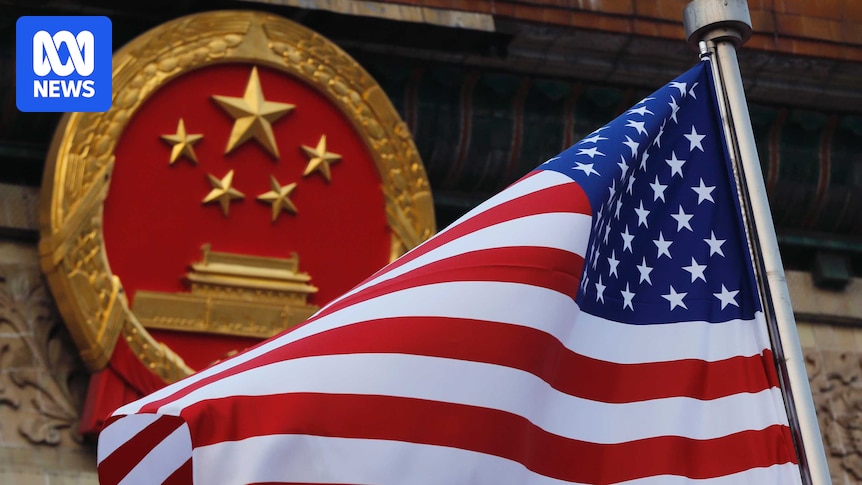
When it comes to AI, Australia is a spectator at a UFC cage fight between the United States and China, except the spectators at this event are all inside the cage with the combatants, not safely in the stands.
China is flooding the world with cheap, very capable AI models, trying to destroy the business models of the leading US companies.
The Americans are desperately trying to stay ahead by building smarter, more dangerous and more expensive models.
To mix metaphors, it’s a race between Cadillacs and BYDs.
All other governments are trying to figure out how to stay safe inside the cage while making sure they don’t miss out.
Cowering among them is Australia, with the government’s new AI Safety Institute now up and running, headed by global “responsible AI” expert Kate Controy.
Back to the future
Geo-politically, we have returned to a world of two competing superpowers, except this time they’re not facing off with nuclear weapons as America and the Soviet Union did in the Cold War, but with the most powerful technology in the history of the world.
Between WWII and 1989, superpower balance was preserved by the potential for mutually assured destruction (MAD), but with AI it’s a contest between the US and China for industrial and scientific supremacy in which the potential for mutually assured destruction is real but distant, debatable and therefore ignored.
The “Statement on AI Extinction Risk” first published on May 30, 2023, with 350 signatories, recalled the language of the Cold War: “Mitigating the risk of extinction from AI should be a global priority alongside other societal-scale risks such as pandemics and nuclear war.”
That statement is still sitting there, now with 1,300 signatories, prominently including those of the CEOs of Anthropic, OpenAI and Google DeepMind, Dario Amodei, Sam Altman and Demis Hassabis. They could be described as the three leading ignorers of the statement they signed.
Spectators inside the cage
Which highlights another key difference with the previous Cold War: this is a contest between private companies run by rich men trying to get richer, with their governments alternating fretfully between egging them on and trying to control them.
Two weeks ago, the United Nations released the preliminary report of its Independent International Scientific Panel on AI, which repeatedly stressed the need for urgency and raised the potential for “catastrophic outcomes”.
The panel warned that the governance landscape is fragmented and ineffective and that “most countries, including many advanced economies, lack the technical expertise to assess the most capable ‘frontier’ models or to participate meaningfully in their governance.”
They observed that “most member states [are] dependent on systems they cannot build, inspect, audit or fully adapt to local context.”
That is: spectators inside the cage.
Europe is trying to pull up the drawbridge with a mandatory pharmaceutical-type testing regime while the US has gone for voluntary pre-release testing for 30 days and is otherwise egging them on.
Australia and the UK are also testing, also voluntarily, after something is released.
Testing new models
In a speech last week to an AI safety forum, the assistant minister for science, technology and the digital economy, Andrew Charlton, talked up the Albanese government’s new AI Safety Institute, which he said is “up and running”, testing AI frontier models.
Which models, exactly, are being tested was not, and is not being, revealed, and nor were the consequences for a model that failed the test, whatever failure might look like, but, said Mr Charlton, “we are not building a think tank. We are building a national testing capability.”
Australia is definitely NOT building something like the Therapeutic Goods Administration that controls the release of drugs based on data about safety and efficacy from three sets of randomised trials.
Some activists around the world are pushing for that kind of regime for AI, but that’s about as likely as a worldwide carbon tax, even as Europe and North America cook in historic heat waves.
The closest to a pharmaceutical regime is Europe’s AI Act, which requires developers of high-risk systems to provide data on safeguards before releasing them on the EU market and, for some models, ongoing monitoring and incident reporting.
The European Commission can impose fines up to roughly 7 per cent of global turnover or €35 million ($58 million), which in practice turns pre deployment testing and documentation into a mandatory step for any model intended for EU use at any sort of scale.
The EU AI Act is due to start next month, and we’ll see how European businesses feel if their American and Chinese competitors get access to, say, Anthropic’s Fable 5 or Chinese equivalent, and they can’t.
Companies on edge
Meanwhile, corporate customers of all the AI models, American and Chinese, are starting to get uneasy that they’re losing control of their own businesses.
Alex Karp, the CEO of Palantir Technologies, a US AI integration firm, expressed this colourfully in a recent interview on CNBC, saying “something has gone completely wrong”.
He said the AI labs were “stealing Alpha” — that is, taking proprietary data, workflows and competitive know-how through the prompts that company employees write into the AI, and then either competing with them or selling it back to them.
Even sceptical commentators who said — correctly — that Karp was talking his own book admitted that he had a point: there is a genuine debate about where the value from AI is accruing.
Separately, companies are now having to weigh up the risks of going with Chinese models to get the lower prices; increasingly they’re deciding that price wins.
Loading
China surging in front
Over 12 days in May, four Chinese labs — DeepSeek, Z.ai, Moonshot and MiniMax — released “open-weight” models that are competitive with the US frontier models on coding and agentic benchmarks, at a fraction of the price.
For example, DeepSeek’s V4 Pro now costs as little as US87 cents per million output tokens against roughly US$25–30 for Claude Opus or GPT-5.5 output.
The Chinese models already seem to be beating the Americans.
According to the research outfit, OpenRouter, in the week ending July 6, eight of the top 10 AI models by volume of output tokens were Chinese. The top five Chinese models produced 20.3 trillion tokens — almost three times as many as the 7.7 trillion total of the top five US models.
So China is now repeating in AI what it did in cars, batteries, phones, robots, renewable energy, TVs, and toys, except in AI the security issues are probably greater than those that got telecommunications giant Huawei banned in both the US and Australia.
The world is dealing with a complicated layer cake of AI security challenges: day to day safety that the Australian AI Safety Institute was created for, plus US frontier labs stealing corporate alpha and Chinese ones maybe facilitating Communist Party surveillance.
And then there’s the small matter of the risk of extinction — you know, the one that 1,300 AI academics and creators say should be a global priority while they carry on building it as fast as possible.
Alan Kohler is a finance presenter and columnist on ABC News. He hosts the podcast That’s Business with Alan Kohler in the ABC Business Daily feed on Friday. He also writes for Intelligent Investor.