








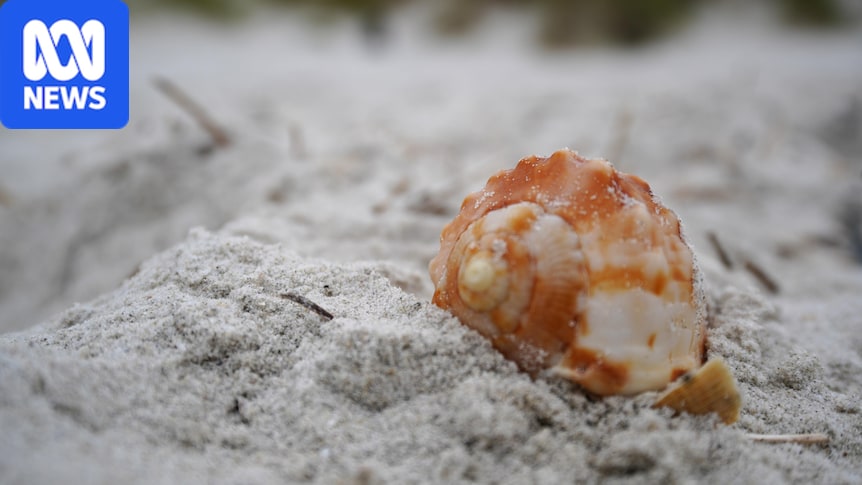
Sherie Van Burgel happily admits that her family is “the biggest shell-collecting family” in Albany, 400 kilometres south of Perth.
Shell collecting is a popular activity on the coastline around Albany, and Ms Van Burgel said she often took her children to beaches specifically to look for shells.
“If there’s been a huge storm, I’m like, let’s go and we get the kids, we get our little shell-collecting baskets, and we go and find the prettiest shells,” she said.
Sherie Van Burgel and her children search for shells at the beach. (ABC Great Southern: Will Corbett)
“We’re pretty lucky in Albany. We’ve got some beautiful big shells, small shells, all shapes, really.
“Our house is basically decorated with shell containers with the most beautiful collections.”
Sherie Van Burgel loves taking her children to the beach to look for shells. (ABC Great Southern: Elaenor Nield)
In June 2025, the popular beach was covered with piles of shells following a winter storm, but shell collectors say there have been significantly fewer shells than usual since that event.
Great Southern hosts diverse range of shells
University of Western Australia marine biologist Tim Langlois said WA’s south coast had a large number of seashells from marine species found only in the region.
Tim Langlois enjoys collecting seashells in his spare time. (Supplied)
Dr Langlois said this was due to ocean currents and the makeup of nutrients that wash from the land into the sea.
“Many of the submarine species typically are slow growing and only occur in a few places, so the thing is, we know so little about actually the diversity of the shellfish, like the molluscs and the bivalves; there’s probably a heap of unknown species out there,” he said.
Dr Langlois said the diversity of marine creatures meant that shell collectors on the south coast could find beautiful and unusual varieties.
A paper nautilus collection from Denmark, Western Australia. (Supplied: Paris Hawken)
“Every now and then we find awesome things like paper nautilus, and nautilus shells, and then there’s the little radical ram’s horn squid shells; they’re an actual squid that makes that shell,” he said.
The question of collecting or leaving shells
While most people don’t think much of taking a few shells when they are at the beach, WA has a 10 per day bag limit for shell collection of most species, outside of marine parks.
Central Queensland University professor of Environmental Science Nathan English said there was a reason for the limit.
“There will always be more shells, but the problem is that nature needs those shells more than we need them on our bathroom vanity,” Dr English said.
“So nature uses those shells as homes or as grit or as building materials for the next generation.”
Nathan English says seashells should be left in nature. (Supplied)
Dr English recommended taking photos or drawings of shells at the beach, then leaving them there.
“You can play with the shells, pick them up, put them in your sandcastle, just leave them at the beach when you go home,” he said.
“That’s an octopus caravan or a hermit crab home or the grit that birds need to help digest their food.“
The Department of Primary Industries and Regional Development allows exemptions where appropriate for the collection of shells to create artwork.
A special connection to nature
For Ms Van Burgel and her children, collecting shells is a way to connect with nature and appreciate the coastal environment they live in.
She did add that she was aware of the bag limit and ensured the family did not collect more than 10 at a time.
Oliver Van Burgel enjoys making things with the shells he finds at the beach. (ABC Great Southern: Will Corbett)
“It’s that connection to the ocean that you have and the connection to nature, that you can take it away,” she said.
“There’s the old saying, you can take a shell and put it to your ear and hear the ocean. I’m pretty sure you can. It’s magic.”