








A dean of law and a former police prosecutor have raised concerns over why police granted triple murderer Julian Ingram bail after he allegedly attacked his former partner.
Aboriginal and Torres Strait Islander readers are advised that this article contains names and images of Indigenous people who have died.
The ABC has obtained court documents that detail allegations made against Ingram in late November by Sophie Quinn, his 25-year-old ex-girlfriend who was heavily pregnant when he shot and killed her 54 days later.
“Why weren’t more serious charges laid?” asked Professor David Heilpern, who reviewed the documents.
“On the face of it, it seems like a classic example of undercharging,”
he said.
“This classically happens in domestic violence cases.”
The court documents reveal Ingram had a criminal history dating back to 2005 when he faced the children’s court on a charge of maliciously inflicting grievous bodily harm.
In 2016, he was issued three community service orders of 300 hours relating to two domestic violence charges of stalk/intimidate and contravening an Apprehended Violence Order (AVO), and in 2021 he was put on an 18-month community correction order for a common assault domestic violence charge.
Former NSW police prosecutor and the state member for Orange, Phil Donato, has questioned why that history, along with the allegations made by Ms Quinn, were not enough to deny Ingram bail.
“You can never predict future behaviour, but you can certainly take into account history, the objective seriousness of the facts,” Mr Donato said.
“I just think there’s too high an unacceptable risk that there would be future offences being committed, and certainly I wouldn’t be comfortable giving him bail if I was the police officer or police prosecutor,”
he said.
Sophie Quinn, John Harris and Nerida Quinn were killed in the shooting spree at Lake Cargelligo. (Supplied)
On January 22, less than two months after Ms Quinn filed for an AVO, Ingram fatally shot her, along with her aunt, Nerida Quinn, and cousin, John Harris, in the remote NSW town of Lake Cargelligo.
After a 109-day manhunt, Ingram’s body was found with suspected self-inflicted gunshot wounds next to a ute about 50 kilometres north-west of the town.
Police have launched critical incident investigation to probe their own officers’ actions in the lead-up to and investigation of the shooting, including Ingram’s history of domestic violence, his interactions with authorities and how he was able to access firearms.
“Police actions and investigations will be reviewed to ensure they complied with policy, procedure and legislation,” Western Region Commander Assistant Commissioner Andrew Holland said in February.
“Fresh information has come forward and it has given me reason to believe that the matter needs to be further investigated,” he said at the time.
The decomposed body of Julian Ingram was found next to a ute in the Round Hill Nature Reserve. (ABC News)
The AVO
An AVO was filed on behalf of Ms Quinn in the Lake Cargelligo Local Court on December 3, 2025.
According to a police report, the pair separated on Monday, November 24 after being in a relationship for about 12 months.
Two days later, when she visited Ingram’s house, he allegedly attempted to duct tape her hands and dragged her from the lounge room to the kitchen.
She was 24 weeks pregnant at the time.
The court documents state that Ingram, 37, forced Ms Quinn to lay down on the couch where he “straddled her and attempted to duck (sic) tape her hands”.
The report stated that Ingram believed the child was not his and said “this is one way to get it out of you”.
Sophie Quinn had an AVO out against Julian Ingram at the time of her murder. (Supplied)
The documents state that Ms Quinn repeatedly told him she was pregnant while he dragged her by her hands to another room.
“The defendant once again mounted the PINOP [person in need of protection] as she ended up on the ground and attempted to tape her hands together. The defendant has then struck the PINOP to the upper left side of her face with an open palm twice,” the documents read.
It is alleged Ms Quinn was able to make her way to the front door before he yelled “tell everybody that is not my kid”.
According to the police report, Ingram went to Ms Quinn’s house the following evening where he wrote “slut” with pink spray paint across the driver’s side, boot and bonnet of her vehicle.
He also spray-painted “I love (heart shape) u” on the passenger side and the incident was caught on CCTV.
It was the same vehicle she would later be shot dead in, alongside her cousin, Mr Harris.
Ms Quinn reported the incidents to police two days later, when she supplied a statement and described Ingram’s actions as making her feel like “shit” and not safe at all.
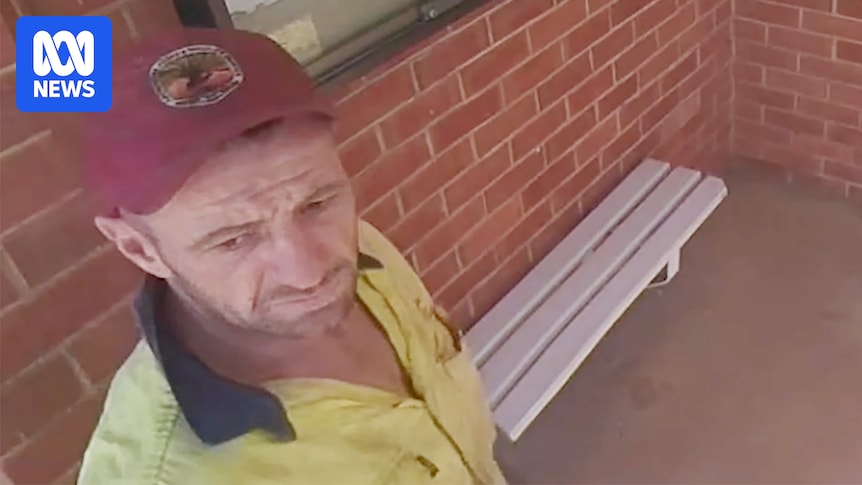
Julian Ingram captured on CCTV at Lake Cargelligo on January 29, hours before he murdered three people. (Supplied: NSW Police)
The following day police arrested Ingram and charged him with stalk/intimidate fear physical harm (domestic), common assault (DV) and destroy or damage property.
He was granted conditional police bail, to appear in court three days later.
They also served him with an interim AVO, which ordered him not to approach or contact Ms Quinn in any way or go within 100 metres of where she worked or lived.
The court appearance
During a court appearance on December 3, Ingram entered pleas of not guilty to the first two charges but pleaded guilty to destroying or damaging property.
Bail was continued.
As per his bail conditions, Ingram reported to the police station on the morning of the murders.
The matter was listed for a hearing in the Lake Cargelligo Local Court on Tuesday, February 3.
When that day arrived, the manhunt for Ingram had entered its 12th day.
David Heilpern says he has been disappointed by the lack of reforms in most of the country. (Supplied: Southern Cross University)
Experts question police decisions
The ABC has had this incident reviewed by experts in the field, who raised concerns that Ingram was not appropriately charged and should not have been afforded the presumption of bail.
Professor Heilpern was a country magistrate for 21 years, the first five of which he spent in western NSW where domestic violence cases were the “bread and butter” of local courts.
Now Dean of Law at Southern Cross University, he said he disagreed with the police decision to grant Ingram bail, describing the “serious set of facts” as “greatly concerning”.
“Where there is excessive jealousy shown that erupts into physical violence and damage to property, that is a real red flag that there is the potential for much greater violence,”
he said.
Police search for Julian Ingram. (ABC Central West: Xanthe Gregory)
Professor Heilpern said much more serious charges should have been laid against Ingram, including assault occasioning actual bodily harm.
“Being struck twice to the face with an open hand, being held down and being attempted to be duct taped while you are pregnant does not seem to me to fit within a ‘common assault’ level of charging,” he said.
While the police report does not detail any injuries to Ms Quinn, Professor Heilpern said it was hard to believe someone could have suffered such an assault without having any.
“I can’t tell you how many times that I saw charges of common assault where there were graphic descriptions and sometimes photos of serious physical injuries that were occasioned to the victims of the domestic violence crime,” he said.
“It hamstrings bail decisions and sentencing those charges because the court can’t take into account any physical injury that is described in determining sentence on a charge of simple assault.”
Julian Ingram was granted bail on domestic violence charges less than two months before he killed three people, including his former partner, in Lake Cargelligo. (Supplied: NSW Police)
Professor Heilpern also argued that a charge of kidnap to obtain advantage would have been far more appropriate than the lesser charge of stalk/intimidate.
In this case, he said the “advantage” was to obtain information about the baby’s paternity,
A kidnapping charge in NSW carries a maximum jail term of 14 years and a presumption against bail.
It also would have triggered Molly’s Law, legislative change in NSW that was triggered by the domestic violence murder of Molly Ticehurst in Forbes, some 200 kilometres from Lake Cargelligo, in 2024.
Under the reform, current or former partners charged with a “serious domestic violence offence” that carries a maximum penalty of 14 or more years in prison, must demonstrate why they should be granted bail and wear an electronic monitoring ankle bracelet.
“If all of those initial decisions that were made were ones that were appropriate on the facts, then the bail decision would most likely have been different,” Professor Heilpern said.
Phil Donato served for NSW Police for 22 years, including a decade as a prosecutor. (ABC Central West: Hamish Cole)
Mr Donato agreed Ingram should have never been granted police bail.
“The nature of these facts are disturbing,” he said.
“They’re not a one-off isolated incident. There was a pattern of behaviour over several days.“
The AVO application details the police officer’s reason for granting bail.
It laid out nine considerations, including “the accused’s last incidence of violence was in 2021”, that the “last breach of ADVO was in 2016” and that the “accused is not likely to receive a custodial sentence”.
The officer wrote that “there is a bail concern that the accused person, if released from custody, will: endanger the safety of victims, individuals or the community”.
Bail reforms were passed in 2024 that strengthened conditions for “serious” domestic violence offenders. (ABC Central West: Hamish Cole)
A coronial inquest and the NSW Police critical incident investigation, overseen by the Law Enforcement Conduct Commission, is likely to probe many of these issues.
Professor Heilpern urged authorities to have a “serious look at the practice of undercharging in domestic violence offences … to lessen the chances of this happening again”.
Mr Donato said in the Central West, where domestic violence incidents occur at a rate 50 per cent higher than the NSW average, police stations were under-resourced and domestic violence services were underfunded.
“The danger is always complacency by police and the courts because you’re dealing with it at such a volume every day,” he said.
“The reality is there’ll be a review and there’ll probably be legislative change … but it’s not going to bring those three people back, it’s not going to bring Molly [Ticehurst] back.”
NSW Police declined to comment while the critical incident investigation was ongoing.
A date has not been set down for the coronial inquest, with the court awaiting a brief.