







I think I’ve finally found the cult I want to join.
Given that Groucho Marx’s maxim about abhorring club membership is one I have long taken to heart, this is significant and made even more so because I suspect any woman reading this will immediately want to join too.
The secret women’s society I’m referring to involves copious amounts of wine, food and feverishly dancing around to wild music wearing diaphanous gowns; with initiation culminating in cutting the heart of an oxen out of its chest with a sword and your bare hands.
Or, as it’s known in my house, Friday night drinks.
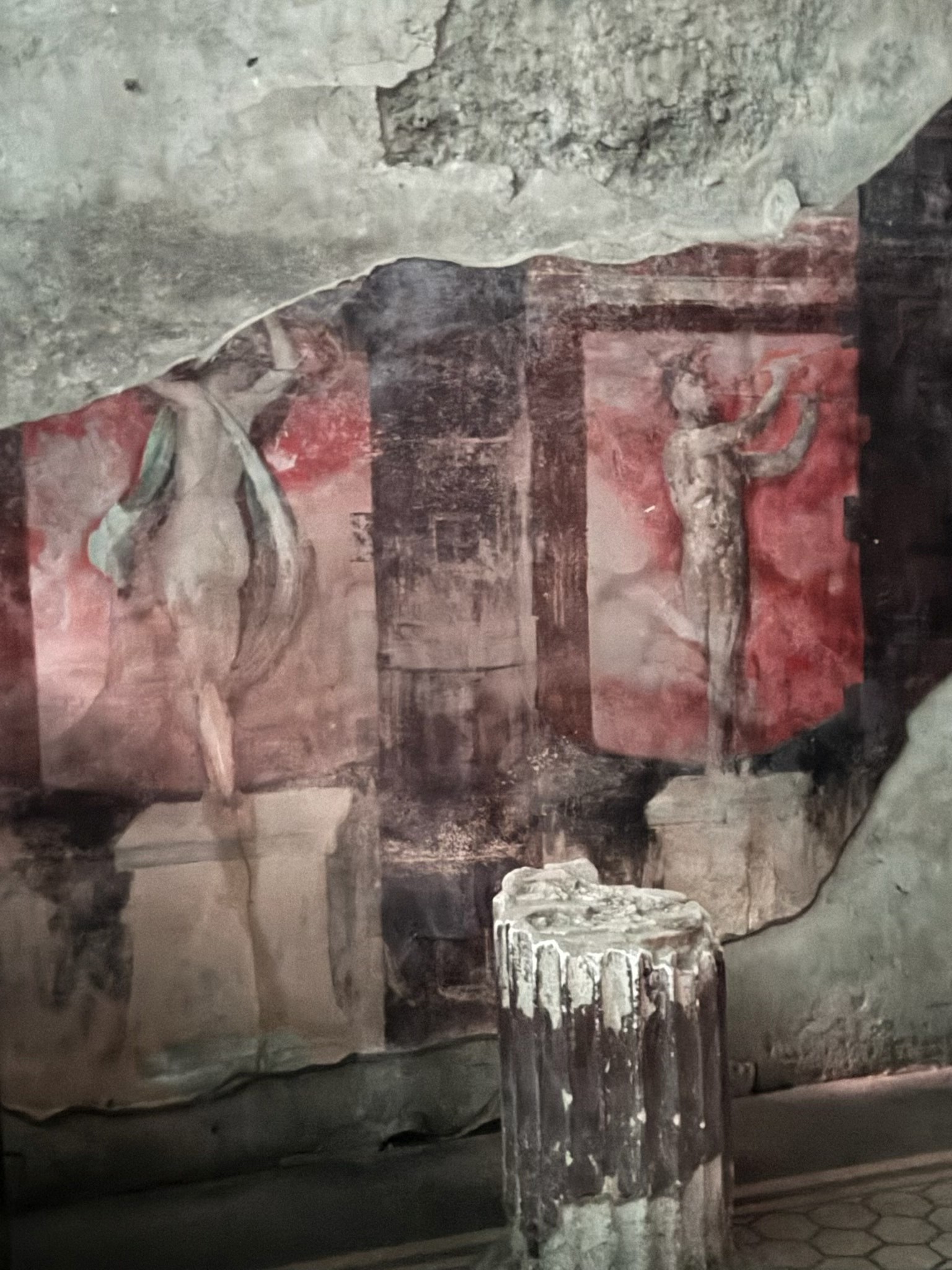
The walls of the dining room are frescoed in exquisitely detailed panels of Satyrs and woodland deities painted in the rare, blood-red pigment called cinnabar. (Supplied: Virginia Trioli)
This cult was revealed to me in a series of recently uncovered rooms in a home that had been buried for almost 2000 years beneath the ancient Vesuvian ash and pumice at the excavations of Pompeii.
The walls of the dining room are frescoed in exquisitely detailed panels of Satyrs and woodland deities painted in the rare, blood-red pigment called cinnabar. They depict the transition of a demure young woman into a maenad, a frenzied female follower of Dionysus, complete with her final, triumphant brandishing of a dripping ox heart. In one panel, another woman is leaping off her pedestal and running towards the garden outside, as if fleeing in terror at the bloody rites inside. As Groucho always said, not everyone wants to join.
Visiting this remarkable site earlier this year and seeing these rooms which are now open to the public was, without exaggeration, one of the highlights of my life. The colours and richness and beauty of the painted detail was one thing. The vast, preserved ordinariness and mysteries of a working Roman port-town was another.
But best of all, was discovering the optimistic and very human philosophy that preserves and protects all of it. In a time when we are watching breathtaking fools make ruinous choices, and are globally shrugging off crucial decisions to the silicone minds of AI, scholarship and intelligence became the most important artefacts I encountered.
Why hadn’t it been excavated before?
The frescoes are in a banqueting hall of the House of Thiasus, in what was once a very posh neighbourhood of Pompeii, and they form a megalography — a cycle of paintings featuring nearly life-size figures. It’s only the second painted example of female Dionysian initiation after the 1909 discovery of the Villa of the Mysteries.
The only reason this one was uncovered was because it was part of an area of the long-buried town where the ground above had become unstable and started to slip. For safety and preservation reasons the area was carefully dug up between 2023 and 2025.
But why hadn’t it been excavated before? For a most beautiful reason.
Because specific parts of the site have been deliberately left unexcavated, so they can be uncovered by future archaeologists, scholars and engineers who may have better technology than us to uncover and preserve these ruins.
I find this decision wonderfully generous and admirably restrained. Any Roman historian would be itching to get their trowel into the crumbly lapilli of small pumice stones that both buried and preserved the town in 79AD. Imagine the other gorgeous rooms and their treasures just below their impatiently stamping feet.
But as my friend at the Parco Archeologico di Pompeii, archaeologist Sophie Hay explains, contemporary excavation reveals the faults in the many diggings that came before, so it follows logically that the next work must be done by those who know better.
“We have a responsibility to future generations to leave unexplored parts of the city so they may apply technology to try to answer questions we cannot at present even dream of asking,” she says.
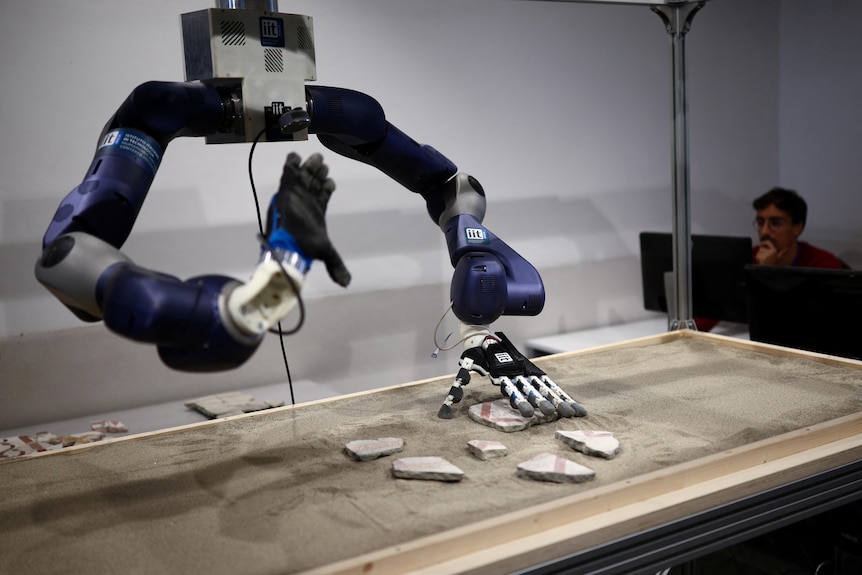
Robots are already helping archaeologists reconstruct fragmented frescoes buried for centuries in Pompeii by combining image recognition, AI-driven puzzle-solving, and ultra-precise robotic hands. (REUTERS/Guglielmo Mangiapane)
There is humility and grace in this decision, even though it of course rubs up against its natural opposite: the pride of one’s own capacity.
It is deeply human to feel that you know better. Know better than your poor forebears; know better than the maleducated children who will come after you. Even to know better than the super-fast thinking of the artificial intelligence that will no doubt better aid the archaeologists of the future. The most intelligent we will ever be must be right now. Or, in this time of devolution, perhaps five minutes ago?
This decision to trust in the future, surprisingly, goes hand in hand with a trust of future technology and decision-making that is a rare feeling now when we look at the fools and monsters dominating the tech world with malign decisions.
Because what frames the Parco’s decision is, I think, a clear understanding of future technology as only one more tool in service to a deeply human quest: revealing the story of what happened to the people of Pompeii on that warm August day in 79AD. There may be newer, smarter ways of getting there, but all knowledge, all decisions must eventually lead underground to that moment in time, and then to the very connecting act of preserving it and making it accessible to a ceaselessly curious public.
The tools may indeed get better, but the critical thinking of the human archaeologist must remain. “It’s important that we take charge of it [AI] ourselves,” says Gabriel Zuchtriegel the director of the Parco, “otherwise others will do it for us, lacking the necessary humanistic and scientific background”.
Not for the first time, I wish we would listen more closely to the historians, to those who have tracked our rise and fall, and who have seen the precipice even before we know it’s there.
This weekend we have reflections on modern dating and sensory deprivation for you, while they are often one and the same thing.
And don’t forget to tune into Grace Tame’s special series on women and autism on Yumi Styne’s Ladies We Need to Talk.
Grace is a wise and fierce advocate for understanding — many autistic women will feel seen by this series.
Have a safe and happy weekend and let the wonderful Jessie Ware take you away on her continuing voyage into opulent disco soul, with her new single, Superbloom. It’s made for swaying.
Go well.
Virginia Trioli is presenter of Creative Types and a former co-host of ABC News Breakfast and Mornings on ABC Radio Melbourne.