





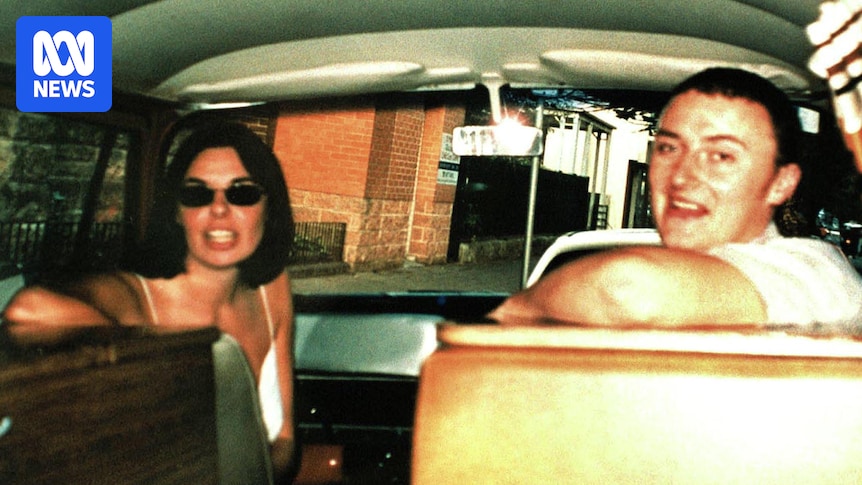
They were a couple in their twenties embarking on a trip that is a rite of passage for so many young Brits.
But a chance encounter with a stranger in the outback changed both their lives forever.
Twenty-five years on, the murder of British backpacker Peter Falconio and the abduction and escape of his girlfriend Joanne Lees in remote Central Australia remains one of the nation’s most infamous cases.
Erica Gibson’s boots crunch in the red dirt as she walks towards the Barrow Creek Hotel.
She has returned to mark an anniversary, to pay tribute and remember a case that has never really left her.
The frontage of the roadhouse, just off the Stuart Highway, is a mix of old beer signs, ancient steel water drums and working fuel bowsers alongside those of yesteryear.
It’s been 25 years since she walked this path. The last time, her steps were charged with a mix of urgency, tension and concern.
It was the night of July 14, 2001 — a date that’s etched into her memory.
Back then, Ms Gibson was a young police sergeant based in Alice Springs, and she and a colleague had rushed the 280 kilometres north to the tiny Central Australian town after receiving a call about an incident there.
“The information provided was so extraordinary and out of the usual kinds of incidents that we would respond to, it was almost, I guess, disbelief on my part,” she recalls.
“Our mission at that time was to get to Barrow Creek as fast as we could.”
The officers needed to speak with Joanne Lees, an English tourist who had been travelling from Alice Springs to Darwin with her boyfriend Peter Falconio.
That evening, the couple had been flagged down by a stranger with a gun who had shot Mr Falconio, who was now missing, then attempted to abduct Ms Lees.
At the Barrow Creek Hotel two-and-a-half decades later, Ms Gibson recalls that getting to Ms Lees quickly wasn’t the only thing on their minds that night.
The person responsible was on the loose.
“It was certainly an identified risk that the perpetrator or armed offender, he may have been travelling directly towards us,” she says.
“There were so many unknowns about the direction of where that offender could be, all of those things.”
The officers drove through the night to get to Barrow Creek, where they were greeted by the hotel’s lights glowing against the pitch black of the outback scrub and sky.
The isolated outpost, with a population that generally hovers around 10, looked deserted.
Then, publican Les Pilton had appeared and directed Ms Gibson to a woman at the bar.
“She just appeared shocked,” Ms Gibson remembers of Ms Lees, as she now sits at the same bar, still owned by Mr Pilton.
“She was extremely traumatised and confronted by what she had been through.
“She continuously asked where Peter was and if he had been found.”
The two women moved to Mr Pilton’s office at the back of the hotel so Ms Lees could give a formal statement.
What she told the police officer was so chilling, it’s stuck with Ms Gibson ever since.
And it would go on to become so well-known, it is carved into the fabric of outback Australia.
Driving north on a warm winter Saturday, Mr Falconio and Ms Lees stopped to watch the sunset at the tiny township of Ti Tree.
Three weeks earlier, they had taken off on a lap of Australia in a vintage orange Volkswagen Kombi van.
The English couple had been together for four years and were on a round-the-world tour to celebrate Mr Falconio’s university graduation.
They left Ti Tree and continued north on the Stuart Highway — but around 8pm, they noticed a Toyota LandCruiser ute following them, and the man driving it waved for them to pull over.
Mr Falconio stopped the Kombi, got out and went to speak with the man, who told him that he’d seen sparks coming out of the van’s exhaust.
As Mr Falconio walked to the back of the vehicle, Ms Lees heard a loud bang.
Police would later conclude Mr Falconio was shot.
From there, the stranger turned to Ms Lees.
In her 2006 memoir, Ms Lees wrote that the man then assaulted her, bound her wrists together with cable ties and electrical tape, and bundled her into his ute.
She recalled escaping, her heart beating out of her chest, as she ran for her life while the man and his dog were hunting her down.
She hid in bushes until he gave up and left, but still waited five hours to be sure he was gone before flagging down a passing road train.
Bleeding and in shock, Ms Lees was taken by the two truck drivers to the Barrow Creek Hotel, where she would wait for Ms Gibson to interview her.
When the pair finished speaking, it was already late into the afternoon of the next day.
By then, police had found the pair’s Kombi one kilometre south on the Stuart Highway, parked around 100 metres off the road.
Officers had also placed roadblocks on the 12 likely routes leaving the area and a search was underway.
But they found no trace of Mr Falconio.
Ms Gibson’s return to Barrow Creek for the first time since that night is weighted with reflection.
“I just think back to the time of the night that we were on that road — no street lights, it was dark,” she recalls.
“Just the eeriness of the Stuart Highway between Alice Springs and Barrow Creek.
“I saw for myself how dense the spinifex bushes were, so it just made me think about a lot of the information that Joanne provided regarding how she hid in those bushes.”
In the days and weeks following the attack, Ms Lees spoke at press conferences pleading for information.
“If I could say one thing to this man who did this, I would ask him to let police know where Pete is,” she told the media.
But instead of hearing her plea for help, public discussion centred on her perceived lack of emotion.
“She wasn’t overly demonstrative or a hysterical victim,” Ms Gibson remembers.
“She just appeared to be in extreme shock.”
In 2006, Ms Lees spoke exclusively with the ABC’s Enough Rope program, saying the press’ treatment would always haunt her.
“I chose to sort of grieve in private … all I can say is I was a victim of a violent and serious crime and had no support or guidance,” she told interviewer Andrew Denton.
“And that was just maybe [a] five, 10-minute press conference, but the rest of the 24 hours I screamed, I cried, I got angry, I got upset, I went through a whole array of emotions.“
The turmoil for Ms Lees didn’t end there.
It would be two years before police would catch the stranger Ms Lees and Mr Falconio met that fateful day on the Stuart Highway.
Initially, police had 2,500 persons of interest — and at the top of their list was 43-year-old Bradley John Murdoch, known to authorities for drug trafficking.
His ute matched the vehicle Ms Lees had described and he was captured on CCTV footage arriving at an Alice Springs truck stop at 12:38am on July 15.
When police showed Ms Lees photos of potential suspects, she identified Murdoch as her attacker.
On November 10, 2003, Murdoch was arrested in South Australia, charged with murder, assault and abduction, and extradited to the Northern Territory.
Throughout his weeks-long trial in 2005, Murdoch maintained he was innocent, despite a forensic scientist telling the NT Supreme Court that a blood smear found on the back of Ms Lees’s shirt was “at least 150 quadrillion times” more likely to be from Murdoch than anyone else.
The case drew media attention from around the world, with Ms Lees’s testimony crucial — not just as evidence, but also on a more personal level.
“I wanted him to look at me and acknowledge me as his victim, and once he did that I didn’t really want to look at him again,” she later told ABC’s Enough Rope
“I was petrified and terrified on that night, but I felt strong and empowered when I was in the witness stand.“
The jury unanimously found Murdoch guilty of all charges, and Chief Justice Brian Martin sentenced him to life behind bars with a non-parole period of 28 years.
Murdoch’s refusal to reveal where he hid Mr Falconio’s body became a catalyst for the NT’s “no body, no parole” laws in 2016.
But putting Murdoch behind bars was not the end of it.
He still claimed he was innocent, and by then, the case had become notorious.
Just a decade on from Ivan Milat’s “backpacker murders”, Mr Falconio’s murder had reignited a deep-seated fear among young, overseas holidaymakers travelling through Australia.
It was the subject of multiple books and documentaries, and partly inspired the horror film Wolf Creek.
Central Queensland University criminologist Xanthe Weston says 25 years later, Mr Falconio’s murder still “haunts the country”.
“We have so many questions that remain unanswered,” Dr Weston says.
“Obviously, the largest of which is ‘where is Peter Falconio’s body?'”
In the weeks leading up to his death from cancer in 2025, police made an eleventh-hour attempt to get Murdoch to tell them where his victim’s remains lay.
He told them: “I know nothing. Know nothing. I’ve said this for 22 years, I know nothing.”
“People like Bradley Murdoch like power and ultimately, maintaining that secret was his power,” Dr Weston says.
Last year, police doubled the reward for information leading to the discovery of Mr Falconio’s body to $500,000, but NT Police Acting Commander Mark Grieve says so far the renewed appeal has resulted in “very few” tip-offs.
“I’ll be honest, 95 per cent of that information that comes through is assessed and is certainly not viable,” he says, noting it is “extremely disappointing” police have been unable to return Mr Falconio’s remains to his family.
“Unfortunately, at this point in time, the only person who knows, or definitely knows, where he’s buried is now no longer with us,” he says.
“It’s a sad, sad fact when you think that you may not be able to bring that sort of closure to a family.”
Dr Weston says she is “not at all surprised” Murdoch was defiant until the end, but she believes someone out there may still hold the answers.
“It is fairly likely that he did tell someone because somebody like Bradley Murdoch would want to show off about their crime,” she says.
“It’s not too late. Peter’s body could still be recovered.“
In many ways, the tiny outpost of Barrow Creek has today moved on from what happened on July 14, 2001 and its aftermath.
But the shocking crime is still front of mind for many travellers who pass through.
Barrow Creek Hotel staff Helga and Kevin say curious tourists always have questions about what happened there all those years ago.
“Just about one in every second person that comes up here brings up the case and would like to know a little bit more,” Kevin says.
These days, the bar area is wallpapered with the signatures, photos and mementos of passing visitors and locals from nearby communities and cattle stations.
Now, Erica Gibson looks around at the visual feast of traces of characters from the past, the marks left by those who have passed through the hotel’s doors.
Being first on the scene and with a victim-survivor in the early, critical hours of such a massive case has left an indelible mark on her life.
“I had a long career with police, so it’s one of those events that certainly sticks firmly in my mind,” she says.
“I reflect regularly on what happened and how it happened.
“It’s certainly not something that is forgotten easily.”
Also not forgotten is Mr Falconio, the man Ms Lees described as a family man, who always made her laugh and had a passion for the construction industry.
On the wall just above the far end of the bar, nestled among newspaper clippings, scrawled notes and cash and a dried cow pat, is a $5 note.
It blends in so easily, you wouldn’t notice unless you were told about it.
Written in black marker are the words in bold capitals, ‘PETER + PAUL FALCONIO’.
Ms Gibson learned Paul Falconio visited Barrow Creek after his brother went missing.
He pinned the money to the wall in the hope that if his brother survived the ordeal and emerged from the harsh outback scrub, he’d be able to buy a beer with it.
“That $5 is very significant and it’s a salient reminder of the hopefulness people had at the time,” Ms Gibson says.
Kevin says it’s also a piece of history that won’t ever let them forget the people at the heart of the case.
“That [$5 note] is just a reminder of the family, and they’re probably still trying to put the case to rest too because it will never ever go away for them.“
Credits
Reporters: Courtney Barrett Peters and Emma Masters
Camera operators: Xavier Martin, Michael Franchi and Marcus Kennedy
Digital producers: Gemma Ferguson and Grace Atta
Editing: Kylie Stevenson
Archival support: Luke Mafrici
Additional imagery supplied by: Northern Territory Police, Getty Images, AAP Photos, and the families of Joanne Lees and Peter Falconio.