





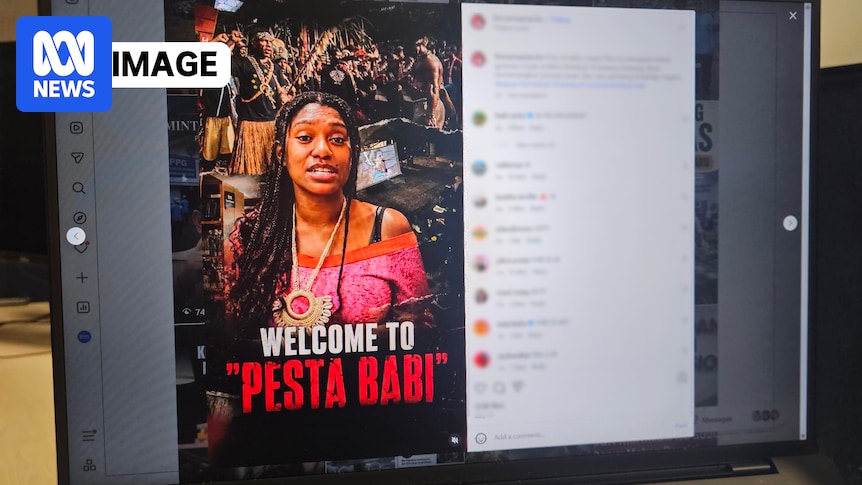
When Koteka Wenda stumbled across an AI-generated video of her circulating on social media, she was shocked.
In the video, she was speaking out against a documentary that has become the subject of fierce debate.
“The resemblance of my likeness is so sinister,” she told the ABC.
“I felt like me and my people were violated.”
Ms Wenda is the daughter of Benny Wenda, the leader of the United Liberation Movement for West Papua.
The deepfake video shows Ms Wenda criticising the 90-minute film Pig Feast: Colonialism in Our Time, or Pesta Babi in Indonesian.
The film by Dandhy Dwi Laksono and Cypri Jehan Paju Dale exposes mass deforestation and indigenous land exploitation in West Papua, allegedly facilitated by the Indonesian government through national strategic projects and big corporations.
Loading…
It also explores Indonesia’s energy transition, how the regional sugar and biofuel industries are connected to Australia, and reveals how multinational corporations have benefited from several projects run in West Papua.
West Papua activists targeted
The West Papua conflict is a long-running political and armed conflict in the western half of the island of New Guinea, a region administered by Indonesia.
At its core, it is a dispute over whether West Papua should remain part of Indonesia or become an independent state.
The Indonesian provinces of West Papua and Papua, often referred to collectively as West Papua, shares a border with Papua New Guinea. (ABC News: Jarrod Fankhauser)
Ms Wenda and other West Papuan activists say the use of AI in targeted campaigns against them is the latest form of repression aimed at silencing those who speak out about West Papua.
Last month, Amnesty International released a report documenting how disinformation campaigns were targeting and discrediting Indonesian government critics.
Ms Wenda said that she feared AI-fabricated content could mislead her supporters, who may question “why this high-profile freedom fighter” switched sides.
“If they don’t know me, they’d probably think it was me,” she said.
“I’m concerned that my likeness is being used and actually is being believed to be the truth.”
Veronica Koman says she has been targeted on social media for speaking out about West Papua.
(ABC RN: Alice Moldovan)
Sydney-based West Papuan activist Veronica Koman experienced a similar attack last year.
In one social media video, she appeared to praise the efforts of the Indonesian government in West Papua.
Indonesia’s Ministry of Communication and Digital later classified the clip as a “hoax”.
Ms Koman said she believed that the original footage of herself was taken from her personal Facebook account.
The footage was then altered to make it appear as if she said the Indonesian government cared more about West Papuans than in the past.
It was not the first time Ms Koman had been targeted.
“Before that, there was a deepfake video of me engaging in sexual acts,” Ms Koman said.
“It’s very harmful, upsetting and really disgusting.”
While Ms Koman did not specifically accuse anyone of creating the fake videos, she suggested “state actors” were likely responsible.
“It’s only state actors that are able to use so many resources,”
she said.
“Who would want to do that? Like, so much money invested and time wasted on such things.”
‘Old wine in a new bottle’
The recent Amnesty International report, Building up Imaginary Enemies, revealed how Indonesian authorities, including the military, used disinformation campaigns to target and discredit government critics.
“This disinformation is a political weapon, deployed to consolidate the government’s power when public criticism intensifies, while demonising and weakening those who dare to speak out,” Amnesty International secretary general Agnes Callmard said in a statement.
“Amnesty’s research shows that in the 18 months since Prabowo took power, online disinformation has emerged as a key tactic to systematically discredit government critics, shut down public debate and justify repression, all while social media companies sit back and let it happen,” she said.
Ken Setiawan, an associate professor from the Asia Institute at the University of Melbourne, said human rights and Papuan activists had long been repressed in Indonesia.
Ken Setiawan says repression of human rights in Indonesia is not new. (Supplied: Ken Setiawan)
“And we know that the security forces have been heavily involved in the repression of human right activists, particularly when it comes to West Papua,” Dr Setiawan said.
“What has changed is the technologies that they used, but it’s old wine in a new bottle.“
The ABC contacted the Indonesian government and military for comment.
‘Digital colonisation’
Activists say being targeted for speaking out about West Papua, including through disinformation campaigns, is “nothing new”.
“It’s part of the long-standing Indonesian government’s war on information about West Papua since the 1960s,” Ms Koman said.
“It all began with the ban on journalists coming into West Papua, and this misinformation and disinformation should be seen in that context.”
In 2022, a coordinated online disinformation campaign aimed at strengthening Indonesia’s claims over West Papua was uncovered by researchers at the University of Melbourne.
A joint investigation between the BBC and the Australian Strategic Police Institute in 2019 found well-funded “slanted or untrue content” in the form of news, infographics, and videos on social media, promoted narratives supportive of Indonesian government policy in West Papua.
The researchers also found that the campaign used disinformation through “bots” or automated social media accounts to undermine the voice of the activists.
“Many people told me that they’re confused about what’s actually happening in West Papua, because activists said A, government said B,” Ms Koman said.
“And we know that we can’t trust the government, but we also cannot distrust activists.”
Ms Wenda said campaigns targeting activists, such as the deepfake video of her, were a new form of “a digital colonisation”.
“We, West Papuans, our voices have been silenced for more than 60 years, and we’ve been struggling to gain attention from the international media,” she said.
“This is a new battle for us to fight.“
Ms Wenda said despite the challenges posed by AI, social media had given activists “confidence” that their voices were finally being heard.
“I believe that the truth cannot be silenced even despite our voices being appropriated or stolen,” she said.
The Indonesian military has generally denied allegations of human rights abuses in West Papua. (Reuters: Olha Mulalinda/Antara/File)
Ms Wenda and Ms Koman said they hoped the younger generation was more critical with what it saw on social media.
Ms Koman said those who wanted to keep advocating for West Papua should “carefully consider” the technology they used.
“Then we can keep our credibility,” she said.