







Senior doctors from a hospital in Melbourne’s north are warning people against taking drugs being labelled as experimental weight loss medication retatrutide, after discovering multiple cases of liver damage and other serious illness.
The injectable medication has not been approved by any worldwide drug regulator, including the US Food and Drug Administrator and the Australian Theraputic Goods Administration (TGA).
Victoria’s chief health officer on Friday issued a health alert, saying the department was aware of six cases of acute liver toxicity associated with the unapproved peptide product.
The attraction of “reta”, as it’s commonly called on social media, is that it may be faster acting than the existing prescription weight-loss drugs available.
But doctors told the ABC that anyone buying a substance labelled as retatrutide was buying a black market knock-off.
Woman hospitalised less than a week after use
Megan Hancocks, 32, became interested in reta after seeing videos and posts on TikTok and Instagram, but couldn’t find where to buy it.
Late last year during a beauty appointment, she mentioned her interest in the drug to a clinician who told her she had a selection of off-market peptides bought from a Chinese manufacturer available for purchase in cash.
Ms Hancocks bought a product labelled as retatrutide, as well as a popular peptide for skin commonly called GHKCU.
Ms Hancocks said she now knew she did not need to use a weight loss drug.
“I was quite small looking back now, but obviously your mind tells you otherwise,” she told the ABC.
Ms Hancocks hesitated for a while before injecting the medicine, because she didn’t have the advice of a doctor and was unsure about dosage.
But she decided to proceed and took her first dose on December 24 last year, and a second dose on December 28.
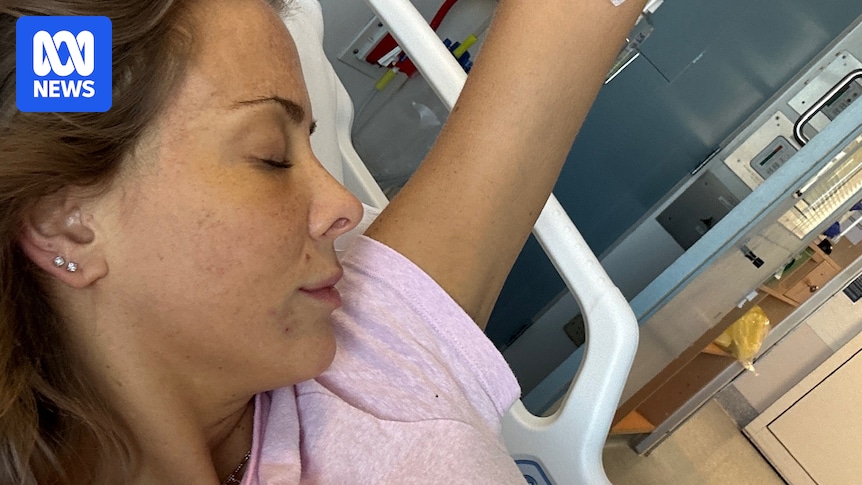
Less than a week later, she went to hospital and was found to be in acute liver failure.
Ms Hancocks spent about a month at the Royal Melbourne Hospital in January, but has been back in hospital multiple times since. (Supplied)
Symptoms included extreme jaundice, constant nausea, vomiting, severe constipation, stomach swelling and extreme fatigue.
Ms Hancocks was at the Royal Melbourne Hospital for about a month, where at one stage her doctor began discussing the prospect of a liver transplant.
Ms Hancocks experienced jaundice, meaning a yellowing of the whites of the eyes and skin. (Supplied)
Miraculously, she said, her liver took a turn for the better and she avoided the transplant.
But six months on, Ms Hancocks is on steroids for liver repair and has been in and out of hospital several times.
She cannot work and now lives with her mother.
Ms Hancocks said the side effects of weight gain, sores on her skin from the treatment and hair loss have taken a massive mental toll.
Megan Hancocks has been suffering skin reactions to liver repair treatment. (Supplied)
“When I look in the mirror I don’t see the same person anymore and that’s been really hard,” she said.
Ms Hancocks says she has avoided even her close friends, only leaving home for medical appointments.
She said her experience should discourage anyone thinking of trying anything labelled as reta.
Megan Hancocks is unable to work and now lives with her mother on the Gold Coast. (ABC News: Glenn Mullane)
Multiple hospitalisations in recent months
Liver transplant specialist Marie Sinclair, from the Victorian Liver Transplant Unit based at the Austin Hospital, first heard of Ms Hancocks when her treating doctor and the Royal Melbourne flagged her for potential liver transplant.
Since then, Dr Sinclair has seen and heard of other patients who have become ill after taking so-called retatrutide, including a woman who presented to emergency at the Austin a few weeks ago in acute liver failure.
The patient in her 20s had purchased vials labelled as retatrutide online on a recommendation from her gym, which the Austin is now having tested.
Dr Sinclair said the woman’s symptoms when she got to hospital included abdominal pain, nausea, fatigue and severe jaundice.
These are the vials of medicine Dr Sinclair’s liver failure patient received. The Austin has submitted these for testing to find out what’s in them. (Supplied)
“The whites of the eyes become yellow and the skin all over does become yellow as well,” Dr Sinclair said.
“When there is a severe insult to the liver the liver cells can die, and we can see this in a blood test when we look at the inflammation in the liver.”
“In severe cases people can die from liver failure or they need a liver transplant to save their life.“
Dr Sinclair’s patient is unlikely to require a liver transplant.
Dr Sinclair has been treating a woman who was in acute liver failure after taking ‘retatrutide’ bought via a website. (ABC News)
Dr Sinclair has conferred with colleagues from other hospitals and confirmed other cases of people who took medicine labelled retatrutide.
These include a woman in her 20s treated at the Austin for liver injury, and a man in his 40s with major kidney injury from extreme dehydration caused by having diarrhoea about 40 times a day.
Dr Sinclair was told both these patients were encouraged by their gym to try the drug.
Retatrutide yet to be approved for market
US-based pharmaceutical company Eli Lilly is the sole owner of the patent for retatrutide and is currently still running clinical trials.
“Retatrutide is an investigational molecule that has not been approved by any regulator anywhere in the world,” a spokesperson for Eli Lilly told the ABC.
“No-one can legally sell it for human use.”
The spokesperson said “counterfeit and black market medicines” were untested, unregulated and could be deadly.
“Patients deserve safe, effective and clinically tested medicines, not harmful knock-offs,”
they said.
The Eli Lilly spokesperson said prescription-only medicines offered without a prescription via social media or unofficial websites were unlawful.
“These products are either counterfeit or resold outside the approved supply chain – and both situations pose serious risks to patients’ health.”
The company said it was taking steps to “combat the proliferation of counterfeit and unsafe products” including working with law enforcement, publishing warnings and trying to identify harmful online content.
Endocrinologist Niloufah Torkamani says her patients have asked her about going on ‘retatrutide’ after seeing it on TikTok. (ABC News)
Besides what’s in the drug, director of the Austin Hospital’s Medical Weight Loss clinic, Niloufar Torkamani, has concerns about the types of people who take it.
“They’re not made for someone who is very, very slim and wants to get a little bit more fat off their body,” she said.
“In a very low BMI or weight range they could have a whole other list of complications that would not have been seen even in the clinical trial because those patients were not included in the clinical trial.”
Patients regularly asking for new drug, doctor says
Dr Torkamani said the retatrutide in clinical trials was “from the family” of weight loss medications such as Ozempic and Mounjaro.
“This is the next generation of these medications, which works on three hormones,” she said.
She said early trials had shown retatrutide could achieve a higher percentage weight loss than the available GLP-1s such as Ozempic and Mounjaro, with results mimicking bariatric surgery weight loss.
“It seems like because of the third hormone in it, the muscle mass preservation might be much better,” she said.
But this only applies to the official Eli Lilly-owned retatrutide, not the knock-off substances.
Despite this, Dr Torkamani said her patients were already regularly asking her about taking retatrutide, even though it is not available to prescribe.
“I get emails from my patients, [saying] ‘can you upgrade me to this better medication I heard [about] on TikTok’,” she said.
“Then I get questions when I see my patients who have stopped getting results from the current medications and want to optimise their care, asking to go on this medication.”
In March, the TGA issued a safety warning about counterfeit weight loss drugs, advising people stick to approved, prescription weight loss medicines.
The ABC contacted the TGA for comment.
For Dr Sinclair, the unknowns of the knock-off retatrutide are the primary concern.
“We don’t know what these things are, it’s quite frankly terrifying,” she said.