







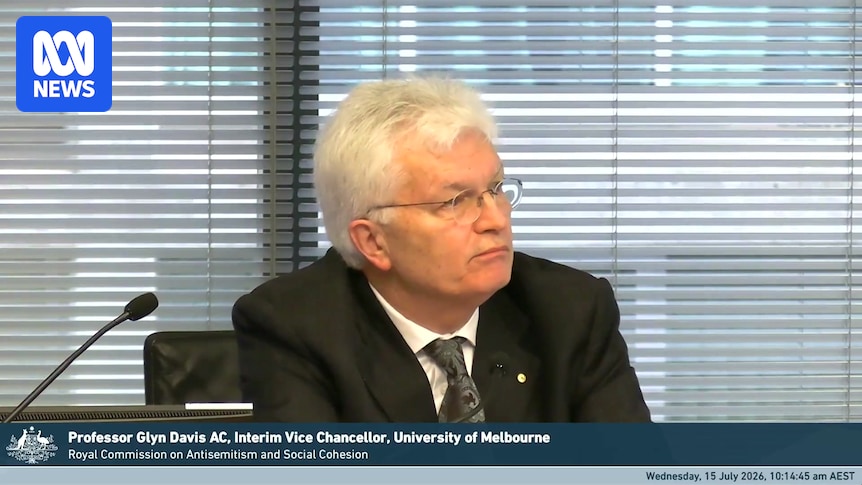
University of Melbourne Vice-Chancellor Glyn Davis says the institution’s management chose not to publicise the names of students it disciplined for occupying a Jewish academic’s office to avoid making a “stain” on their young lives.
The interim head of the prestigious institution has given evidence to the Royal Commission on Antisemitism and Social Cohesion on Wednesday, which is examining universities’ handling of pro-Palestinian protests and their support for Jewish staff and students.
Professor Davis took on the vice-chancellorship in February this year and was based in Canberra in 2024 when encampments of up to 110 tents sprang up on the South Lawn of Melbourne University’s Parkville campus.
He was questioned about the experience of physics professor Steven Prawer, who told the commission yesterday of his disappointment at the university’s response to the 9 May 2024 occupation of up to 20 masked protesters in his office.
University of Melbourne professor Steven Prawer gave evidence at the royal commission on Tuesday. (Supplied)
The commission heard Professor Prawer was being targeted by pro-Palestinian activists due to his involvement in a long-running PhD research partnership with the Hebrew University of Jerusalem, and their belief that this indicated complicity with the actions of the Israeli state.
Professor Davis told the commission that years earlier he’d helped establish the Hebrew University partnership and contacted Professor Prawer personally after the incident to voice his sympathy.
“For him to be singled out and treated in this way was appalling,”
he said.
However, Professor Davis backed his predecessor Duncan Maskell at the time and said the university had improved security for Professor Prawer that year, at its own cost, to protect him.
Ironically, he said, the very day tradespeople were working on Professor Prawer’s office to improve its security was when the protesters got in.
Professor Davis said the university did “grapple” with whether to publicise the names of four students who were ultimately suspended for their involvement in the office incursion.
But the decision was to conceal their names to “not make a stain on the rest of their lives”.
“I can say it wasn’t made lightly,” he said.
University changes policy after protest
Professor Davis condemned the protesters for inaccurately conflating the university’s ties with Israeli academics as being “somehow complicit to genocide”.
“That’s not just a slander, it’s unspeakable,” he said.
He also condemned posters put up around campus about ties to Israel as antisemitic, including ones targeting Professor Prawer.
“I’ve found … distressing the conflation of the Jewish identity with the actions of a nation state,” he said.
“This is antisemitism in my judgement and should be condemned.“
A poster that appeared around the University of Melbourne. (Supplied)
Professor Davis told the commission the university’s primary goal in its handling of the 2024 encampment, and protesters’ occupation of the Arts West building during it, was to avoid the violence that was occurring on US campuses.
He said the university could not force the protesters off campus as security did not have sufficient powers.
But, Professor Davis added, the university had since changed its policy.
“If an occupation would happen again, security would have sufficient powers to dismantle the occupation,” he said.
“It doesn’t change security staff are limited in what they can do. They don’t have powers of police — nor should they.”
Students set up tents and unfurled banners inside the Arts West building. (ABC News: Ahmed Yussuf)
The university also paid for an independent racism review in June 2024 which found racism was “prevalent and systemic at the university”, mostly in the form of “micro aggressions”.
He said since 2024, the university had developed a website to act as a “single front door” for students and staff to make complaints, which went live last month.
He said the vast majority of student complaints were to do with coursework but that staff were being trained to respond to complaints of racism, including antisemitism.