






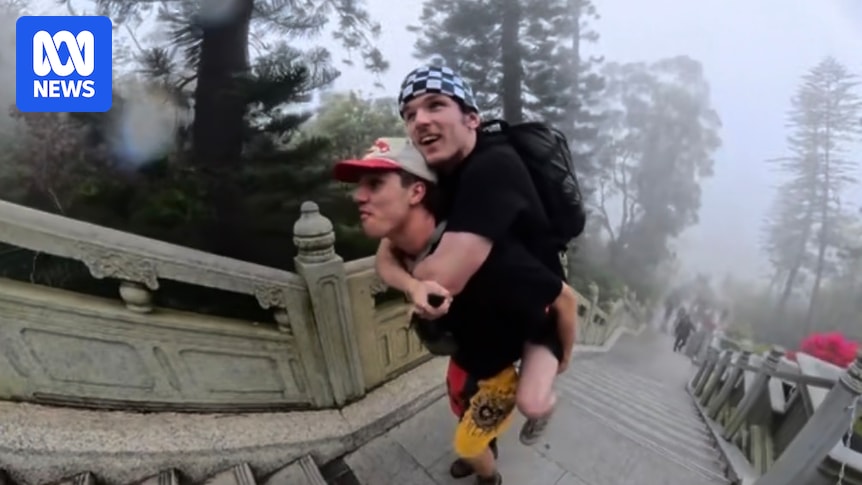
It’s not a typical sight: two young Australian travellers piggybacking their way through iconic landmarks and tourist destinations around the world.
Fletcher Crowley and Lachie Bennett know it looks unusual.
“People jump to conclusions. [They think], ‘What are these hooligans doing?'” Lachie says.
Fletcher and Lachie piggybacked up 268 steps to the Tian Tan Buddha (or Big Buddha) in Hong Kong. (Supplied: Two Mates 1 Chair)
But Lachie has nailed the art of ignoring what people think after piggybacking his friend Fletcher Crowley at all sorts of locations: up hundreds of stairs to the Big Buddha in Hong Kong, through caves in Brazil, to the top of theme park rides, and anywhere else the pair wants to go.
“To be fair, though,” Fletcher says, “we probably do look like we’re taking the piss half the time.”
But it’s not some stunt or prank.
This is just one of the ways these 20-year-old mates from Sydney are pushing the boundaries of what’s accessible.
“In Africa, we piggybacked up a lighthouse, and this lady goes, ‘Are you playing fun and games?'” Fletcher says, laughing at the memory.
“And I was like, ‘No, I can’t walk.’“
Loading…
‘I love scaring myself’
Before and since the accident that changed his life at 17 years old, Fletcher has thrived on adventure and adrenaline.
“Surfing, skating, mountain biking, skiing … I just love scaring myself,” he says.
Fletcher was left paraplegic after breaking two vertebrae attempting a mountain biking jump.
Though he has some sensation and movement in his legs, he says he now can’t walk more than 20 metres without feeling “absolutely wrecked”.
There was pain and anger in the days following the accident, Fletcher says, but he wouldn’t let it linger.
“This has happened. What are we doing now?” Fletcher says.
“I got straight into researching what you can do and all the adaptive sports, all the ways to travel, and all the different opportunities.”
Fletcher Crowley has used a wheelchair since he was 17. (Supplied: Two Mates 1 Chair)
As part of his recovery, Fletcher spent time at a resort built for people with spinal cord injuries.
It was there that another thing changed his life: becoming friends with Lachie Bennett.
“I can obviously do everything to survive and to live,” Fletcher says.
“But to really push living and do all this cool shit we want to do, that’s where Lachie comes in.“
The pair quickly discovered they had a lot in common: a love for travel, sports and pushing boundaries. (Supplied: Two Mates 1 Chair)
Two mates, 1 chair
They’d gone to the same school and had mutual friends, but it was after meeting at the resort where Lachie worked that the pair became friends.
Loading Instagram content
Two years later, thousands of followers know them as Two Mates 1 Chair on social media, where they share their lives and travels.
“We just clicked. Our brains are very, very similar,” Fletcher says.
Wanting to push the boundaries to make adventure accessible is also in Lachie’s nature. For work, he does recreational support in adaptive surfing, biking, kayaking and more.
One day, driving past theme parks on the Gold Coast, the pair tried something that would go on to help them travel the world.
“I was like, ‘We should go to Wet’n’Wild,'” Lachie says.
“And Fletcher was like, ‘How’s that going to work?’
“And that’s where the piggyback started.”
Piggybacking is one of the ways Lachie and Fletcher navigate places that would otherwise be inaccessible. (Supplied: Two Mates 1 Chair)
The pros of travelling with a wheelchair
Lachie and Fletcher have just returned from a three-month trip spanning four continents.
In what they call “the trip of a lifetime”, they travelled to Hong Kong, Brazil, South Africa and across Europe.
“We thought about the accessibility of each place, but it didn’t affect at all if we were going to visit.”
Fletcher and Lachie love finding new ways to get around. (Supplied: Two Mates 1 Chair)
And despite the barriers one might assume travelling in a wheelchair imposes, Fletcher and Lachie’s trip was as spontaneous and on-the-fly as anyone else’s; they set off with a rental car and just a few nights of accommodation booked.
“People would reach out to us and say, ‘Come stay with us,'” Fletcher says.
“In Switzerland, we stayed with a family the whole time.”
Fletcher and Lachie stayed with families and met many locals along their journey. (Supplied: Two Mates 1 Chair)
There were some situations where accessibility was an issue, such as in the snow and on trains, they say, but together, they made it work.
“We get the shits when it’s just three steps. You should just have a ramp at that point,” Lachie says.
“We went into it thinking it was going to be a lot harder,” Fletcher says.
Loading Instagram content
In fact, they’re both keen to point out the pros of travelling with a wheelchair.
“It’s front-row parking with this bloke,” Lachie laughs.
“[Under my chair] is carrying two backpacks around permanently. It’s literally a personal boot with me 24/7.”
And then there’s their unique mode of transport, “piggybacking the world” as they say on TikTok, which opened up a lot of possibilities.
“I think it’s kind of our thing now: just finding tall things to piggyback,” Fletcher says.
“I reckon Lachie came back so much fitter than when he left.”
“On this trip, we learnt a lot to just ignore what people think,” Lachie says.
“We just do us.”
The impact of their story
Through their social media channels, Lachie and Fletcher hope to change how people view the possibilities of travelling with a disability.
“We’ve had a fair few people in chairs, and not even just in chairs, [saying], ‘You guys proved to me that we can travel.'”
They both love adventure sports. (Supplied: Two Mates 1 Chair)
They acknowledge their style of travel is not possible for many.
“It looks so different for everyone else as well. Each disability is so different.”
With the ultimate goal of one day assisting others to experience what they have, the mates also hope their adventures show the power of community and friendship.
“I think it’s a matter of trusting yourself, trusting your friends,” Fletcher says.
“Anywhere in the world you are, we’ve learnt, there’ll be someone who will help.”
Both Fletcher and Lachie say their friendship has opened up a world of opportunities and possibilities. (Supplied: Two Mates 1 Chair)
For Lachie, being able to assist someone “brings me so much joy”.
“Life wouldn’t be as good without mates,” he says.
“I’ll always enjoy it more, even if it’s a stranger or a mate. It’s so much more fulfilling if you can share a scream or a giggle with someone else.”
Fletcher feels the same.
“Mateship’s a big thing for us.“