









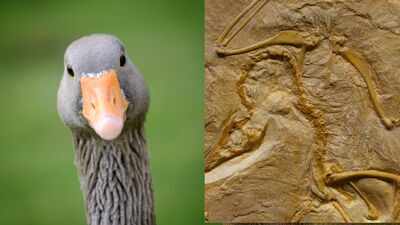
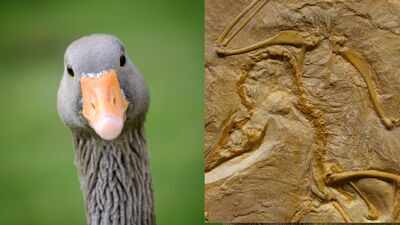
A rare discovery of fossil goose found in the mud of an ancient lake in Central Otago is shaking up everything scientists thought they knew about New Zealand’s famous bird life. For a long time, it was assumed that the country’s unique, giant birds had been evolving isolated on the islands for tens of millions of years. However, this new discovery by an international team of researchers—including experts from the University of Otago—proves that the real story is much more chaotic, dynamic, and full of surprise arrivals than anyone realized.A hidden “Mother Goose” in the mudThe breakthrough happened at the famous St Bathans fossil site, an area known for waterfowl fossils but where actual goose bones are incredibly rare. Scientists decided to carefully re-examine every single bone ever labeled as a goose from the site, comparing them against modern and extinct skeletons. Hidden in the mix, they found something entirely new: an undescribed species about the size of a small goose.They officially named the new bird Meterchen luti. In a nod to the classic nursery rhyme, the name literally translates from ancient Greek and Latin to mean “Mother Goose of the mud.” But while it might sound cozy, this little goose threw a massive wrench into existing evolutionary theories. Crucially, researchers found that this ancient bird is not closely related to the giant, flightless New Zealand geese that went extinct recently, nor is it tied to Australia’s Cape Barren goose.Tearing Up the Old TimelineFor years, a popular theory argued that this ancient St Bathans goose was the direct ancestor of New Zealand’s famous giant flightless geese (Cnemiornis), which would mean that specific lineage lived on the island for at least 14 million years. But there was a catch: modern DNA evidence stubbornly insisted that the ancestors of those giant geese actually arrived from Australia much later, only about 7 million years ago. For a long time, scientists favoring the old theory simply ignored the genetic data.This new fossil analysis completely settles the debate by backing up the DNA. It proves that the old “long history” theory was wrong. Instead of a slow, unbroken line of evolution, New Zealand’s bird history was shaped by waves of different species arriving at different times. The little Meterchen luti got to the island over 14 million years ago but eventually died out completely, leaving no descendants behind.The Incredible Speed of Island EvolutionWhat this means is that many of New Zealand’s most iconic heavyweights—like the takahē, the massive Haast’s eagle, and the giant flightless goose—are actually relatively recent immigrants. Their ancestors only showed up about four to seven million years ago.Once they arrived, however, island life triggered a massive growth spurt. The giant flightless Cnemiornis geese evolved incredibly fast, ballooning into 18-kilogram, one-meter-tall monsters—the largest geese the world has ever seen. By combining old-school fossil hunting with modern DNA technology, scientists are finally painting a true picture of an island ecosystem that was constantly shifting, changing, and reinventing itself.