






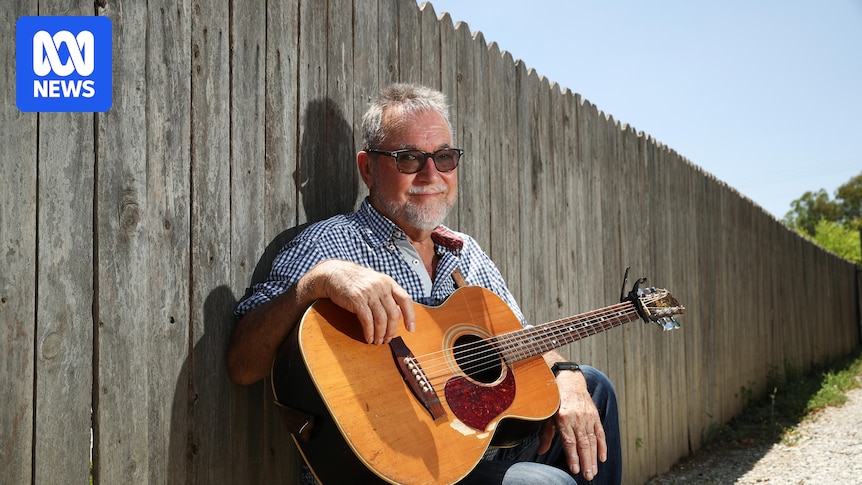
Folk and country music legend John Williamson is about to leave Australian winter behind for the palm-lined beaches of Fiji when we meet at his office in the heart of Sydney’s CBD.
After touring for more than five decades, the 80-year-old singer of Old Man Emu and True Blue is ready to wrap up his performing schedule and ease into retirement in his property on the Gold Coast Hinterland.
Two floors up from the building’s glossy lobby, John’s “office” is decorated more like an outback pub. The walls are heavy with Australian art and music memorabilia. Across a window hangs one of Williamson’s own proposals for a new national flag — a yellow kangaroo bounding forwards, never backwards, towards a Southern Cross. More than a dozen Golden Guitar awards are bolted above a door frame, beyond which a handful of expensive guitars are mounted on the walls.
Painted red-tailed and yellow-tailed black cockatoos hover above us and Williamson later does a very good impression of the bird’s squawk, which he thinks sounds like it is throwing a tantrum.
This year you headlined Tamworth country music festival for the last time, saying now that you’re 80 there are a few things you want to do before you “drop dead”. What’s on the list?
Well, I have an 180 acre block… I’m still discovering what’s on there, because rainforest is like that, you know. But it’s really two countries, it goes from tropical rainforest up into koala country on the ridges. There are mostly hardwoods but that means I have a lot of dead timber lying around that I can use, you know, to build things, and lots of wonderful rhyolite and basalt.
I’ve been slowly building a sculpture park mainly out of rustic grassy iron stuff and old machinery and I’m now an ambassador for the sculpture competition (Sculptures Out Back in Roma, 500km north-west of Brisbane).
They’re all bush people that build scrap metal, and that’s fantastic. I’ve already got a kind of a Stonehenge thing with huge rocks sitting around so I can develop that.
I also want to pick my own tomatoes. I’ve got four chooks but because in my life, the way it’s been with travel, I might have a beautiful tomato plant, and I’ll go away, and the neighbours pick it. I want to be there to eat my own tomatoes.
I know you’re a folk artist as much as you are a country artist but I was reading that Australia now ranks only behind the US and Canada as the most popular markets for streaming country music. How do you feel about the state of our local country music scene?
It is a bit of a worry. I think we’ve always been over-influenced by the American stuff.
I’m a storyteller. I tell stories about us and maybe put our little towns into a song, and all the rest of it with an Aussie accent. I don’t think there’s quite enough of it (with an Australian accent) so I encourage that as much as I can for people to believe themselves and believe in their own voice, instead of listening to America. Even if it’s an Aussie lyric, it sounds American, you know?
I still think we’re suffering from inferiority complexes under there… I always think it still goes back to the convicts.
What are the stories that have felt most meaningful for you to tell in your music?
Well probably one of the most meaningful ones is The Prettiest Girl in the Kimberley.
I met these old fellows who were virtually squatting on land alongside the spillway off the Argyle Dam, and they were young ringers that worked on that station before it was flooded.
One told me the story that he fell in love with an Aboriginal girl on the station but when he was a teenager, that was illegal for him to mix with the black girls, and he maintained that he got that law changed, and he did marry her.
I think that it’s worth keeping that history up there because we’ve got to go back and remember that. It’s shameful, but we got to live through it, you know, we’ve got to admit it.
It was actually Warren Williams from Hermannsburg that was my first big connection with Aboriginal people, and it was great when he approached me to re-record Raining on the Rock with him. It was one of the best things that ever happened to me, because I finally had a face-to-face connection with mob.
Has your process changed over time when you sit down to write a song?
I don’t think so. Probably still getting better at it. probably quicker at it or something. People ask me what comes first (the words or the melody). It is always the words and if I want to find the melody, I listen to how I say it because there’s no such thing as a non-melody. I’m talking in a melody now. For Rip Rip Woodchip I stole the melody from a butcher bird.
(John does an impeccable butcher bird call.)
I don’t know how I’m going to transcribe that.
You were recently a judge for the Wilderness Society’s kids book awards and you’ve also got your own picture books. What made you want to tell stories for kids?
Well all my books for kids have been songs first.
It is my passion for our environment that makes me write these songs and I haven’t necessarily been aiming at the kids. I mean, Old Man Emu, obviously it’s always been a funny song for kids so that’s been illustrated twice. I’d love school teachers in every little bush town to take the kids out on an excursion, have an expert with them that knows the bush and pick out the stuff that’s quite unique to their area, rather than just think it’s just another bush town. It can be quite different to the next bush town down the road, you know.
You’ve spoken a lot about that idea of national identity being tied to the natural environment and you’ve said before you “love being Australian”. At a time when the nation can feel divided on questions of national identity, what makes you proud to be Australian in 2026?
Well, the thing that drives me the most is being proud of the nature of the country, like Africans would be proud of lions and tigers and giraffes. That sort of drives my music more than anything. That’s why I’m a conservationist, because we have so many different characters of bush, thousands of different areas where the bush changes, and I don’t think enough Aussies appreciate that. They just think it’s all gum trees. If you don’t appreciate it and love it, well, you don’t care for it.
True Blue came out of more than anything, because I was asked to write without any information by John Singleton for a TV show. All he said was “sticking up for your mates” or something like that, which you’d like to think that’s the same in any country, but it was really about honesty and about caring for one another.
In our little bush town in Quambadook no one locked their cars like they do now, or didn’t lock their doors in their house. To me True Blue is that old thing of trusting one another, and where your word is your bond. To me that is what a good Aussie is.
It’s really hard to describe. I mean, it’s a big country and one of the one most wonderful things about us being Australian is the freedom of space, you know, you can drive for days without, you know, worrying about a border. Space is freedom.
True Blue has been played at anti-immigration rallies. You’ve toured the country and encountered Australians from all walks of life. What do you think unites Australians rather than divides us?
Well, I’d like to think it is the old “fair go” thing. We are very open, generally but where people are struggling to buy a house, it seems like somebody’s got to be blamed for that. They’re all looking for answers, and the answer isn’t hating other people, you know, like I don’t think that’s gonna work..
One of the things about Australia is our diverse cultures. I saw a program on the ABC, I think it was about Indonesians loving the coffee from Melbourne and that (coffee has) come from the Italians, you know… I mean, it wouldn’t be the same without all that. Heck, I mean, these people are creating more businesses really.
Well, I guess I’ll let you get ready for Fiji.
People can’t understand why I’m retiring because I’m performing as well as I ever did, but the thing is, I want to go out performing as well as ever, not forgetting words. It is hard to half stop because your voice is strained all that time, as soon as you stop, but it starts to get cranky or loses power. I’m not comparing myself to Joan Sutherland but as soon as she stopped, that was it. She said she couldn’t perform again, ever, really. I do have exercises taught to me by (my daughter) who’s been through the whole classical thing and taught me how to train my voice or keep it exercised.
(John performs a vocal drill and laughs).
This interview has been edited for clarity and brevity.