






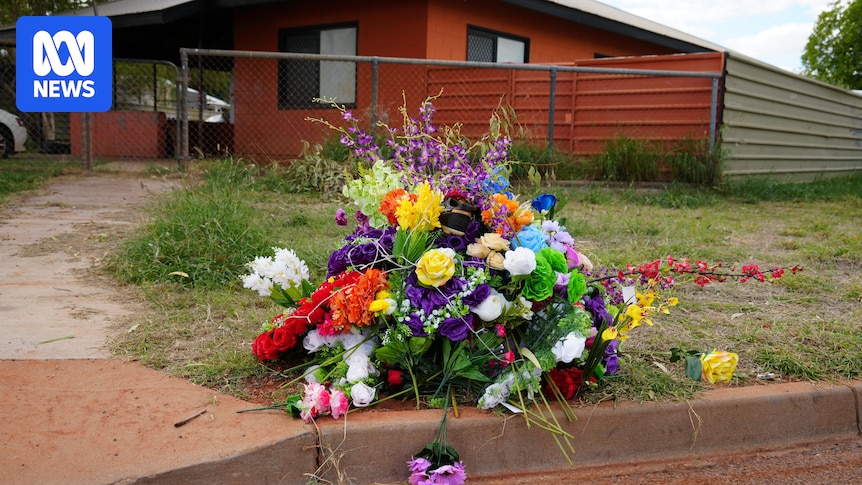
The bunches of vibrant flowers laid on a sparse street corner in the outback town of Tennant Creek sit in stark contrast to the reality they mark — the place where a young man died in a brutal attack.
A 17-year-old boy was charged with murder over the stabbing death of a 21-year-old man in the early hours of Friday June 12, a crime Northern Territory Police said was witnessed by “a substantial crowd”.
A flower memorial has been placed outside a home in Tennant Creek for a 21-year-old resident who recently died. (ABC News: Will Green)
NT Police said major crime were investigating links to a riot days earlier in a nearby town camp, which allegedly involved up to 100 people armed with a variety of weapons.
A statement from authorities, released after the disturbance, said the alleged incident was “related to an ongoing feud involving families from outlying communities and is related to a couple of fatal vehicle crashes in the region over the last couple of years”.
The situation has left the close-knit community shaken and again grappling with a tragedy some believe may have been avoided if better support services were in place.
Sid Vashist says the recent death was an absolute tragedy. (ABC News: Will Green)
Barkly Regional Council mayor Sid Vashist, who has lived in Tennant Creek for almost 15 years, told the ABC the town had been through more than its fair share of heartache.
“It’s an absolute tragedy … there’s a lot of trauma in our community,”
he said.
“There’s angst, people are anxious.”
Mr Vashist said the community was quick to respond following the tragic death — bottle shops closed for the weekend, local football matches were cancelled, the local police force was boosted and emergency mediation was established.
Bottle shops in the town closed and football matches were cancelled. (ABC News: Will Green)
“Things have been rather quiet and it’s a healing process for the families,” he said.
“There is a lot of underlying issues that we need to, as a whole-of-community approach, work together, and that is happening.”
Mediation key part of regional deal
Member for Barkly and NT Aboriginal Affairs Minister Steve Edgington said mediation between the families was a key focus of government.
“The violence resulting in a young person losing their life is of great concern to me as the local member, but also the whole of community,” he said.
“To move forward, we really need to be working with the families to ensure that mediation occurs through the Community Justice Centre.”
Steve Edgington said mediation between the families was key to resolving issues in Tennant Creek. (ABC News: Marcus Kennedy)
Ongoing community mediation was part of a $78.4 million commitment over 10 years under the Barkly Regional Deal (BRD), an agreement forged by all tiers of government.
It came in 2019 after then-prime minister Malcolm Turnbull visited the town following the rape of a two-year-old girl.
Seven years since it was signed, the team assigned to manage the deal has confirmed $800,000 of the $1.65 million allocated to the mediation remains unspent.
In an email, BRD’s Backbone Team executive director Danielle Tucker said: “Mediation projects were funded in the past, and we are currently working through a community co-design process now to establish how to finalise this initiative over the remaining life of the BRD”.
But Mr Vashist said the mediation should have been ongoing.
Local police numbers were boosted in the wake of recent unrest in Tennant Creek. (ABC News: Will Green)
“When the mediators have actually started to get runs on board, unfortunately they’ve been asked to pack and leave,” Mr Vashist said.
“But why would you stop good programs? … I’m personally over talking about it again and again.
“When things are working, you don’t stop — you continue them and you provide more funding.”
NT Member for Gwoja Chansey Paech shared the mayor’s sentiments.
“I’ve heard firsthand from people just how upset and disappointed they are that these important peacekeeping and mediation services seem to have disappeared,”
he said.
“We really need to acknowledge that absolutely prevention is the cure to the complex social issues we’re experiencing across the Territory.”
Housing and transport exacerbating tension
There are also concerns a lack of housing and transport to the NT’s most remote communities is leaving people stuck in town and exacerbating tension.
Transport to surrounding communities is contributing to the town’s problems. (ABC News: Emma Masters)
“On any given day when this town has additional 500 to 1,000 people, this town comes under stress,” Mr Vashist said.
“We have people living in overcrowding, the housing remains a huge issue, and we have people who are living under the poverty line.“
Mr Paech said he wanted to see a study done into the needs of people travelling into larger towns like Tennant Creek.
Chansey Paech wants to see research exploring the needs of people travelling to towns like Tennant Creek. (ABC News: Tristan Hooft)
“When we talk about transport connections and corridors for remote communities coming into town, we absolutely support those networks because it’s important for people to have that connection to our larger regional towns for access to health, education, financial and support services,” he said.
“Services that were subsidised by the Northern Territory government, many of those routes have since no longer been subsidised and that’s having a big impact on family now being forced to pay larger fares to get to and from their remote community.”
The young man’s death occurred in a town camp on the outskirts of Tennant Creek. (ABC News: Will Green)
The ABC made a series of requests to speak to Warumungu traditional owners for this story, but cultural protocols prevented them from speaking in the days after the young man’s death.
The 17-year-old boy faced court on June 15 and will appear again on September 17.