





Tasmanian poultry producers are bracing themselves for the arrival of the H5N1 strain of avian influenza, staring down a worst-case scenario of mass euthanasia.
The deadly virus was detected in Australia for the first time late last week in a sick migratory seabird at a beach near Esperance, in Western Australia, and a second bird has since tested positive.
Since 2021, bird flu has wiped out millions of chickens, ducks and wild animals across the globe.
Pure Foods Eggs chief executive Laura Manion said the Longford facility had already ramped up already strict biosecurity measures, but they would only go so far.
“It’s one of the, I guess, downsides of having free-range farming, because it means that no matter what steps and sort of biosecurity measures we put in place, and how vigilant we are, we can’t stop interactions between our birds and wild birds,” she said.
“It can just be a wild bird flying over and defecating into the yard and you’ve got the strain.“
Pure Food Eggs turns about 80,000 dozen eggs each week. (ABC News: Morgan Timms)
The state’s largest egg producer is majority free range, and normally has around 220,000 birds laying, turning around 80,000 dozen eggs each week.
“If [the virus] does come to Tasmania and we’re in the unfortunate position that it comes to our farm, it does mean at this stage it’s a total depopulation of birds, which also has flow-on effects for staff and jobs until you can rebuild, which takes time,” Ms Manion said.
Farmers brace for the worst, hope for the best
Further west at Sheffield, Mt Roland Free Range Eggs is not panicking.
“Being the area where we’re at, there’s really very little we can do, because we’re surrounded by so many bodies of water and there are so many wild ducks,” owner Phil Glover said.
“It’s just going to be if we get it, we get it.”
Phil Glover says if needed, he can lock up his chickens to avoid bird flu. (ABC Rural: Meg Powell)
If bird flu comes to Tasmania, Mr Glover can temporarily lock up his birds in barns.
“Everything’s inside already, our food’s inside, our water’s inside, we can just close the birds up until such time as we think the threat’s passed,” he said.
But that option doesn’t exist for fellow free-range farmer Duncan Holt, who only has mobile caravans where his chickens lay their eggs, and roost at night.
“I can’t keep them locked up, there’s not enough space,”
he said.
The Glengarry-based farmer said if his birds became sick, it would mean shutting down his business.
“I would assume that if one bird is infected, all of them are infected,” he said.
“Our biosecurity measures have increased, we are careful about washing boots, and the vehicles that are allowed on the farm, and making sure that we don’t visit other chook farms and that people that have visited other chook farms don’t come on our farm.”
Poultry farm locks down
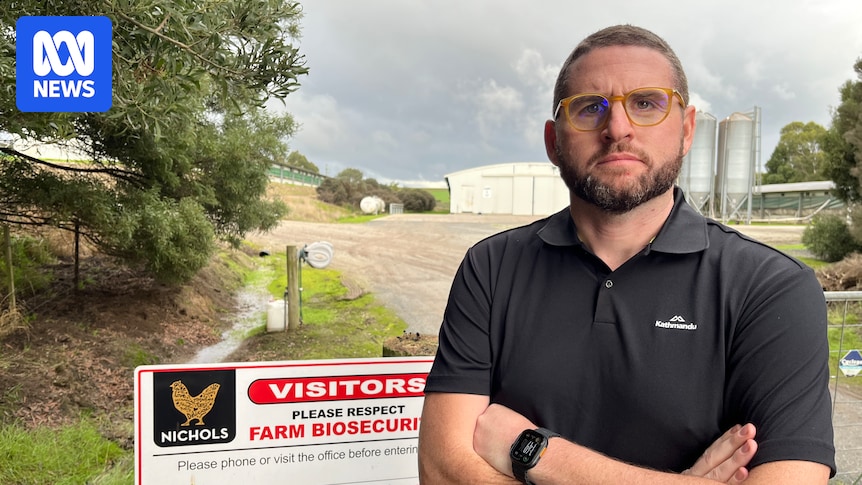
Like Inghams in Western Australia, Sassafras-based Nichols Poultry has gone into lockdown, which chief executive Brad McAuliffe said was “pretty standard”, and meant restricting site access for the foreseeable future.
Brad McAuliffe has lost birds before to a bird flu outbreak in Victoria. (ABC News: Sandy Powell)
His poultry business in Victoria lost more than half a million birds to a previous bird flu outbreak in 2024, but he said the industry had come a long way since.
“I think what it does and the way that it moves through birds and poultry would be catastrophic for Tasmania,”
he said.
“[But] I think we’re doing everything we can to hedge those bets and make sure that we’re 100 per cent protecting the supply of chicken meat in Tasmania.
“At the moment we’re doing everything not to vaccinate our birds against it … [but] I think that’s the only way as a nation that we’re going to be able to overcome this.”
Deborah McSweyn says vaccines cannot be used due to trade agreements. (ABC News: Kelsey Reid)
Tasmania’s chief veterinary officer, Deborah McSweyn, said while there was a vaccine available, “with our trade agreements in Australia we can’t currently use it in commercial poultry”.
“However, we can use it in some of our identified threatened species under permit,” she said.
Dr McSweyn said she was “alert but not alarmed” and urged anyone who saw any sick or dead birds to avoid, record and report.
Mass euthanasia possible
The Tasmanian government has stressed that an “enormous amount” of preparation has already been done both to prepare for bird flu locally and nationally.
“However, we cannot be complacent, and we cannot fall into the trap of expecting that will never happen, so we’ve got to count on the worst,” Primary Industries Minister Gavin Pearce said.
“We’ve got this, Tasmania.”
Rae Burrows says Biosecurity Tasmania is contemplating how to humanely euthanase mass numbers of birds, if it comes to that. (ABC News: Kelsey Reid)
Biosecurity Tasmania general manager Rae Burrows said since late 2023, staff, along with industry stakeholders including the RSPCA and Tasmanian Institute of Agriculture, had put together “heaps and heaps” of policies and standard operating procedures, and tested them in different scenarios.
Ms Burrows advised the most practical measure the poultry industry could take was to keep birds away from wild populations.
But she said if the virus hit farms, culling was “definitely possible”.
“That’s one of the things that we’ve been looking at, the most humane method to actually euthanise lots and lots of birds if we need to, but hopefully we won’t need to,”
she said.