









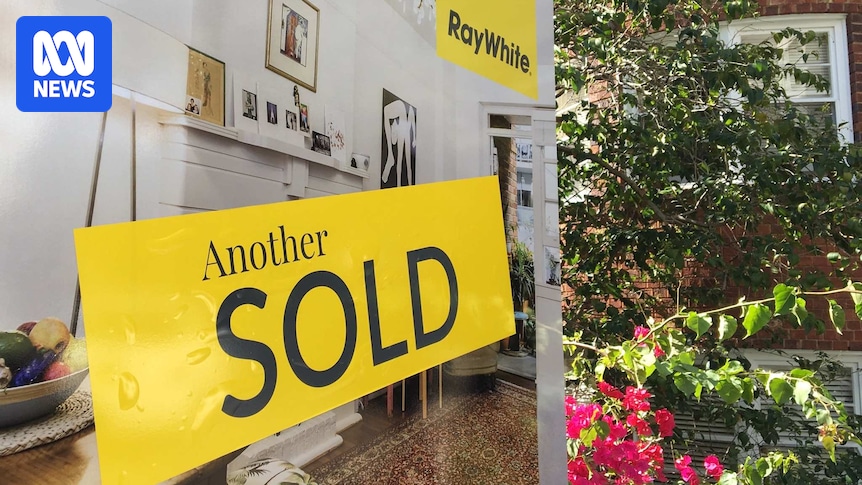
Up to $122,000 could be wiped off the value of the typical Sydney house over the next year, while Melbourne’s median house price could drop below $1 million, Domain forecasts.
The real estate platform has published housing price forecasts for the next financial year and has tipped substantial falls for the Sydney and Melbourne markets, with prices in Canberra also facing downward pressure.
The look-ahead comes after months of the property market losing momentum, with national dwelling values flatlining in May, and Sydney, Melbourne and Canberra already seeing falls, according to Cotality.
Domain’s forecasts for the 2027 financial year noted “a more fragmented and constrained market”, as higher interest rates and tax policy changes affect both borrowing capacity and buyer demand.
The Reserve Bank hiked rates in February, March and May this year, and the full effects are still washing through the economy.
Domain chief residential economist Nicola Powell said the housing market was no longer moving in lock-step around the country.
“Higher interest rates are weighing heavily on Sydney and Melbourne, while more affordable segments and mid-tier cities are continuing to hold up,”
Dr Powell said.
While the Sydney, Melbourne and Canberra markets are forecast to see falls, price growth is expected to continue in Brisbane, Adelaide and Perth.
Across most markets, units are tipped to outperform houses, with Domain noting that first-home buyer schemes and affordability constraints will drive the price divergence, particularly in Sydney, Brisbane and Perth.
It said the hit to borrowing capacity from interest rate rises had constrained purchasing power, meaning first-time buyers were increasingly entering the market via units.
Units are the only type of housing attainable for some buyers. (AAP: Dan Himbrechts)
Domain’s forecasts have assumed the RBA’s cash rate will peak at the current level of 4.35 per cent, and there will be a rate cut in the second quarter of 2027.
However, the prospect of further rate hikes has been acknowledged as the “principal downside risk” to their forecasts, which would push prices toward the lower end of the ranges published in the report.
| City | Range of forecast house price movements FY27 |
|---|---|
| Sydney | -7% to -3% |
| Melbourne | -8% to -4% |
| Brisbane | 3% to 7% |
| Adelaide | 4% to 8% |
| Perth | 5% to 9% |
| Canberra | -4% to 0% |
| Combined capitals | -2.5% to 1.5% |
| Source: Domain |
No housing correction yet: Domain
The Domain report said the federal budget’s negative gearing and capital gains tax discount changes are adding a “structural shift on top of a cyclical one”.
On Wednesday, Housing Minister Clare O’Neil described the recent cooling market conditions as a “correction” after years of extraordinary growth.
“House prices have gone up just in that time by more than 50 per cent and we are seeing a correction on that,” the minister said.
Domain’s Dr Powell told The Business she would not label it a correction yet.
“We are seeing softer market conditions and that’s really being led by Sydney and Melbourne, and we’re seeing that come out in weaker [auction] clearance rates,” she said.
“I think a correction would be where we’re seeing a significant drop in property prices, I’m talking in excess of 10 per cent, and that is not what we’re currently seeing unravelling.”
The drop in prices is significant, but not everyone agrees it constitutes a “correction”. (ABC News: Jordan Young)
While Domain’s forecasts are for falls in Sydney, Melbourne and Canberra, they do not reach that 10 per cent threshold in the worst-case scenario.
“We’ve got to remember there are different dynamics across our different capital cities and we still have an undersupplied housing market,” Dr Powell said.
She said there are behavioural factors that will stem falling prices, as sellers will pull their home off the market if they don’t think they will get what they believe it is worth.
Additionally, she said high construction costs would also contribute to capping price falls.
“It is still higher costs to replace a home than it is to buy an established home.”
Strongest resale profits in 21 years: Cotality
Despite the talk of a housing downturn, it is far from a doom-and-gloom situation for most existing property owners.
Property research firm Cotality released its quarterly ‘Pain and Gain’ report, tracking profits and losses from home resales.
Cotality analysed nearly 101,000 residential property resales made in the first quarter of the year, and found 96 per cent made a nominal profit for the seller.
There are warnings that rental prices may increase in the short-term. (ABC News: John Gunn)
That was up slightly from 95.9 per cent in December and the strongest result since 2005.
The median gain increased to a record $377,000, while the median loss remained unchanged at $45,000, Cotality said.
“The strong resale results we’re seeing today largely reflect the substantial value growth accumulated over recent years rather than current market conditions,” Cotality’s head of research, Gerard Burg, said.
“Housing values continued to rise through most of 2025, and many sellers have benefited from holding their property through multiple growth cycles, which has allowed them to build significant equity over time.“
The small portion of homes that were sold at a loss were more likely to have been bought recently.
Loss-making house resales had a median hold period of 4.3 years in the March quarter, the Cotality data showed — putting their purchase date around late 2021, early 2022.
“Most people selling for a profit today are benefiting from years of accumulated value growth, but those who purchased closer to the recent peak have had less time to build equity and are more exposed to market fluctuations,” he said.
The level of property price growth in recent years is unlikely to be repeated across all markets, however.
Declining home values will “erode profitability” of resales in the coming months, Mr Burg said, noting that “future performance will increasingly depend on local market conditions, property type and when a property was purchased”.
Cotality postcode-level data showed 123 suburbs that have experienced falls in dwelling values of 5 per cent or more, over the period from January through May, overwhelmingly in greater Sydney and Melbourne.
The biggest declines in dwelling values year-to-date were recorded in Sydney’s East (Malabar -12.3pc, Chifley -9.9pc, South Coogee -9.7pc), Sydney’s Northern Beaches (Wheeler Heights -9.8pc) and Melbourne’s Inner East (Deepdene -11.3pc).
Use the map below to find how dwelling values in your postcode have changed year-to-date.
Negative gearing changes won’t make much difference to rents: JP Morgan
The trajectory of home prices will no doubt be closely watched by aspiring home buyers, who continue to grapple with rental prices, which the latest inflation figures show rose 3.6 per cent in the year to May.
As analysts pick over the likely fallout from the federal government’s tax changes, which are now almost certain to pass parliament with Greens backing, some are warning that rents could spike in the short-term as investors exit the market.
However, economist Tom Kennedy from investment bank JP Morgan argued “scrapping negative gearing is likely neutral to slightly supportive of rents”.
He said the exclusion of current home owners from the negative gearing changes on properties they already owned on budget night would prevent a mass exodus of investors and a dramatic fall in rental properties.
“In our view, grandfathering of the policy (existing arrangements are not affected) materially blunts any near-term effect on rents,” he wrote in a note.
“We broadly align with the Commonwealth Treasury’s assessment that the net effect on rents is likely to be modest.
“In our view, rental inflation will continue to be driven primarily by fundamentals including vacancy rates, the pipeline of new supply, and migration dynamics.“
He backed this argument with historical experience from the last time negative gearing was scrapped, briefly, between 1985 and 1987.
“The evidence on rental inflation over that episode is mixed and, in our view, ultimately inconclusive as to any inflationary impact,” he observed.
“Real rents (deflated by headline CPI) appear to have remained relatively low and stable through the period.
“Nominal rents in Sydney and Perth rose strongly, but this appears more closely tied to idiosyncratic supply/demand conditions and low vacancy rates, as rents in other markets (Melbourne/Brisbane) were broadly unchanged relative to prevailing trends.
“Given the policy change was uniform nationally, any rental inflation upturn attributable to negative gearing should, in principle, have produced more consistent effects across regions.”