







Nate Lawson loved superheroes, but even superpowers might not have been enough to defeat what fate had in store for him.
He was just 11 when he lost his battle with Schimke immuno-osseous dysplasia (SIOD).
The genetic disorder is so rare, affecting as few as one in 3 million people, it is difficult to properly study.
The disease is characterised by short stature, kidney disease and a weakened immune system.
Nate was just 99 centimetres tall and developed renal failure as the disease progressed.
“We tried to keep his life as normal as possible,” his mother, Kelly Lawson, said.
“He was very much a dancer in his own time and he was very loud.
“He really loved his friends above everything else.”
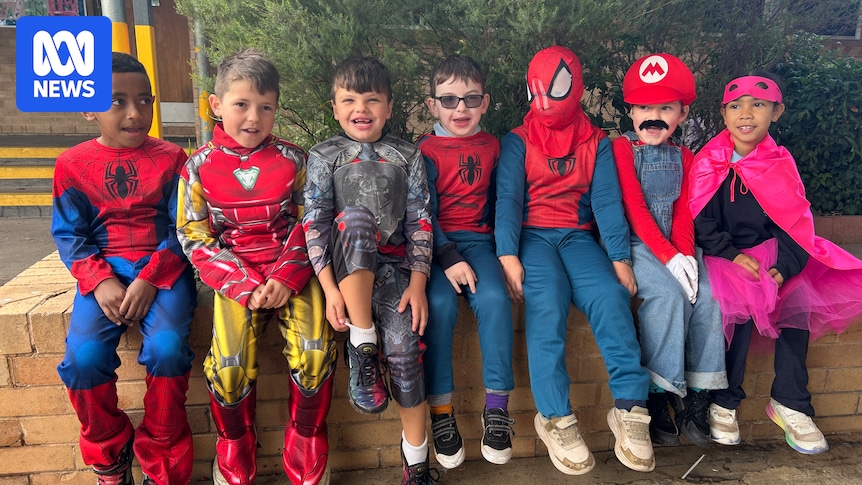
School students at Ashmont Public School in Wagga Wagga dressed up as their favourite superhero. (ABC News: Jess Scully)
Those friends were among the students from 17 public schools across Wagga Wagga who took part in Superhero Day this month, swapping their uniforms for costumes in memory of Nate.
The money they raised went to the paediatric ward at Wagga Base Hospital, where Nate and his family spent much of their time.
The occasion also helped raise awareness of the rare disease that initially baffled Nate’s doctors.
Nate with his sister. (Supplied)
Ms Lawson said her son had health issues from the time he was born, in 2011, but because SIOD was so poorly understood, it took a long time to get a diagnosis.
“He had a stroke in 2018 … and they tried to figure out what it was,” Ms Lawson said.
Nate was diagnosed later that year and died in 2022.
Limited research
Andreas Zankl is a senior staff specialist in clinical genetics at the Westmead Children’s Hospital and a professor of medical genetics at The University of Sydney.
Nate was the first patient he met in person with SIOD in Australia.
“At the time, I actually didn’t make the diagnosis because the X-ray changes were mild and he was still very young,” Dr Zankl said.
In 2018, when Nate was admitted to hospital in Sydney with a stroke, medical staff contacted Dr Zankl for any new ideas about his condition.
“I re-looked at the X-ray and with the information of having a stroke, I made the diagnosis of Schimke immuno-osseous dysplasia,” Dr Zankl said.
There is no cure for the disease, which means treatment strategies focus on managing symptoms as they appear.
For Nate, this was kidney failure.
Dr Zankl said, according to medical literature, only about 100 cases of the disease had been reported across the world, however there could be other unreported cases.
The small patient population means there has been little research into the disease.
“Everything in medicine is variable … you need to study it on a group of patients,” Dr Zankl said.
“If you only have one or two patients to go by, then that’s really hard to do. You can’t actually do a proper study.”
Schimke immuno-osseous dysplasia affects multiple systems in the body. (Supplied)
Despite his frequent medical appointments and hospital admissions, Nate continued his schooling at Sacred Heart Primary School in Wagga Wagga.
This time next year students there and across the city will once again pull on costumes to remember a little boy who was as brave as any cartoon character.
“He was a real trooper, and a real superhero,” Ms Lawson said.
Superhero Day is an annual event in Wagga and will continue to run for the foreseeable future. (ABC News: Jess Scully)