






Midwifery care tailored to First Nations families produces better infant health outcomes, a Melbourne study has found.
The study, published in medical journal The Lancet, tracked 669 Indigenous babies born in three Melbourne hospitals between 2017 and 2022 where their mothers received specialised care.
The results have been compared to more than 1,000 First Nations babies born between 2012 to 2017, before the service was created.
Baby Uzoma, born in 2020, was part of the First Nations midwifery program. (Supplied: Royal Women’s Hospital)
The findings show babies born within the culturally-tailored midwifery program were less likely to be pre-term or of low birth weight. They were also less likely to go to neonatal intensive care and their mothers were more likely to establish breastfeeding.
| Health indicators | Babies born in usual care | Babies born in the Baggarrook model |
|---|---|---|
| Low birth weight | 15.7% | 10.5% |
| Pre-term birth | 18% | 12.9% |
| Admitted to NICU (neonatal intensive care unit) | 28.7% | 21.7% |
| Breastfeeding initiation | 85.9% | 90.7% |
The Baggarrook Yurrongi or “Women’s Journey” model has been running out of the Royal Women’s Hospital in Parkville, at Sunshine Hospital since 2017, and at the Mercy Hospital For Women in Heidelberg since 2018.
Eligible women are assigned a midwife who sees them throughout their prenatal check-ups, the birth and then postnatal care. The families also receive support from the hospitals’ First Nations health units and local Aboriginal health services.
“Across the world, people will be looking to these sort of statistics and saying ‘this is amazing’, we all need to do it,” lead researcher from La Trobe University and the Royal Women’s Hospital, Della Forster, said.
“We think every woman having a First Nations baby should be having access to this care if she wants it because the results really change lives.“
Mothers of 669 Indigenous babies, including Ziggy, received special care. (Supplied: Royal Women’s Hospital)
Professor Forster said there was further study to be done to find out exactly what it is about better care that makes newborns physically healthier.
“Possibly it’s about stress,” she said.
“We’re actually doing some physiological measures to see if having this model makes, literally, makes stress measures less.”
In recent years, there’s been a global push for better outcomes in Indigenous perinatal health.
Professor Forster said the maternity model pioneered in Melbourne was helping to narrow disparities in birth outcomes, supporting the Australia’s Closing the Gap goal of more First Nations babies being born healthy and strong.
She said the program would now expand to hospitals in Bendigo and Mildura, along with Eastern Health and Peninsula Health. Beyond that, more funding would be needed, she said.
‘It was the trust more than anything’, new mum says
As a non-Indigenous woman Jacqueline Howard hadn’t thought she’d be eligible for a culturally-tailored First Nations midwifery program.
The 35-year-old had missed out on a spot in the midwifery caseload program at the Royal Women’s Hospital and so expected to have her baby in the public system the way most Australian women do — seeing different midwives and doctors for every check-up and the birth.
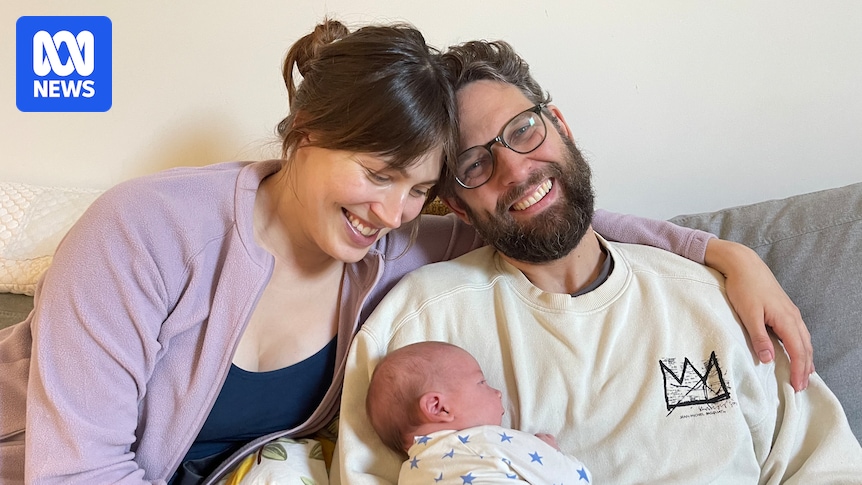
Ms Howard and Mr Wynyard Gonfond are grateful for the care they received at the Royal Women’s Baggarook Yurrongi program. (Supplied)
But once the hospital realised husband Olli Wynyard Gonfond was Indigenous the couple were offered a place in the Baggarrook program, where they were assigned one midwife through pregnancy and birth.
They welcomed baby boy Émile Malu four months ago at 41 weeks’ gestation with a “chunky birth weight”.
The parents-to-be received 24/7 access to their midwife, Indigenous cultural support and Mr Wynyard Gonfond received advice about how to support his wife and prepare the home.
They met a small group of six midwives in the Baggarrook program and other First Nations families in the program.
“They gave us so many thoughtful ideas of how we could bring ceremony into the birth that we hadn’t necessarily considered,”
Ms Howard said.
Midwives told the couple previous families had brought soil from country for their baby to “walk” on country for their first step.
The new father was delighted his wife was eligible for a culturally-tailored midwifery program. (Supplied)
“We loved that idea and so I brought some sand from back on Biripi country [on the mid NSW coast],” Mr Wynyard Gonfond said.
“After he had a cuddle with mum and then with dad, we sort of walked him on that sand in the hospital while I did a little acknowledgement of country for him in language.”
Mr Wynyard Gonfond’s family tradition of placing a tiny drop of a special tonic on the baby’s tongue before breastmilk was also welcomed.
“You’re going to these big institutions and you start to wonder, are they going to be happy with me putting some unknown substance on my baby’s tongue … but they were all just like, that sounds amazing,” he said.
Baggarrook program midwives Georgia Triantafillopoulos and Jaimie Benn, who was the midwife for Jacqueline Howard and her husband. (Supplied)
Ms Howard said continuous support from one midwife meant she got a consistent response, compared to friends of hers who have complained of conflicting information between health professionals.
“I think it was the trust more than anything,” she said.
Ms Howard had a miscarriage shortly before she was pregnant with Emile. While she was pregnant with him, she got a new job, then was made redundant.
She said her anxiety levels could have been high throughout her pregnancy, but weren’t, partly due to the care she was receiving.
‘We’re on call 24/7’
Midwife Evelyn Burns, a Kuku Djungan woman (from far north Queensland), who was in the birth suite with Ms Howard, is not surprised the Baggarrook program has been proven to be a success.
“We know that having a known care provider in pregnancy and birth leads to better outcomes … but for our communities having that known care provider makes women feel more safe, and their families feel more safe,” she said.
Midwife Evelyn Burns works in the culturally-tailored First Nations maternity unit at the Royal Women’s. (Supplied)
“Also, the beauty of Baggarrook is that we are on call 24/7.
“If you have a random question in the middle of the night or you’re concerned about anything, there’s always someone there.”
Because the midwives are in more regular communication with the women, Ms Burns said they are more likely to pick up on symptoms such as decreased fetal movement, pre-eclampsia or gestational diabetes, and address them early.
Midwife Amelia Stephens with mother Rosie Wise Britten from the Royal Women’s Hospital’s Baggarrook program in 2019. (Supplied: Royal Women’s Hospital)
“I love being a midwife, but first and foremost I’m Aboriginal and I want to work and help my community so to be able to do that in a mainstream hospital setting and work with mob every single day is amazing,” Ms Burns said.
“Seeing these outcomes and knowing that it’s making a difference is so rewarding.”