








A domestic violence survivor has spoken about her fight to keep her former police detective ex-husband behind bars as he attempts to be released on parole.
Twelve months ago, Stella Magnisalis stood outside the South Australian District Court and spoke about the five years of abuse she suffered at the hands of Matthew Alan Thomson.
Thomson, 43, was sentenced in June last year to two years and three months’ jail after pleading guilty to six counts of assault against his ex-wife between April 2013 and February 2018.
But his non-parole period has now expired, and Ms Magnisalis has spoken out again in the hope that Thomson, with whom she has a child, will be kept behind bars for his full sentence and be monitored upon his release.
Former police detective Matthew Thomson was sentenced to two years and three months’ jail in June 2025. (ABC News)
“I feel like I’m just starting to get my life back on track now [and I’m] incredibly fearful,” Ms Magnisalis said.
“Is he going to be monitored, unmonitored?
“I want him to serve his entire term in prison so that he’s not a risk to society, period.
“[I’ll be] forever risk-assessing, plan-managing safety issues, things that you take for granted in day-to-day life: walking down the street, going to a supermarket, you know that this person’s out in the community.”
Commissioner for Victims’ Rights Sarah Quick said it was essential the Parole Board considered the impact that Thomson’s release could have on victim-survivors.
“Their voices are not only important — they provide critical insight into safety, risk and the lasting impact of crime, helping the Parole Board to make balanced and informed decisions,” Ms Quick said.
The Department for Correctional Services told Ms Magnisalis in April that Thomson had already applied for bail but that the decision had been deferred pending Thomson’s “participation in a program”.
In response to questions from the ABC, the Parole Board said that Thomson was expected to be interviewed as part of his parole application after completing a domestic and family violence intervention program.
The Parole Board anticipated it would take until mid-October for a “post-treatment report” to be completed prior to that interview.
Pattern of abuse
Thomson was with South Australia Police for about 12 years until he resigned in 2017.
He worked as a detective for much of that period, including in the Child and Family Investigation Unit at Port Adelaide.
Stella Magnisalis says Matthew Alan Thomson’s access to a firearm kept her entrapped. (ABC News: Che Chorley)
Stella Magnisalis said the fact that her perpetrator was a police officer made it even harder for her to speak up or leave.
“He was privileged and protected,” Ms Magnisalis said.
“He used and abused his position of authority.”
Ms Magnisalis said she was a victim of coercive control and that Thomson isolated her from friends and family for years, repeatedly beat her, shut her out of the house, made her sleep on the floor, cut up her credit card, and also brought bullets home from work.
“Lots of things really stick with me, but when you’re using various tactics, a bullet is something that’s quite significant,” she said.
“He had access to a firearm, he had access to a hammer, he had access to scissors … various weapons.
“But the firearm — he has a licence, he’s a police officer — is something that kept me entrapped.“
Ms Magnisalis said she continued to carry the trauma Thomson inflicted on her.
“I didn’t know who I was,” Ms Magnisalis said.
“I was trapped, I was well and truly physically, emotionally, psychologically trapped.”
Mary Leaker from Embolden, the peak body for domestic, family and sexual violence services in SA, said the pattern of abuse Stella experienced was common.
Mary Leaker says it is important for victim-survivors to know they have support. (ABC News: Sarah Maunder)
“One of the things we need to be really aware of is that, for someone using domestic and family violence and coercive control, the intention of that pattern of behaviour is to entrap the other person in that relationship. That’s actually the point of that behaviour,” Ms Leaker said.
“So, it can be really, really, really challenging for victim-survivors to leave and to navigate that pathway to safety.”
Ms Leaker said it was important for people to know that help was available.
“People are absolutely in control of when and how they look to navigate a pathway to safety, but that help and support is absolutely there,” Ms Leaker said.
Ms Leaker said she was waiting to see what changes to the justice system would be made following last year’s Royal Commission into Domestic, Family and Sexual Violence.
“One area is around decisions, around intervention orders, decisions around bail and parole decisions that don’t prioritise the safety of victim-survivors,” she said.
“So the law may be there on paper [but] victim-survivors may have a different experience of how laws are implemented.
“We absolutely need to keep listening to victim-survivors for that experience of how, whether it’s legislation, policy, service provision is actually operating on the ground.”
Conviction was a win
Ms Magnisalis said she also knew other women who had been victims of Thomson, and she feared the former police officer, who had a child with another woman just before he was sentenced, would offend again.
At the time of Thomson’s sentencing, Ms Magnisalis accused SA Police of being a “boys club” and told the court in her victim impact statement: “The system failed to protect me.”
Ms Magnisalis said when she had initially attempted to tell police about the abuse, she, like many victims, had not received the help she needed.
Stella Magnisalis speaks outside court after Matthew Alan Thomson was sentenced in June 2025. (ABC News: James Wakelin)
“Even receiving the right support at the front of a police station, a lot of victims are quite often dismissed,” Ms Magnisalis said.
“Police officers are sometimes completely removed; they don’t take you seriously.
“So, you face so many barriers before you get [anywhere]. [The conviction of Thomson] is a huge win for everybody.”
Ms Magnisalis said that since the court case, she had struggled to navigate government bureaucracies as she attempted to find out when her ex-husband could be released.
“I have been proactively going through different avenues because we do know that the parole board and SAPOL don’t talk to each other. They’re two separate entities, and therefore we slip through the cracks,” Ms Magnisalis said.
“You go through one chapter, you think that’s done, and then you can’t leave it up to the professionals. You really have to be all over it all the time.
Sarah Quick says the justice system should uphold victims’ rights. (ABC News: Che Chorley)
Ms Quick said that often the justice system puts too much of the “burden” back on victim-survivors.
“When systems proactively support victim-survivors and uphold their rights, that burden is reduced — freeing them to focus on recovery,” she said.
“It is critical that victim-survivors are aware of — and can access — the supports available to help them navigate the criminal justice system.”
Ms Magnisalis said she hoped that systemic problems highlighted in the domestic violence royal commission would lead to change.
“Strengthen these organisations, especially SAPOL, midwives, teachers — upskill them in this type of trauma-informed practices,” she said.
“A simple, open-ended question can lead to life-changing outcomes; it saves lives: ‘Is everything OK? What’s going on there?’
“Because everybody sees the red flags, everybody sees the bruises.
“But it’s the subtleties, the controlling of the narrative, that people don’t see that needs to be highlighted amongst professionals.”
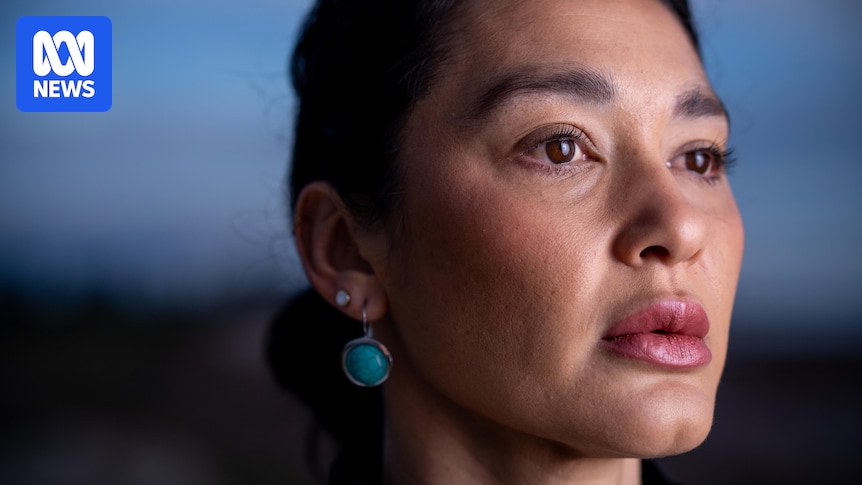
Stella Magnisalis is speaking out in the hope that her ex-husband will remain in jail for his full sentence. (ABC News: Che Chorley)
Ms Magnisalis said, despite her trauma and the fear she felt, she remained optimistic and had a message for those suffering abuse.
“You are not alone,” Ms Magnisalis said.
“One in four women suffer this … it’s a staggering amount.
“I’m putting my voice forward for those who can’t speak.
“I have my daughter, she keeps me on my toes, and she keeps me on track, so I’m hopeful.”