








Listen to this article
Estimated 4 minutes
The audio version of this article is generated by AI-based technology. Mispronunciations can occur. We are working with our partners to continually review and improve the results.
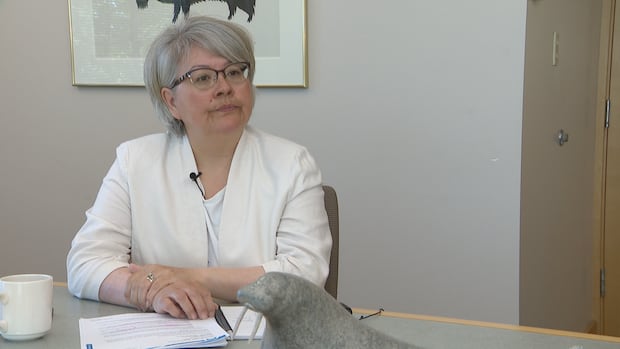
Northwest Territories Housing Minister Lucy Kuptana said the housing conditions of some Behchokǫ̀ residents are “really troubling.”
Kuptana recently visited the community and said the number of Housing N.W.T. units needing major or even basic repairs is creating a difficult situation.
“Housing is so badly needed across the North that we lack a lot of the funding to make it happen, to get those repairs done,” she said.
In 2024, over half of Behchokǫ̀’s households had a housing problem, with a need for major repairs being the most common one, according to a territorial needs assessment released by Housing N.W.T. in March.

Some Behchokǫ̀ residents spoke to CBC News last month about their housing problems, including mould or a lack of running water.
Kuptana said it will take federal investments and flexibility with Housing N.W.T. programs to address the housing needs, not only in Behchokǫ̀ but in other communities across the territory.
Federal help needed
Kuptana says she’s been speaking to federal ministers about obtaining more housing funds for the territory, but also said it’s an issue that requires advocacy from all levels of government, not just the territory.
She also called for more federal housing funding last fall to address the many issues pointed out in a damning report on Housing N.W.T. from the Office of the Auditor General of Canada.
Kuptana said negotiations with Ottawa are still ongoing for Housing N.W.T.’s application to Build Canada Homes, the federal agency tasked with building affordable housing at scale.

“I’m hoping that we have an announcement by mid-June,” Kuptana told CBC News last week.
Adjusting Housing N.W.T. programs
Kuptana said she is aware of people in small communities being asked to pay full rent for units in bad shape, and said that’s something the housing corporation is working to address. That includes revising its rental scale and how rates relate to unit condition ratings.
“I don’t want anybody living in a mouldy home,” she said. “It’s just that the work right now is almost overwhelming and the system itself is feeling like it’s on its heels.”
Kuptana also said she’s discussed increasing flexibility and expanding eligibility for homeownership programs with Housing N.W.T., though she also suggested the territorial government could get out of those entirely.
“I think as a government and Housing N.W.T., we try to take on so much that we forget what we’re doing,” she said.
“We need to focus on social and public housing, and let others perhaps deliver homeownership programs and make it more accessible in communities like Behchokǫ̀.”
Monfwi MLA Jane Weyallon Armstrong argues that any solution to the territory’s housing issues needs to include more powers and money for Indigenous governments, as well as expanded access to homeownership programs. She believes such programs are the best way out of the housing crisis in the Tłı̨chǫ region.

She acknowledged Housing N.W.T. has limited resources and has made some progress, but said it’s been slow and the territorial agency could be doing more.
“The Indigenous [governments] know what they are doing, they know what their people want,” she said.
Weyallon Armstrong said young families especially would benefit from expanded homeownership programs that would make it easier to stay in the communities where they were born and raised, or return to after leaving for their studies.
“That’s where their culture, their language, everything is,” she said. “Our young people, we need to set them up.”