








Do you ever find yourself mindlessly scrolling social media, wondering where the time has gone?
Few of us are immune to the addictive allure of the never-ending scroll.
Slow Read, a new exhibition at Town Hall Gallery in the Hawthorn Arts Centre, Victoria, is an invitation to put down our phones and immerse ourselves in art.
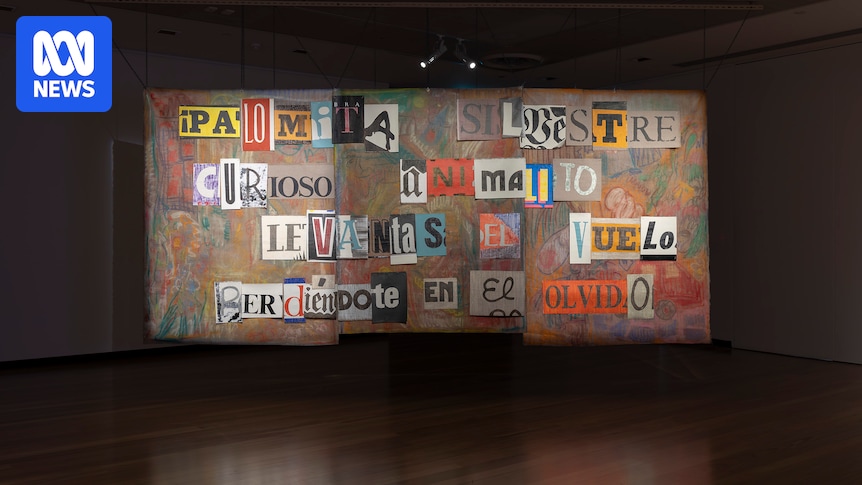
The show features works from multimedia and collage artists from across Australia, including Gracia and Louise, a duo from Naarm/Melbourne who have been collaborating on a range of collages, prints, zines and drawings, often depicting nature, since 1999, and Venezuelan-born artist Nadia Hernández, whose work Palomita/Soledad incorporates fragments of her grandfather’s poetry.
An installation view of Slow Read at Town Hall Gallery, featuring an artwork by artists Gracia and Louise. (Supplied: Hawthorn Arts Centre/Christian Capurro)
The assembled works from the nine artists turn books into multi-dimensional and tactile art that demand, and reward, our full attention in a digital age.
“The artworks can offer a rich and meaningful encounter when viewers are open to them, but this requires time,” exhibition curator Rachel Keir-Smith says.
The opposite of doom-scrolling
Jacky Cheng, a Malaysian-born artist of Chinese heritage who lives and works in Yawuru Country in Broome, Western Australia, contributed a work titled Thrums to the exhibition.
Her work plays on the double meanings of ‘thrum’. A thrum can be a steady, repeated wave, like a humming sound. Historically, thrum can also mean leftover thread from a loom.
Cheng’s work brings to mind a visualised wave of sound. She weaved together kozo paper offcuts and old calendars, including some that belonged to her grandmother, before stitching them together with nylon.
“These printed fragments, once part of a daily ritual of tearing and marking time, carry embedded systems of language, belief and cultural rhythm,” Cheng says of her artwork, Thrums. (Supplied: Hawthorn Arts Centre/Christian Capurro)
The stitching was especially time-consuming, and Cheng worked on the project for almost a year.
“I often think of weaving as a way of bringing fragments together,” Cheng says.
“Individual pieces of paper might hold one story, but when they’re woven together, they create a relationship with one another.
“The process mirrors how identities form; not just a single narrative, but through many overlapping experiences, memories and cultural influences.”
Cheng says she is not immune to wasting time online herself but has found that answering her emails in the morning and then working on her art practice for four or five solid hours has made her more productive.
Cheng is a visual arts teacher as well as an artist. (Supplied: Michael Jalaru Torres)
She even devised a novel replacement for her phone. “I made this cardboard phone,” she says with a laugh.
“I place it on the table, and I’ll look at it and say ‘See, I’ve got no messages!”
Cheng says her practice has been a way to slow down and work in a considered way.
“The act of weaving, it’s the opposite [of doom-scrolling]. It’s repetitive, deliberate and definitely time-intensive.
“The work really asks the audience to spend time with it rather than immediately understand it. The meaning unfolds gradually.”
Weaving the past into the present
Jayda Wilson, an emerging First Nations artist of Gugada, Wirangu, and Thai descent, who lives in Karna Yauta (South Australia), contributed their work (un)silenced to the exhibition.
Featuring archival documents and transparencies, (un)silenced reflects on the importance of language and the impact of colonialism.
Their work sees archives not as inert records from the past, but sites that can be reinterpreted and reimagined with contemporary resonance.
In (un)silenced, Wilson reflects their family’s experience of living under the White Australian Policy. (Supplied: Hawthorn Arts Centre/Christian Capurro)
(un)silenced engages with the text of a speech their grandmother, Neva Gryzbowicz (née Wilson), gave to the Anthropological Society of South Australia about growing up as a First Nations woman.
In her speech, Gryzbowicz talked about authorities banning people from speaking Gugada and Wirrangu wangga, languages from the Far West Coast of South Australia.
“A lot of my work is exploring [Neva’s] work, and how that informs my work as well,” Wilson says.
“It’s not so much a conversation, but I’m weaving the experiences from back then and my experiences now, and how the past has informed the present.
Wilson is an artist whose work explores the connection between language and identity. (Supplied: Jayda Wilson)
“I’ve got the full document [of Neva’s speech] reprinted, and then I did a lot of highlighting of what I wanted to include and things that stood out to me.
“Next to it are a series of transparent papers where I’ve hand-traced the notes. It’s like a dissecting of story, or a piecing together of another story, then the full document is the layered poem on top.”
Wilson says they can enter a “flow state” when creating their multi-faceted work.
“My work is about slowing down and rethinking things.
“Because I work with text and a lot of layering of text as well, you need to look between the lines a little bit and take time to unpack.”
‘Drawing on the book to create something new’
Keir-Smith became interested in artists’ books, a type of artwork made from a book itself, while looking through the State Library of Victoria’s Rare Book Collection.
“Artists’ books were both artists drawing on the book to create something new but also working with a more conceptual framework for extending, celebrating or teasing out different multidisciplinary strands of their practice,” Keir-Smith says.
Keir-Smith says artists working in this form can create something new from existing books or add new layers of meaning to an existing work.
“The artists have presented information and used the book elements of text, image, pagination, layout and design in a certain way that requires time and attention.
“To me, that feels completely different from an online experience.“
Keir-Smith says that recent studies have found there are significant health benefits of engaging with art, including reduced anxiety and improved concentration.
She says the ideal way for visitors to experience the exhibition is to slow down, put their phone away and let their senses guide them.
“Some people find engaging with art intimidating, but it is important to remember that we have all the tools to experience it within ourselves: looking, noticing, feeling, questioning and making connections,” she says.
“Ideally, visitors leave with a renewed sense of what a book, a page, a printed image or an archive can do when treated through an artistic lens.
“We’re talking about books as these privileged sites of learning and engagement that feel so completely different to the online experience, where you’re so over-saturated.”
Slow Read is at the Town Hall Gallery, Hawthorn until July 25.