






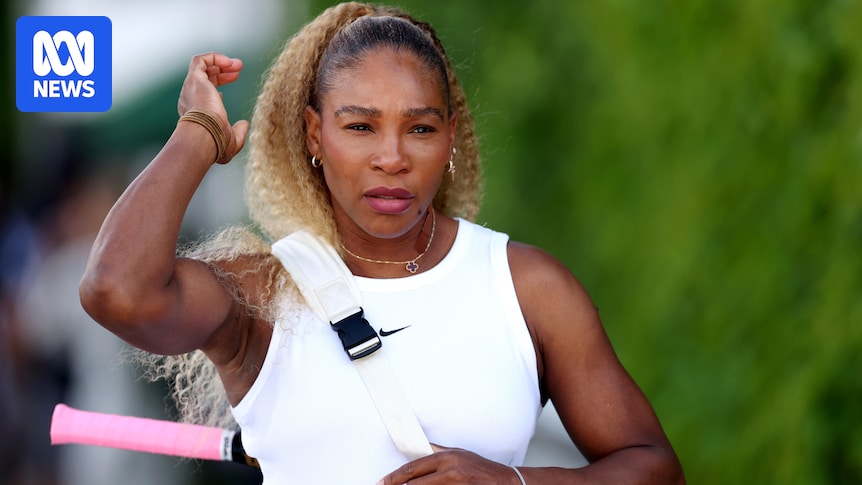
Tennis legend Serena Williams took aim at the game’s anti-doping protocol ahead of her Wimbledon return, claiming the system is “unprofessional” and “unreasonable”.
The 44-year-old, who is a seven-time Wimbledon singles champion, returned to the testing pool before she could announce her comeback to professional tennis.
“It’s gruelling. They changed the rules now,” Williams told a pre-Wimbledon media conference.
“I didn’t know some of the rules. So apparently if you miss a test outside of your window, it still counts as missed.
“I’m like, ‘I guess I can’t go pick up my kids’.
“It’s unprofessional. I hate it. I think it’s necessary, but I think a lot of the stuff, if I want to go places outside of my window, I should be able to go without having it count as a missed test.”
Williams’s first Wimbledon match since 2022 takes place on Wednesday morning AEST when she faces Australia’s Maya Joint.
She returned to professional tennis earlier this month in a doubles match at the Queen’s Club grass-court tournament.
The anti-doping protocol was in the spotlight last week when Markéta Vondroušová, the 2023 Wimbledon champion, was suspended for four years for refusing a test.
Players are required by the International Tennis Integrity Agency (ITIA) to provide their daily “whereabouts” for no-notice testing.
Serena Williams returned to the WTA Tour at Queen’s earlier this month. (Getty Images: Paul Harding)
Williams described the measure as “unreasonable”.
“That was a big reason why I didn’t want to come back,” she said.
“Because it’s just so hard. I mean, my life is busy, I run a company, I run a VC (venture capital) company, I travel the world. I have children.
“It’s like I could be in so many different cities so many different times.”
But the ITIA, in response to Williams’s comments, said the rules had been the same for several years.
“If a tester is unable to reach a player during their allocated hour, then it may well be a ‘strike,’ and three failures could lead to a charge,” an ITIA statement read.
“If a tester is unable to reach a player outside of their allocated hour, it is not considered a strike.”
In 2023, Jenson Brooksby was given an 18-month suspension after an independent tribunal determined he missed three drug tests within the span of a year.
Under anti-doping rules, athletes can be penalised without a positive test if they have three “whereabouts failures” within 12 months.
“There have been no changes to the whereabouts rules in the last few years,” the ITIA added in its statement.
“We understand the system can seem challenging, but it is there to protect players, not to trip them up.
“If players are unsure or have questions, we would welcome a conversation with them directly or through their agents.”
Williams, who has previously criticised the frequency of anti-doping testing, said she was willing to comply.
AP