








The South Australian government is pushing for the state to become home to billions of dollars’ worth of artificial intelligence (AI) data centres, but concerns have already been raised about the impact on energy and water supply.
Premier Peter Malinauskas has released a data centre strategy and plans to introduce new laws into state parliament to regulate the industry.
He hopes AI companies could invest billions in building data centres in South Australia and create hundreds of ongoing jobs, particularly in areas like the state’s Mid North and Whyalla, where there are large electricity transmission lines, wind farms and a pipe delivering fresh water from the River Murray to households and industry.
“This is a genuine economic opportunity for young people in regional South Australia and, if we do it right, not recklessly … it should be an uplift for everybody rather than at the expense of anyone,” Mr Malinauskas told 891 ABC Adelaide.
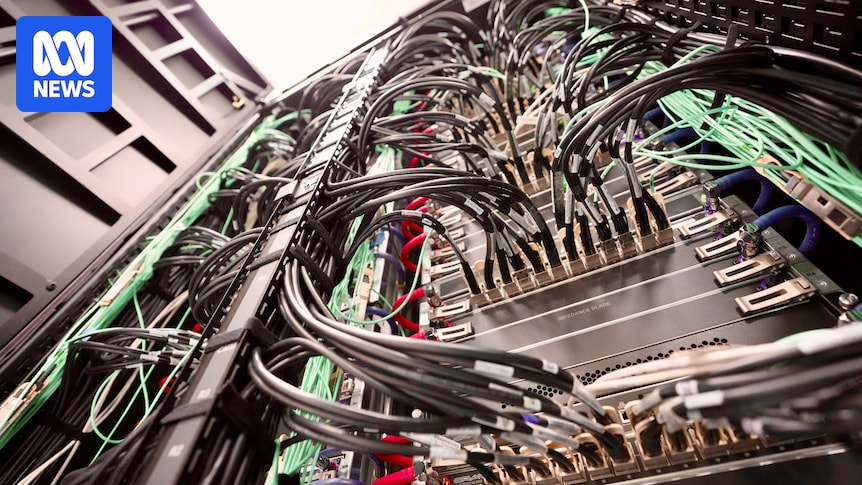
AI data centres are made up of banks of computer servers that are used to run large language model services like ChatGPT.
They need a large amount of electricity to run the computers as well as water to keep them cool.
The strategy aims to capitalise on the large proportion of renewable energy in the electricity market in South Australia and a new undersea internet cable that linked Adelaide with Singapore via Perth last year.
Peter Malinauskas plans to introduce new laws to regulate the AI data industry. (ABC News: Carl Saville)
Mr Malinauskas said technology was improving to reduce the amount of fresh water needed in data centres.
“Some of the commentary around water use of data centres is outdated and, in some cases, exaggerated,” he said.
“Water is of course required for data centres but nowhere near in the volumes … that many have asserted, given the advancements in technology.”
The government said it would introduce a new data centre and AI infrastructure act to parliament, which will include a “streamlined” development process with “reduced duplication and improved certainty”.
The legislation will also ensure energy use is “managed appropriately with no negative impact on consumer bills”, according to the government.
The government’s mooted $5 billion Northern Water project, a 400-kilometre pipeline stretching from a desalination plant on the Spencer Gulf to BHP’s mining operations at Olympic Dam, could also be used to support data centres, the premier suggested.
Mr Malinauskas argued that data centres represented a “source of demand for the energy that we already have”, pointing to a $32.5 billion pipeline of yet-to-be completed renewable energy projects from the private sector.
‘We’re not asking for government subsidies’
Chief executive of industry peak body Data Centres Australia Belinda Dennett said there was a global race for AI investment which required “signalling to investors, to customers, that you’re open for business”.
But she rejected comparisons between Australia and the United States, where companies have been offered tax concessions to build data centres.
“It’s a massive difference between the US and Australia: data centres pay their own way, they’ve always paid their own way,” she said.
“We’re not asking for government subsidies.”
Already, a company called IREN has proposed a $10 billion data centre next to a substation at Bundey, between Morgan and Burra, raising concerns from residents about water use and consultation.
A proposed data centre would be located near this substation at Bundey. (ABC News: Carl Saville)
Opposition spokesperson Ben Hood said he was also concerned about water and the use of primary production land.
“In a dry year, does a data centre come first or a farmer?” he asked.
“I think the second is also who pays? Now, New South Wales has some guidelines that have been out for consultation where the government says operators should fund the infrastructure [for] their own projects so it doesn’t land on household bills.
“So will it be the same here? Or will South Australians have to pay?
“And the third, of course, is keeping the lights on. These large-scale AI data centres and the compute runs flat-out around the clock — you can’t switch it off so when the wind drops off.”
Ms Dennett said Australia’s electricity regulations were “very clear” that it was a “user-pays” system.
“That’s why we think Australia is in such a better position than the US,” she said.
“They did offer massive tax incentives to build data centres, and they didn’t make them pay their own way, and they’re now scrambling to try and fix that.”
Robert Simms says the AI industry should be regulated. (ABC News: James Wakelin)
Greens MLC Robert Simms said his party would be “carefully scrutinising” any legislation put before parliament.
“The Malinauskas government shouldn’t be rolling out the red carpet for data centres, it should be slamming on the brakes,” he said.
“The focus of AI and big tech is on making enormous profits, and they’re drawing on our natural resources to do so.”
Mr Simms said he was concerned some of the jobs created during construction would be a “short-term sugar hit” offset by jobs being “decimated over a long period of time if we don’t properly regulate this industry”.
Guardrails for AI
Co-founder of renewable energy projects firm Energy Estate Simon Currie said it was important to attract data centre investment, while also putting in place protections.
“We don’t need to be the cheapest in the world, we want to be the best,” he said.
“[It means] effectively sitting there and saying, ‘Yes, we’re going to open the door, and we want you to come, but there are guardrails’.
“And those guardrails are bring your own power.”
Mr Currie says it is “pretty hard to find people who aren’t using AI in their lives right now”, arguing it is not a technology the country should be reliant on importing.
On the issue of imposing guardrails, he said: “The horse hasn’t bolted from a South Australian perspective, the companies are only just coming.”
Belinda Dennett says Australia is in a better position than the US. (ABC News: Jack Ailwood)
Ms Dennett also argued that data centres can play a role in stabilising the grid.
“Data centres don’t take public holidays off and they don’t stop on weekends,” she said.
“So, often, they’re the times when we see the glut of renewable energy, solar in particular, making the grid unstable.
“Data centres are a great offtaker, and they make sure the grid remains stable.”
A report commissioned by Greenpeace earlier this year concluded that the AI boom could demand more new electricity over the coming 15 years than Australia’s cars or homes.
The report, which used government projections, suggested that data centres’ demand for energy will increase more than sixfold from 2024-25 to 2040, surging from 2 to 13 per cent of the country’s total energy use.