






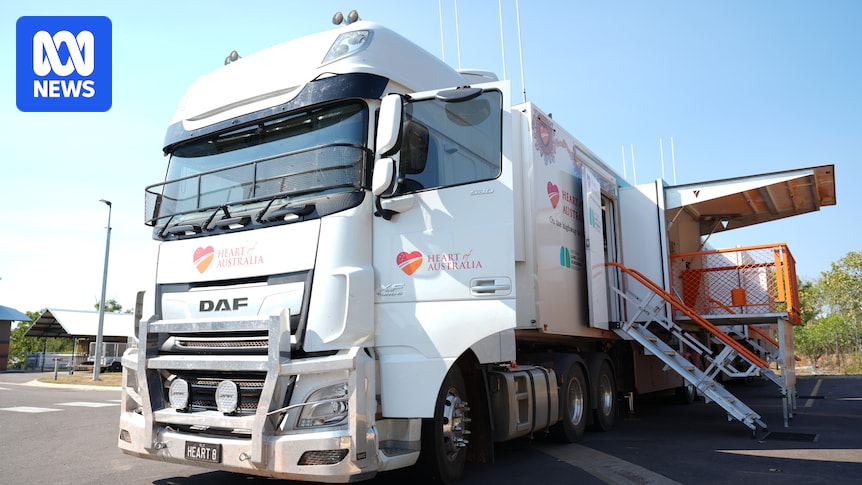
A road train-turned-clinic is travelling across outback Northern Territory to screen remote community residents for lung cancer, in an effort to quell the jurisdiction’s high mortality rates for the disease.
Last month, the Heart of Australia’s first NT lung cancer screening truck began its maiden voyage across the Territory, screening residents in 22 remote communities, aged 50 to 70, under the National Lung Cancer Screening Program.
The truck features a battery-powered computed tomography (CT) scanner onboard, which can take advanced x-rays of a patient’s lungs and identify any growths.
The battery-powered CT scanner onboard the Heart of Australia screening truck. (ABC News: Dane Hirst)
The mobile screening program has also started in Western Australia already, and is expected to begin rolling out in more states and territories later this year.
High lung cancer rates
This week the truck visited Jabiru, a remote town nestled in the famous Kakadu National Park.
The community is about a two-and-a-half-hour drive from Darwin and does not have access to lung cancer screening equipment.
Local Bininj woman Kia Gowler, whose work involves reducing smoking rates in the West Arnhem area, said smoking was everywhere in the region.
“Every child knows someone who has smoked and there’s at least one smoker in every household,” she said.
“Even in public areas where there’s no smoking [signs] there is smoking, it’s normalised.“
Kia Gowler says smoking is happening everywhere in West Arnhem Land. (ABC News: Dane Hirst)
The Northern Territory has the highest rate of lung cancer of any Australian jurisdiction and the highest mortality rate from the disease, according to the latest available data from the Australian Institute of Health and Welfare.
In the NT, the disease is also the most common cause of cancer death, and the Territory has the highest rates of lung cancer incidence and mortality in Aboriginal men.
Tobacco researcher David Thomas, from the Menzies School of Health Research, said the West Arnhem region was particularly impacted by smoking related-illness.
David Thomas says smoking rates are high in the NT, with Aboriginal people disproportionately represented in the figures. (ABC News)
“Smoking amongst Aboriginal people in the West Arnhem region is among the highest in the country,” he said.
“In the NT, more than 50 per cent of all Aboriginal adults smoke, which is much more than the 32 per cent of all Australian Aboriginal people.
“We know from different research, between a quarter and a third of all Aboriginal people will die early because of smoking.”
A computed tomography (CT) scan can capture detailed cross-sectional images of a patient’s lungs. (ABC News: Dane Hirst)
Ms Gowler said, without the screening bus, people in the West Arnhem region would have to travel to Darwin to access screening services.
“From Jabiru to Darwin [it’s] 255 kilometres, that’s if they’ve got a car or if they’ve got a referral to then be supported to get into Darwin. The bus only runs two to three days a week, ” she said.
“By the time you do the drive, you get into Darwin, then you’re waiting two to three hours, then you’ve got a long drive back — it can be pretty draining.
“Having the lung screening bus here helps mob so they don’t have to go into Darwin to do that — they don’t have to leave their country, their family, their home to do that.”
Peter Christophersen was one of the Jabiru residents who accessed the lung cancer screening truck this week. (ABC News: Dane Hirst)
Jabiru local and Bunitj man Peter Christophersen was one of the community residents who had his lungs scanned on the bus this week.
He said he hoped others would follow suit.
“I doubt if anyone would travel to Darwin to get it done, certainly I wouldn’t,” he said.
“A lot of blokes don’t get into Darwin, a lot of blokes won’t go see a doctor, here’s an opportunity.
“I’ve had cancer in the family before — not lung cancer — but having this service is a great opportunity to get in and keep your health up.”
Peter Christophersen says the mobile scanner’s accessibility in the community is a huge asset for those who would not travel to Darwin for health check-ups. (ABC News: Dane Hirst)
Battery-powered CT scans allow remote access
The Heart of Australia truck — called Heart 8 — is split into two carriages: the first a reception and waiting area, the second a consult room and CT scanning room.
Inside, it looks just like a clinic, albeit a little smaller.
Heart of Australia’s Deborah Guion said the truck’s unique build made it perfect for servicing remote communities, where power insecurity is a risk.
“It’s one of three trucks in the country that have a battery-powered CT onboard, which means we can go into those very remote communities,”
she said.
She said the Commonwealth-funded National Lung Cancer Screening Program would allow the team to visit communities multiple times a year, and that the initiative had already seen life-changing results.
Deborah Guion says the truck’s battery-powered CT scanner allows the service to reach people in remote communities. (ABC News: Dane Hirst)
“In Fitzroy Crossing in Western Australia, we had one participant who came onboard the truck — he was 52 years old and asymptomatic,” she said.
“He came through the screening and was diagnosed with a stage two cancer … [he] had surgery two weeks later.
“He returned to his community cancer-free, two months later.“