



Taxpayers would save $1 billion a year in health sector costs if Sydney residents had better access to shady tree canopy and nature, a new report has suggested.
The Sydney think tank Committee for Sydney is calling for a series of new greenways and tree plantings across the city to fight urban heat island effects, especially in areas mooted for greater housing density around train stations under the state government’s Transit Oriented Development (TOD) plans.
The healthcare savings estimate comes from a University of Sydney study that found people with more access to greater tree canopy were less likely to need to go to hospital for cardiovascular disease.
A previous report by the committee found heatwaves were costing Western Sydney $1.4 billion in productivity losses, health costs and household cooling costs.
Committee for Sydney research showed heatwaves were costing Western Sydney over a billion dollars. (ABC News: Berge Breiland)
Committee for Sydney policy lead Estelle Grech said these costs could be avoided with better-placed tree canopy, which she says will be needed especially as the city’s population grows.
“Billions of dollars are on the line if we don’t get this right,” Ms Grech said.
“That’s a cost to people’s health, their budgets, but also the state’s health budget.
“It’s really important because Sydney is growing. We need to build more housing, but we need to do it well.”
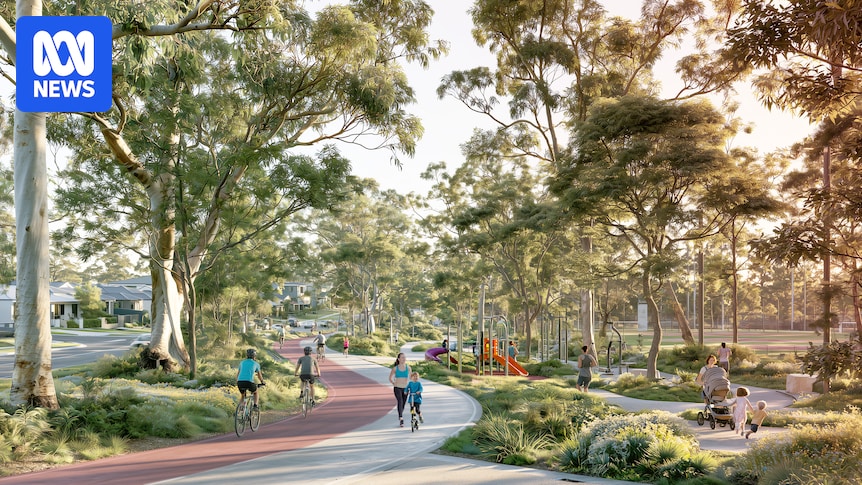
Part of the Prospect to Cooks River greenway would run alongside water pipes. (Supplied: Committee for Sydney)
The report, which describes putting canopy in with development as “breathable density”, also suggested there were mental health benefits to having easily accessible tree canopy nearby.
Sydney tree canopy unevenly spread
Greater Sydney’s tree canopy sits at 21.7 per cent, according to the most recent figures from 2022.
However, government data shows the canopy is unevenly spread across the city.
While areas near TOD-nominated precincts in Sydney’s north like Hornsby, Roseville and Lindfield have more than 30 per cent canopy access, train stations in the western suburbs such as St Mary’s and Lidcombe have less than 10 per cent canopy.
“We have good tree canopy in some parts of the city, I think the problem is that it’s not fair,”
Ms Grech said.
Recent government data shows tree canopy, in dark green, largely focused on Sydney’s north and the city’s urban fringes. (Supplied: NSW government)
“Where you live really determines whether you have access to a good public space, good tree canopy or access to water. Whether that’s like a beach or a lake.”
The 21.7 per cent figure is well short of a NSW government target of 40 per cent tree canopy cover by 2036.
Greenways present low-hanging fruit for more canopy
A recent University of Sydney study found while Sydney’s tree canopy was coming back, the opportunities for new planting were often limited by suitable land.
In the Committee for Sydney report, Ms Grech said the strongest opportunity for new planting would involve making a new series of greenways through Western Sydney using land owned by councils and Sydney Water.
One proposed route links Prospect Reservoir to the Cooks River, while another connects the Parramatta River to the Georges via Duck River and Salt Pan Creek through suburbs like Auburn, Yagoona and Bankstown.
The report proposed many greenways running alongside waterways and water infrastructure, including routes between Prospect Reservoir and the Cooks River, which is number 1 on the map. (Supplied: Committee for Sydney)
“It’s really [an] opportunity to use disused waterways that need some love, plant them out, increase tree canopy but also increase public space,” Ms Grech said.
Ms Grech described the plans as low-hanging fruit because the land was mostly publicly owned.
New committee to streamline green infrastructure
Last week the Minns Labor government established the Blue Green Grid Committee to bring together various agencies in charge of parkland and waterways to make sure the city’s green infrastructure was planned as a connected network.
On Wednesday, the government announced it would transfer 28 hectares of land along the Duck River Corridor to Cumberland City Council to become protected open space, some of which features in one of the greenway ideas pitched by the Committee for Sydney report.
“The challenge to provide more green space alongside more homes and jobs is one I take seriously and much of what is proposed lines up with the direction we are already taking,” NSW Planning Minister Paul Scully said.
“The Duck River Corridor transfer is a first practical step in that work transferring 28 hectares of land so that the area is treated as a whole, not a series of independent landholdings.
“As Sydney grows, it should grow greener, and that is exactly what this government is delivering.”
Earlier this year, the NSW government said it had awarded $35.1 million to 131 greening projects across Greater Sydney.