




On a cool morning along the esplanade of the sleepy bayside town of Toorbul, bird songs and squabbles fill the air.
Suddenly a more persistent sound can be heard amid the morning chorus at the shorebird sanctuary, about 60 kilometres north of Brisbane.
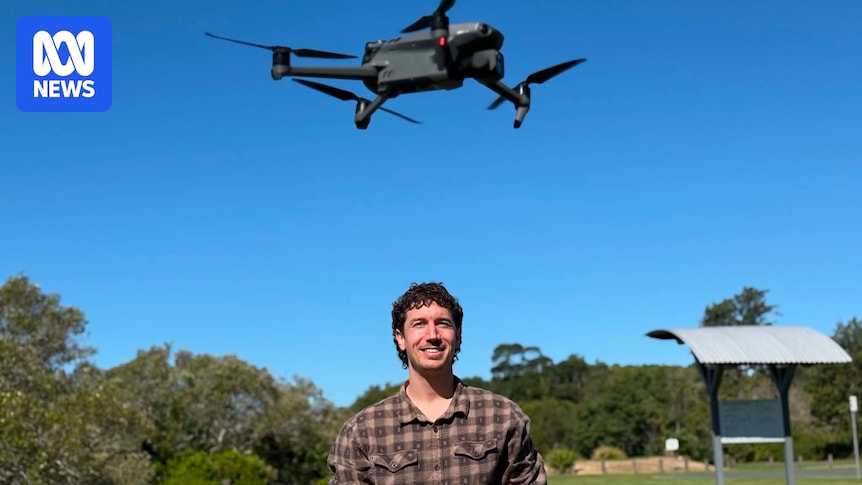
Researchers worked out the best altitude and distance to fly the drones to ensure the birds would not be disturbed. (ABC Sunshine Coast: Jessica Ross)
It is the whirr of a drone being launched by University of Queensland (UQ) researcher Joshua Wilson.
He knows exactly the right altitude and distance to operate without disturbing the shorebirds, which include critically endangered far eastern curlews enjoying a much-needed rest after flying 13,000 kilometres from Siberia.
“I used to work as an engineer designing drones, but I started to think more about what I valued and what I wanted to contribute my time to,” Dr Wilson said.
“For me, the biodiversity crisis is the most important thing.”
Far eastern curlews are now on the critically endangered list. (Supplied: BirdLife Australia)
As part of his PhD, Dr Wilson spent the past four years investigating the use of drones to survey bird populations, with artificial intelligence also helping cut out the legwork.
“Manually counting birds in drone imagery is extremely time-consuming,” he said.
“We found that using the computer vision tool that we developed, we could speed up the process by about 85 times.“
Dr Wilson said the technology meant experts could concentrate on conservation efforts.
“Rather than them spending time labelling birds in drone imagery or navigating really difficult to access sites, it frees up these experts so they can just leave a computer running overnight and spend their time on the more high-value work,” the researcher said.
Global problem needs global input
According to the Australian Wildlife Conservancy more than 200 Australian bird species and subspecies are listed as threatened with extinction under national environmental law, up from 134 in the mid-1990s.
BirdLife International estimates more than half of all bird species globally are in decline.
“This started out as a local project here in Moreton Bay and it’s supported by the Queensland Wader Study Group (QWSG) and The Moreton Bay Foundation,” Dr Wilson said.
“But I quickly realised that if we want to develop tools that can be used globally, we need to train them on images that are from a global context.“
He sent out emails around the world and 33 researchers from 11 countries responded, contributing to a dataset that now contains almost 50,000 birds from more than 100 species.
“We’ve got images of penguins from Antarctica, cormorants nesting in the treetops in Africa. We’ve got white storks on top of roofs of houses in Poland,” Dr Wilson said.
Drone surveys are particularly suited to waterbirds and shorebirds, with no tree canopy to obscure the aerial view. (ABC Sunshine Coast: Jessica Ross)
Richard Fuller from UQ’s School of the Environment said hard to reach locations often prevented effective population monitoring.
“Effective conservation depends on fast and scalable monitoring methods,” Professor Fuller said.
“This study lays the foundation for using AI to efficiently process drone bird survey imagery across vast and difficult landscapes.“
The dataset and AI model used are now freely available, with the hope researchers will continue to contribute images.
Loading…
Why count the numbers?
BirdLife Australia president Hugh Possingham said a global living planet index showed about a 2 per cent decline in birds all around the world, and Australia was “no better”.
Hugh Possingham says declining bird numbers should be a concern for Australians. (ABC News: Paul Adams)
“Sadly, we have lost around about 25 different bird species since the arrival of Europeans to Australia,” Professor Possingham said.
“Even common birds like the willy wagtail that many people used to see in their garden, they’re disappearing, their abundance is going down 2 or 3 per cent a year.”
Queensland’s former chief scientist said habitat destruction, invasive species like cats and foxes and climate change had all played a part.
“Recognising that, yes, waterbirds, shorebirds, they are in serious decline across Australia and secondly, testing interventions is absolutely critical and it requires extremely accurate data,” he said.
“We have a gigantic continent the size of the United States, but we have 20 times fewer people and 20 times fewer scientists.
“We really are at the forefront with tools like Josh has developed so that we can count our wildlife at scale.”
The Queensland Wader Study Group has been monitoring shorebird population numbers for almost 35 years.
QWSG chairperson David Edwards said drones had a use, but with a “caveat” that they should only be flown in a way that does not disturb certain species that are easily spooked.
David Edwards says the QWSG is pleased to assist with the research project. (Supplied)
“We deal with governments and governments like to have hard facts,” Mr Edwards said.
“If you don’t have those facts as a long-term dataset you’re not going to be able to rest your case for protection and further conservation of not only the birds but their habitat.”
He said it was “depressing” for bird watchers to notice decreases “even in our own back garden”.
“It always sounds a bit trite but you want your grandchildren to be able to see what you’ve seen,”
he said.