







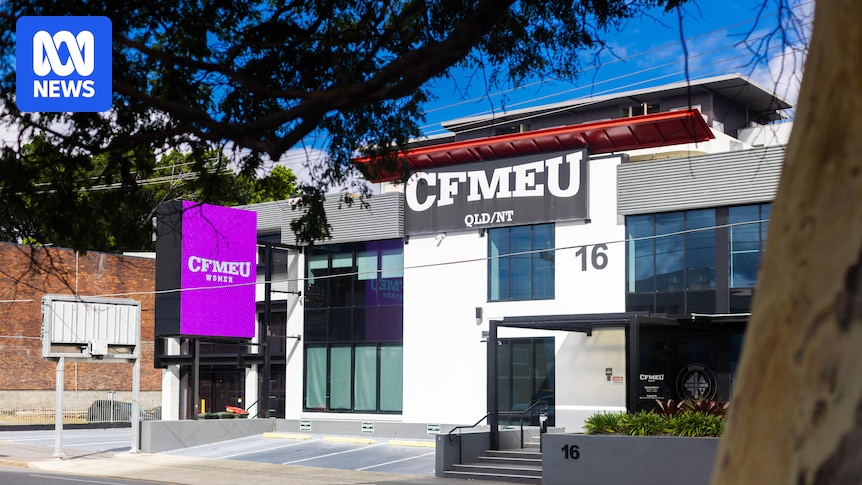
The CFMEU likely used organised crime-style methods to control the construction industry, renowned international criminologists have told a Queensland inquiry.
Professor Federico Varese and Professor Paolo Campana — two of the world’s foremost experts on organised crime from the Universities of Oxford and Cambridge — gave evidence on Thursday at the probe into alleged misconduct, corruption and financial irregularities within the union’s state branch.
Their collaborative research has helped shape international policy and law enforcement strategies.
Professor Varese is an expert on organised crime governance. (Supplied: University of Oxford)
The academics were asked to scrutinise material presented during proceedings and determine whether they believed the CFMEU operated as a so-called “governance organised crime group.”
Professor Varese told the inquiry the CFMEU’s conduct was consistent with “criminal governance”, in which a group uses fear and coercion to control a market.
He cited allegations of violence and intimidation by CFMEU officials and members on construction sites, as well as the illegitimate use of enterprise bargaining agreements.
“While this could be taken as single crimes or single unlawful behaviour, taken together … they paint a picture of an entity that tries to control a market and excludes competitors, be it a competing union or some contractors who do not hire workers from this union,” Professor Varese said.
Professor Varese also referenced previous testimony that a “memorandum of understanding” was allegedly signed between the CFMEU and a Queensland police “association” that prevented officers from intervening in industrial disputes, even when they became violent.
Professor Varese told the inquiry the union had the opportunity to establish itself as an organised crime group. (Supplied)
“This, if established, would be a very serious aspect that really goes to the heart of what criminal governance is,” Professor Varese said.
“Criminal governance operates within a context of existing lawful institutions, such as the police or the work and health entity, but these institutions leave the criminal organisation to govern the territory.”
“That is very significant, I think,” he said.
Professor Campana reached a similar conclusion, telling the inquiry the CFMEU’s alleged influence over the former state Labor government and Workplace Health and Safety demonstrated the CFMEU’s reach extended beyond worksites.
Both professors stressed they were assessing allegations provided to the inquiry and it would be up to the commission to determine whether the claims are true.
Paolo Campana is a professor at the University of Cambridge. (Supplied)
‘Destroyed financially’
Counsel assisting Andrew Meagher KC told Commissioner Stuart Wood KC the experts’ testimony could help inform his recommendations.
He said the commissioner had the power to propose changes to strengthen federal laws to target organisations engaging in organised crime-style conduct.
“It might all seem very obvious … there’s some corruption here, there’s some intimidation there … but … if it is capable of being recognised as a particular form of an operation, it can be effectively destroyed financially,” Mr Meagher said.
“And if wrongdoers cannot make money out of it, they will not do it.”
Hearings will resume next month.