



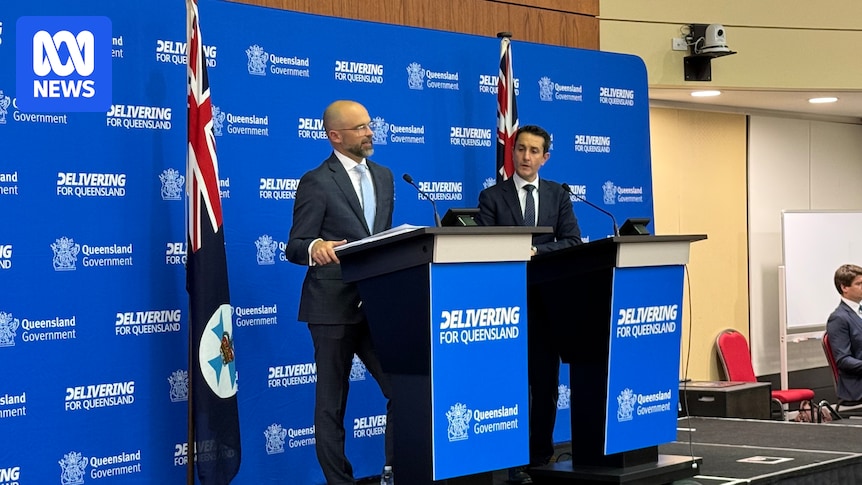
Queensland Treasurer David Janetzki has handed down his second state budget, with a focus on delivering “stability” during “global volatility [and] uncertainty in Canberra”.
While the government has spruiked its commitment to keeping down day-to-day costs in the long-term and a record spend on health, it has not been without criticism.
These are some of the key takeaways from the 2026-27 Queensland budget.
‘No sugar hits’
Premier David Crisafulli spruiked a $9.3 billion cost-of-living relief package in the budget as “not sugar hits” but “relief you can rely on”.
“It’s locked in for the long term and it’s our way of playing a small part in easing pressure in what are national cost-of-living pressures,” he said.
The sugar-free relief comes in the form of back-to-school vouchers, a bulk water freeze, an increase to the electricity rebate scheme for vulnerable households, sports vouchers and legislating 50-cent public transport fares.
However, Queensland Council of Social Service chief executive Aimee McVeigh said the government had failed to deliver.
Aimee McVeigh says the budget fails to deliver on the cost of living. (ABC News: Luke Bowden)
“There isn’t a cost of living or housing package that will make a difference to families now,” she said.
The vouchers to cover school expenses for primary school students have risen to $150, but Rockhampton father Callan Buchholz said across a year that would not go far.
“The cost of getting those things have probably gone up that much in the past year or two anyway,” he said.
Over the border, the New South Wales government, which also handed down its budget on Tuesday, gave motorists $100 off car registration, an $80 discount for motorbike registrations, and a weekly toll cap of $50.
When questioned why Queenslanders did not get something similar, Mr Janetzki said his budget included a “record continuing cost of living package”.
Shadow Treasurer Shannon Fentiman said Queensland had lost “the state of origin budget”.
“Queenslanders are not getting anything to help with the affordability crisis that Queenslanders are in the grip of right now,”
she said.
Ghosts of premiers past
Campbell Newman was infamous for his cuts to public service jobs. (ABC News: Christopher Gillette)
More than a decade on, the LNP is clearly still haunted by the ghost of former premier Campbell Newman and the more than 12,000 public service jobs his government cut between 2012 and 2014.
The treasurer and premier touted their commitment to the public service: 4,500 frontline jobs.
However, what it means for the staff on temporary, casual or contract work remains unclear.
Asked if the contracts due to finish in the new financial year would be renewed or assessed on a case-by-case basis, Mr Janetzki said: “It’ll mean contracts are honoured.”
The government has committed to creating 4,500 jobs for frontline workers like teachers and doctors. (ABC News: Keane Bourke)
Opposition leader Steven Miles said 37,000 staff on temporary contracts still did not know whether they would have a job come July 1.
“The government … have tried to hide behind that FTE figure, but that ignores individuals who are being affected by their program of cuts to temporary staff,” he said.
The recent Public Sector Commission’s State of the Sector report shows an increase of 8,693 full-time equivalent roles. According to the report, 91 per cent of public servants are engaged in frontline and frontline support roles.
Mr Janetzki said it proved “the silly scare campaign” was over.
Interest bill bigger than Olympic investment
Queensland’s interest bill is expected to exceed the cost of building for the 2032 Olympic and Paralympic Games. (Supplied)
Queensland’s total debt is forecast to hit $216.5 billion in the 2029-30 financial year.
While a big number, the treasurer said it would have reached $73.5 billion more under Labor.
With that debt comes an increase in interest repayments; in 2029-30, Queensland is expected to fork out $10.87 billion to cover the cost.
That is more than what the government plans to spend on infrastructure for the 2032 Olympic and Paralympic Games.
The state has committed to a $7.1 billion funding envelope with the Commonwealth for infrastructure for the Games.
Mr Crisafulli acknowledged that while delivering infrastructure for the Games was important, the government’s investment in the Bruce Highway — $9 billion with the Commonwealth on safety upgrades — was also greater.
The budget books are expected to stay in the red until 2029-30, when a surplus of $619 million is projected.
The last time Queensland’s budget was in the black was in 2023-24.
Record spend, but health investment falls short
The Australian Medical Association Queensland was left disappointed by the planned health spend. (ABC News: Lucas Hill)
The government has taken a “business as usual” approach when it comes to its investment in health care, according to the state’s peak medical body.
Mr Janetzki said the government was committed to restoring health services, with a record $35.5 billion health spend.
But Australian Medical Association Queensland president Erica Gannon said the 7.25 per cent increase on the previous year’s investment fell short.
“Doctors will be disappointed that the government’s spend on health this year has not kept pace with either demand or inflation,” she said.
Erica Gannon says more Queenslanders are struggling to access health care. (ABC News: Lottie Twyford)
She said it was also disappointing the government had not released its workforce plan, with an extra 6,000 doctors needed by 2032.
“Without a long-term plan we can’t attract and keep doctors in places and specialities where they’re needed,” she said.
Queensland under construction
The Queensland government has committed to an ambitious infrastructure spend. (ABC News: Luke Bowden)
As the premier puts it: “We’re building things again.”
The budget includes the government’s “largest ever infrastructure pipeline” as part of its $119.2 billion four-year capital program.
Funded projects include upgrades to roads, hospitals, dams, railways and a regional courthouse.
Housing is a big-ticket item with $1.024 billion allocated for 53,500 social and community homes to be built by 2044 and $1 billion for round two of the Residential Activation Fund.
And there is plenty of building to be done for the 2032 Olympic and Paralympic Games.
Master Builders deputy CEO Michael Hopkins welcomed the investment.
“The treasurer has echoed our own language, committing to ‘pull every lever to boost productivity’ while ensuring safety and quality,” Mr Hopkins said.
“It highlights prioritising and coordinating infrastructure projects, and reforming procurement, land use, and building activity regulation, to deliver projects on time and on budget.”
Mr Miles pointed out projects that had been delayed, including further stages to the Coomera connector and upgrades to the Mount Crosby interchange.
He noted $4.9 billion had been deferred from forward estimates.
However, the treasurer was not worried about blowouts.
“That 1.3 per cent [productivity] increase at the back end of 2025 does show that the abolition of BPICs [Best Practice Industry Conditions] and a culture of productivity is delivering those projects,” he said.