



Andy Burnham, the British MP tipped to replace outgoing prime minister Sir Keir Starmer, promised “radical change” to the nation’s “broken” political system as he laid out some of his policy vision on Monday.
The former minister, who returned to national politics via a by-election earlier this month, told a room of supporters in Manchester he would hand more power to local councils, raise living standards and ramp up construction of affordable housing.
Mr Burnham, who most recently served as UK Labour’s Mayor of Greater Manchester, said he would create a “Number 10 North”, so that policy direction was not purely set from the PM’s office at 10 Downing Street in central London.
“Number 10 North will be the nerve centre of a rewired Britain,” Mr Burnham, 56, said. “It will be the conduit through which we redistribute power and resources across the UK.”
He said if he were PM, he would embark on “the biggest rebalancing of power [the UK] has seen”.
“Westminster hasn’t been working for people, and it hasn’t working for a very long time. In fact, it is broken,” Mr Burnham said, in reference to the London borough where most government departments are based.
“The country isn’t where it should be. It is stuck in a rut, and clearly we can’t go on like this.”
Mr Burnham is currently the only declared candidate to take over from Sir Keir and, if no challengers emerge, he could become prime minister by the middle of July.
Sir Keir won an election less than two years ago, but announced his resignation last Monday amid plummeting polling and enormous pressure from colleagues.
His leadership had been plagued by a series of missteps and scandals. For many MPs and analysts, Labour’s disastrous local election results last month were the final straw for Sir Keir’s leadership.
During his speech, Mr Burnham said he had a 10-year plan to raise living standards by supporting the regions to reform essential utilities, reindustrialise, and regenerate cities and towns that had been neglected.
He said he wanted to take what worked in Greater Manchester, now a major engine of UK economic growth, and apply it elsewhere.
The PM-in-waiting also pledged to help young people find jobs and improve access to state-subsidised housing, where there can be long-waiting lists in many parts of the country.
“Britain’s housing crisis is having a ruinous impact on its public finances, so, working with local areas, Number 10 North will oversee the biggest council house building programme since the post-war period,” he said.
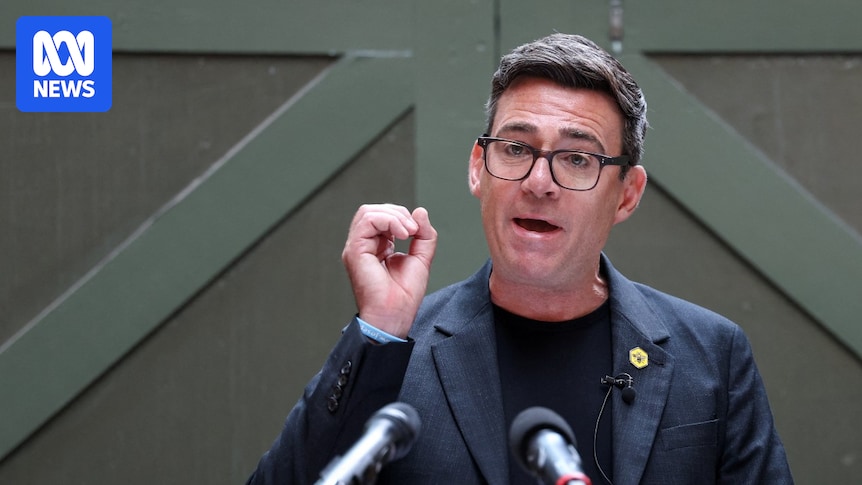
Andy Burnham gave his speech at the People’s History Museum in Manchester. (Reuters: Temilade Adelaja)
Mr Burnham’s speech confirmed economic policy priorities that many expected, but it did not touch at all on other high-profile domestic issues such as health or immigration.
It also did not include details of his foreign policy platform, or national security plans.
Mr Burnham did not take questions from journalists at Monday’s event, which was held at the People’s History Museum.
His team insists he is not avoiding scrutiny, and that he will engage with the media in the future.
Tim Bale, a professor of politics at Queen Mary University of London, told the ABC the speech was designed to give “the impression that this was going to be a big reset for British politics and economic policy in particular”.
He said he thought Mr Burnham’s promises of devolution of power and building more council houses were important, but he thought the speech was “missing a great deal of detail”.
“It was really a broad-brush kind of a speech, there were no figures in there at all. He’s not promising to spend X million or X billion on this or that,” Professor Bale said.
“It was very much a speech giving, if you like, a sense of direction and a sense of energy rather than a spreadsheet kind of speech.”
Opposition parties were quick to criticise Mr Burnham’s vision.
“He doesn’t have a plan beyond telling the mayors to go and sort it out,” Kemi Badenoch, the country’s Opposition Leader from the Conservative Party, said in a separate speech earlier on Monday.
“If he wants to be the leader of our country, it’s time to start acting like it.”
Richard Tice, an MP for the populist, right-wing Reform UK party, described the speech as more evidence of “Burnham’s coup”, referring to the fact the new MP would likely become Britain’s prime minister by default.
“We need a general election,” he wrote on social media.
If Mr Burnham takes office, as expected, he will become Britain’s seventh prime minister in a decade.
He is a former long-time MP, and has previously served as a minister in Gordon Brown’s government, but retired from national politics in 2017 to become the Mayor of Greater Manchester.