







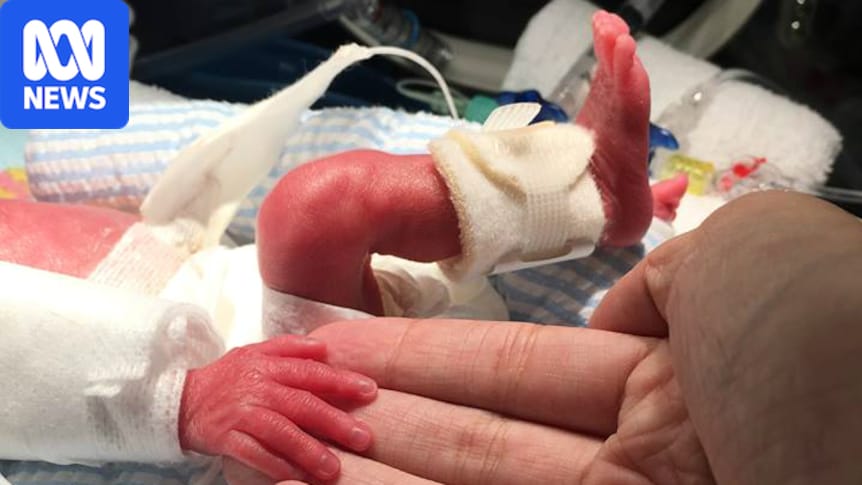
For babies born way too early, the challenges are huge. Their lungs are not well developed, their skin is very fragile and they are far from ready to face the outside world.
A research project at the Women and Infants Research Foundation (WIRF), located at Perth’s King Edward Memorial Hospital for Women, is working on trying to help those babies through building an artificial placenta.
The technology would allow babies to keep getting nutrients and oxygen in the same way they would in the uterus, essentially allowing them to grow and develop further before they have to face the challenges of eating and breathing for themselves.
WIRF chief scientist Professor Matt Kemp is leading the research.
He told Jo Trilling on 102.5 ABC Radio Perth that the biggest challenges were for babies born extremely early, at 22 or 23 weeks.
“These are extremely small, underdeveloped babies,”
he said.
“More often than not, they’re born early because there’s something wrong with the pregnancy as well.
“There’s been an infection, there’s something perhaps not working quite as well with the placenta.
“So not only are they immature, they’re also sick quite often, and it’s a real challenge to treat these babies.”
‘A bridge out of the uterus’
To offer them a better chance at achieving the growth and maturity they didn’t get a chance to do before birth, Professor Kemp and the team at WIRF have come up with the artificial placenta.
“This artificial placenta technology that we’re conceptualising and building is a way of trying to give these babies another three or four weeks perhaps to grow and develop in an environment that’s not dissimilar [to the uterus],” he said.
“It’s not the same, but it’s not dissimilar to where they’ve come from, and it will allow them to bridge across into living outside of the uterus, breathing room air.”
A human placenta after birth. (ABC News: Lauren Day)
The placenta, which grows alongside a fetus in the uterus, is a developing baby’s complete life-support system, providing both nutrients and gas exchange and is joined to the baby via the umbilical cord.
The artificial placenta, currently being trialled in sheep, is also hooked up via the belly button, but otherwise looks nothing like a placenta.
“It’s two small, clear perspex blocks about the size of a Rubik’s Cube connected to a bunch of catheters and hosing,” Prof Kemp said.
“It is essentially a miniaturized gas exchange device.
“But the remarkable thing about the system that we’ve developed is that the system’s powered by the fetus itself — the fetal heart drives the system. It’s not powered by an external pump or pressure source, and that makes it really responsive to the needs of that fetus.”
A tiny baby in the NICU of King Edward Memorial Hospital. (ABC News: Natalie Jones)
Learning more about a complex organ
The research project is not only working towards use in humans one day, it is also teaching the researchers a lot more about how placentas work.
“What we hope it’s going to do is two things. One, for this proportion of very, very small babies born right at the border of viability, where survival is poor and long-term outcomes are also not that great, is offer a bridge to better survival outcomes, and a better chance at a long and healthy life,” he said.
“The other thing I think that’s really important about this technology is it’s also a bio-discovery tool.
“What it allows us to do is to study all of these really complex inputs that are coming from the maternal compartment, from the placenta, that we otherwise can’t unpack.
“That’s really important, and has broad impact, because we know that preterm babies, depending on how preterm they’re born, have differences in growth to term babies.
“We can use this technology to get a handle on what should be coming from the mother and the placenta to help optimise growth.”
Professor Matt Kemp, pictured in the lab at the research foundation, says artificial placentas are still years away. (Supplied: Woman and Infants Research Foundation)
Outcome still years away
Artificial placentas won’t be coming to a NICU anytime soon though, Professor Kemp estimates that will be at least 10 to 15 years away.
Part of the challenge is that the more they continue to work on their technology, the more problems they find they need to solve.
“A good example of this is we’ve managed to solve some of the cardiac-related problems of the circuits.
“The circuits essentially had too much resistance, too much work for the fetal heart.
“We managed to solve that problem, and in doing that, we’ve then found that actually we need some of the growth factors that the placenta is producing to make sure these fetuses grow normally over a very long period of time.
“Each success really unlocks another challenge.“
102.5 ABC Radio Perth Afternoons is currently supporting the WIRF Baby Bundles program, asking the community to help provide essential items to mothers and babies in crisis situations. Find out how you can help here: Knitting for Newborns