




Thousands of cattle stranded for four months by floodwater are “living the dream” on their very own island in outback South Australia.
At Cowarie Station, 250 kilometres north of Marree, around 4,000 of Sharon Oldfield’s cattle have been isolated since February by record-breaking rain and flooding.
“The main channel is still full [of water] and the flood plain still has a lot of water on it, so we can’t actually get around,” Ms Oldfield said.
“It’s not surrounded [by water], but it’s the main channel, so we can’t cross [it]… then when you get to the other side there’s water as well and it’s soft and boggy.”
Cowarie Station has been largely underwater since February, and Sharon Oldfield expects it to remain relatively inaccessible until September. (Supplied: Sharon Oldfield)
Roughly half the property is cut off, with no change expected until around September.
This is not the first time Cowarie cattle have only been accessible by chopper, but this time around it has been “prolonged”.
“The channel has been up and down several times,” Ms Oldfield said.
“It filled from local rain, and then … from the floodwaters in Queensland through the Diamantina and the Georgina, then the Georgina had another rise, and then the Diamantina had another two rises, and then we had more rain. So it’s just kept it full.”
It means the cattle cannot be transported, but they do not seem to mind.
While some outback roads have reopened, many pastoralists are unable to muster and transport their cattle. (ABC Rural: Isabella Kelly)
“We’ve been checking on them by air, and they’re all fine,” Ms Oldfield said.
“Just living the dream out there at the moment.
“Challenges when you’re in the middle of a good season are always easier to deal with than challenges in the middle of a drought.“
Meanwhile, the neighbouring station has had to take their stock the long way around.
“They’ve been walking cattle over 100km to try and get them to a spot where they can actually put them on a transport,” Ms Oldfield said.
Hide and ‘sheep’
In South Australia’s far east, Quondong Station is home to thousands of sheep – allegedly.
“We don’t know where they are or what they’re doing, because they don’t need to come into the troughs for water,”
Quandong’s MaryLou Bishop said.
With 147,710 hectares of land, much of which remains underwater, a ground search was not going to cut it.
Replacing fences is one of the top things on Quandong Station’s to-do list as water recedes. (Supplied: Facebook/Quandong Station)
So, they brought in the big guns: thermal drone operators.
With an employment history stretching from dentistry to the military, couple Tony Eldridge and Colleen O’Callaghan now run a travelling security company utilising technology like drones.
Using their wheelhouse to assess flood damage at places like Quondong Station was a natural progression.
Tony Eldridge and Colleen O’Callaghan say they are living the dream, having retired from dentistry to run their security business. (Supplied: Tony Eldridge )
“We’ve been looking at areas that are flooded, making assessments of what’s impassable, how long will it be possibly before they dry out and vehicles can get down them, what are the fence conditions and the status in those flooded areas like?” Mr Eldridge said.
“The other thing we’ve been doing is having a look at stock numbers within each of the paddocks, bearing in mind these paddocks are huge.”
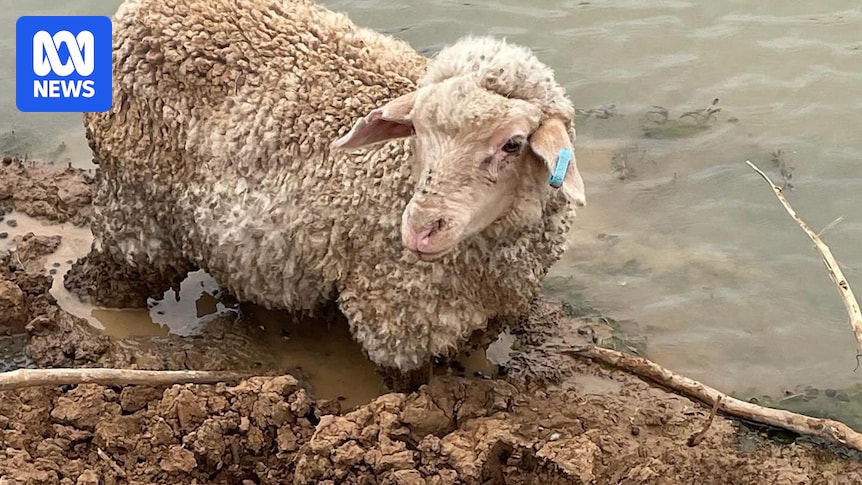
The insulation merino wool provides means some sheep hardly show up on the thermal camera.
While the wool on some merino sheep can make them hard to see on the thermal imaging drone, these ones turned up just fine. (Supplied: Tony Eldridge )
“It takes quite a bit of time to crisscross even by air to look for a flock of sheep and try to find out how many are in each mob … are there any lambs in those mobs as well, how many, and how old are they?”
Mr Eldridge said.
The couple are still camping out on Quondong Station, but they have already managed to track down “a number of mobs”.
“It probably takes a solid day for one paddock to crisscross properly,” Mr Eldridge said.
“Then one of the issues we have is some of the fences have been damaged, so where they are one day, they’re not the next.
Drones have tracked down some sheep on the station. (Supplied: Tony Eldridge)
“It would be near impossible on a property this big to get an absolute 100 per cent clarification of exact numbers.
“The area is just so green, there is so much feed, they have split up and gone in all sorts of directions because they’ve just got so much choice.“
Green fields and lambs
Ms Bishop recently returned to the station for the first time in four months, after road closures made it inaccessible.
What she found was a stark difference to the station she had left on January 31.
“We had sold almost 2,000 wethers in January because we were running out of water, and now we have so much water it is unbelievable,”
Ms Bishop said.
“Back in January we were shearing and it was 50 degrees, and I thought ‘we are mad’.
MaryLou Bishop and her husband Joe Verco, who bought the station in 2003. (Supplied: Quondong Station)
“But thank god we did because two weeks later, if we had delayed it until February or March or April, we wouldn’t be shearing. We wouldn’t be able to get to our stock.
“It’s far better that we survived that horrific heat rather than, they would all drown with a full year’s wool on them.”
For the first time in a long time, the livestock on Quandong Station do not need to return to food and water troughs to survive. (Supplied: Facebook/Quandong Station)
No matter how many new challenges the rain presents, you will not hear any complaints from Quondong Station, where all five of the station’s 300,000-litre holding tanks are full.
“It is spectacular. It is English green,” Ms Bishop said.
Loading…
It is the same story up north at Cowarie.
“It is an absolute delight to see the country at the moment,” Ms Oldfield said.
“I’ve certainly never seen it any better than it is now … it’s just an absolute picture to behold.”