





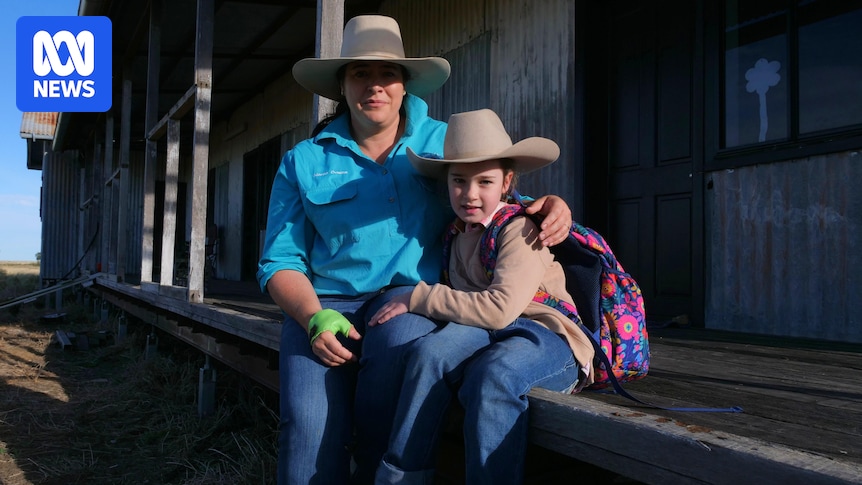
Every school day, seven-year-old Vivien Fitzgerald heads to school on a remote cattle station.
In between mustering, branding, fencing, water-point checking, weed management and housework, her mother or father joins her as her very own “home tutor”.
But parents are now doing it without the information distance education families have used for decades to support their kids in the remote classroom.
“Her English today has been cancelled because the teacher has got other commitments in the school, or might be away,” mother Ellen Fitzgerald said.
“But because that’s only taught online, I don’t have a framework for what to teach her during that period of time.“
Every day, Ms Fitzgerald and her husband Mick balance the education of their daughter with the reality of working a 24,000-hectare cattle station between Winton and Muttaburra.
Vivien Fitzgerald’s favourite subject is science, but she also excels at mathematics. (ABC Rural: Crispian Yeomans)
“Schools of the air” were built across Australia so that every child could have a good education, no matter how remote their home.
But in Queensland, the lesson plan-style resources, known as “correspondence” or “papers”, are being phased out.
Falling behind city peers
Unlike homeschooling, schools of the air involve qualified teachers delivering online lessons to remote classrooms of students who live hundreds of kilometres apart.
When students cannot make online lessons, families can use a printable booklet of step-by-step instructions — independent learning materials (ILM) — to catch students up.
The new materials “are not created for every lesson”. (ABC Rural: Crispian Yeomans)
Ms Fitzgerald said the substitute lessons were “essential” because they gave her flexibility to provide correct, curriculum-aligned instructions at any time during the day.
“We could actually say, ‘We can’t get to that on-air [lesson], we’ll be in the paddock, so you can do your maths lesson in the paddock,'” she said.
“‘This is what we need to learn, these are the activities, these are the materials you need, these are the writing sheets you need — everything you would bundle up.’“
Families will usually print the digital documents as booklets so lessons can be held anywhere on a property, from the shearing sheds to the stockyards.
But Ms Fitzgerald said her daughter was now online for longer.
“Her time spent on air has more than doubled and it’s a lot to ask a little person to sit on a screen and learn in a lecture style,” she said.
Muttaburra grazier Winnie Batt, who has had three of her children enrolled in distance education so far, said the materials were necessary when something went awry.
Winnie Batt says she used the old materials daily to organise her multi-child classroom. (ABC Rural: Crispian Yeomans)
“[That might be] on days when the power goes out, on days when you don’t have stable internet, on days when you need to go mustering, on days when someone in the family has a major medical appointment [and] we have to go away together,” Ms Batt said.
She said the documents were fully scripted, lesson-by-lesson instructions that meant anyone could pick them up to teach the daily curriculum.
“All the different scenarios that are our reality out here don’t fit in to the full-time, on-air structure,”
she said.
“Without ILMs, it takes away our choice to be flexible.”
A new way to learn remotely
Under the roll-out of Version 9 of the Australian curriculum, the Queensland Education Department has slowly been phasing out ILMs.
A department spokesperson said families were instead receiving new curriculum support materials, with a “full set” to be completed by the start of 2027.
Parents are worried the changes will force children online for six hours a day. (ABC Rural: Crispian Yeomans)
But Ms Fitzgerald said the new support materials were nothing like the old ones.
She said a document provided to parents, and seen by the ABC, said the new materials were “not created for every lesson, in every sequence, in every unit”.
For example, the new Year 1 English unit will have eight curriculum support materials — but ILMs had as many as 32 lessons.
When asked about this difference in scope, state Education Minister John-Paul Langbroek said he would work with remote families.
“We’ve established a formal working group to make sure that the materials meet the needs of geographically isolated students and their home tutors,” he said.
“But we’ll take a note of the numerical contrast, if [they] were 32 and they’re now eight and people feel like they’re drowning in a lack of knowledge.“
Mr Langbroek said paper-based materials were important “back-ups” during internet black-outs, but online learning needed to “adapt and evolve”.
He said there are 16,000 students currently enrolled in state-run distance education in Queensland, including 745 who are geographically isolated, a “significant number”.
Ms Fitzgerald said the new materials needed big changes.
“Regardless of what the department wants to call it, at the end of the day, we need to know what to teach our kids,” she said.