







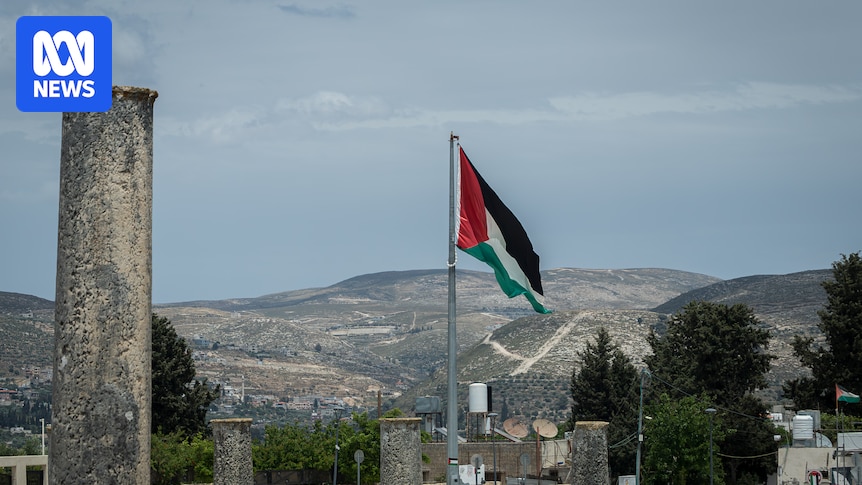
Walk through Sebastia today and the layers of history are visible everywhere.
The West Bank town sits alongside an ancient mound whose stones have been shaped by the Israelite Kingdom, the Greeks, the Romans, the Byzantines, the Crusaders and the Ottomans. Beneath them, tradition holds, lies the tomb of Saint John the Baptist.
The Palestinian families who live here today can trace their own roots in this place back hundreds of years.
It is, says Talya Ezrahi of the Israeli heritage advocacy group Emek Shaveh, “a wonderful example of historical continuity”.
Which is precisely why it has become a target.
Last November, the Israeli Civil Administration issued an expropriation order covering 1,800 dunams — nearly 450 acres — of privately owned land around the Sebastia archaeological site.
It is the largest antiquities-related land seizure in the West Bank since Israel’s occupation began in 1967.
The Sebastia order encompasses not just the ancient site — already on UNESCO’s tentative World Heritage list — but thousands of privately owned olive trees and 550 private plots of land belonging to residents of Sebastia and the nearby village of Burqa.
A new road is planned to redirect tourism through a settler-controlled route, effectively handing the economic benefits of the site to Israeli settlement communities.
“What Israel is planning to do is to separate the archaeological mound from the town of Sebastia,” Ezrahi says.
“Their livelihood is based on tourism. And in fact, it also includes a large number of their olive trees. It will have an absolutely devastating effect on the Palestinian town.”
A joint statement by Prime Minister Benjamin Netanyahu and a number of his ministers on May 21 announced a NIS 250 million ($122.3 million) plan to develop heritage sites across the West Bank.
It described the plan as part of “a revolution in Judea and Samaria”, which is the Israeli name for the West Bank, under which the government has “approved over a hundred new settlements, tens of thousands of housing units, and no less than 160 new farms”.
Netanyahu described the plan in explicitly territorial terms: “Today we are investing in the preservation of our past to secure our future, strengthen our hold on the Land of Israel and pass on to future generations the heritage, identity and historical truth of our people.”
What the statement does not mention is that those sites sit on land that is, under international law, occupied territory — and that the Palestinian families who live beside them, like the people of Sebastia, are still there.
Israel’s plans will take away ‘economic opportunities’
Sebastia’s tour guides, souvenir sellers and restaurant owners once built their livelihoods around the steady flow of visitors drawn to one of the most historically layered sites in the Middle East.
Today, its shops are shuttered. Its streets are quiet. And the land that surrounds those Roman columns — olive groves that families have tended for generations — is under a confiscation order by Israel.
“More than 30 families work in tourism,” says Mohammad Azam, the Mayor of Sebastia.
“They do not have work today. When we say 30 families, we are talking about 300 people who do not have food, and whose economy is not secured.”
What has happened in Sebastia is, in miniature, what is happening across the occupied West Bank — from land seizures justified on heritage grounds to constraints on the banking system, as well as the withholding of funds to the Palestinian Authority.
It is a deliberate, multi-layered economic strangulation that has been squeezing Palestinians from almost every direction at once, and at an accelerating pace.
The images of settler violence and land seizures may be a more conspicuous sign of this process.
For tour guide Zaid Azhari, the personal stakes could not be more concrete.
“If the Israelis take the area, my family will lose all their olive and apricot trees,” she says. “One of the main sources of income for people and villagers of Sebastia is the olive groves. If they take it from them, they take their economic opportunities.“
Ezrahi, whose organisation monitors the use of archaeology and antiquities across the West Bank and East Jerusalem, says what is happening at Sebastia is not an isolated act but the application of a deliberate and long-developing government policy.
“What we’ve been seeing in the past two decades, and particularly with the present government, is that archaeology has become a tool, a mechanism, to justify settlement and justify the displacement of Palestinians all across the West Bank,” she says.
“The idea that the Jews are the rightful owners of the land — and therefore Jewish settlement is basically a return of Jews to their rightful homeland — is being used as part of a government policy to replace the Palestinians with Jews.”
The current minister of heritage, Amihai Eliyahu, belongs to Itamar Ben-Gvir’s Jewish Power party. Under his watch, Ezrahi says, the language of archaeology has been deliberately shifted — from “antiquities” to “heritage” — in ways that carry profound consequences for how these sites are interpreted and who benefits from them.
“Heritage is basically the stories, the myths that we attach to antiquities,” she says.
“And it’s very powerful — it can become a tool for propaganda. What we are seeing now is that heritage is being used to justify settlements, to justify the expansion of Jewish life all over the West Bank, and to ultimately justify annexation.”
The pattern at Sebastia is familiar from other sites, Ezrahi says. Right-wing campaigns focus exclusively on the Israelite Kingdom layers from the 9th and 8th century BCE, filtering out everything else — the Greek columns, the Roman temple, the Byzantine church, the Ottoman Mosque — as irrelevant to the story they wish to tell.
“We’ve seen this with the City of David in Jerusalem,” she says.
“The site may be excavated according to scientific standards, but when it comes to telling the story to visitors, we go into tunnel vision. One overarching story.
“And this overarching story connects the past to the present in a way that is a lot closer to propaganda than to telling the story of a varied and multi-layered diverse archaeological site.”
Sebastia is by far the largest archeological area to be claimed but the strategy has been used in many other places.
For example, the area known as the City of David in East Jerusalem.
While the Israel Antiquities Authority conducts digs at the site, the management of the national park was handed over to an Israeli settler organisation, Elad, which explicitly defines its mission as excavating the ancient City of David and to establish a Jewish presence in the surrounding area.
But it was not on an empty site. It sits on top of, underneath and alongside a densely populated sector of a Palestinian neighbourhood.
Extensive subterranean excavations have caused structural damage. There have been targeted laws that allow land owned by Jews prior to 1948 to be reclaimed — a right not granted to Palestinians who fled or were forced from homes in what became Israel.
Groups like Emek Shaveh point out that the tourism experience focuses almost exclusively on the biblical King David narrative, largely ignoring or minimising centuries of subsequent Byzantine, Islamic, Ottoman, and modern Palestinian history.
There have been other seizures at Herodium, inside Hebron and in Tel Shiloh.
The pattern of what happens is now reasonably well established.
Once the site passes into settler management — whether through a regional council or a private settler organisation — Ezrahi says the practical consequences for the Palestinian town of Sebastia will be severe.
Judging by comparable sites, she expects a permanent military presence, tightening restrictions on movement, and the effective clamping down of normal life inside the village.
“Apart from the fact that they are losing their cultural heritage and their livelihood, it will bring the occupation into the town itself,” she says.
The use of archaeological heritage as a mechanism for land acquisition follows a pattern that Haaretz columnist Moshe Gilad has described bluntly:
“Israeli politicians see archaeology as a way to prove Jews own this land.”
The impact on the Palestinian economy
To understand the full scale of what is being done more broadly to the Palestinian economy, it helps to sit across from Estephan Salameh, the Palestinian minister of finance and planning.
“For 12 consecutive months, Israel has not transferred a single dollar or shekel of our tax revenues,” he says.
Under the Paris Protocol — the bilateral economic agreement that has governed Palestinian finances since the Oslo era — Israel collects customs and trade taxes on Palestinian imports on behalf of the Palestinian Authority (PA) and is obligated to transfer them monthly. Those clearance revenues constitute approximately 70 per cent of the PA’s total income.
For the past year, not a single transfer has been made.
“No government in the world can survive without 70 per cent of its own revenues,” Salameh says.
“The remaining 30 per cent — most of it goes towards servicing the debt. Which means, to make it simple, we have been functioning on 10 per cent of our total revenues.
“The normal scenario is for the Palestinian Authority to collapse. The abnormal scenario is the fact that we are still around.”
The consequence for ordinary Palestinians has been direct and brutal. Teachers, nurses, engineers and other public sector workers — around 150,000 people — have had their salaries cut to roughly 50 per cent.
According to the World Bank’s May 2026 economic update, the PA’s fiscal deficit stood at 7.7 per cent of GDP in 2025 — nearly double its pre-conflict level — with arrears to public employees alone reaching $2.85 billion.
Before October 7, the Palestinian economy rested on several interconnected income streams, Salameh says.
About 150,000 Palestinians held work permits to labour in Israel and Israeli settlements, collectively bringing in around 20 billion shekels a year — money that flowed back into West Bank shops, markets and businesses.
Palestinian citizens of Israel spent a further 6 billion shekels annually in Palestinian towns. And the Palestinian Authority paid full salaries — around 12 billion shekels a year — into the local economy.
Since October 7, the work permits have been cancelled and Palestinian labourers can no longer enter Israel.
The ripple effects through the private sector have been severe and the numbers bear this out.
West Bank unemployment surged and Palestinian workers, many of them in construction, have been replaced by foreign workers, tens of thousands of them from India.
In Israeli settlements and their adjacent industrial zones, Palestinians have been allowed to return to work, bringing some respite to households while, at the same time, strengthening the Israeli settlement project’s grip on the occupied territory.
“Our economy is losing 1 billion dollars every month,” Salameh says. “For a small economy like Palestine, this is huge.”
Layered on top of the financial squeeze are the physical barriers.
Hundreds of military checkpoints and barriers now operate across the West Bank — a number that has grown significantly since October 7.
These roadblocks imposed by Israel often create major traffic jams and have increased the cost of local transport.
But they do not only prevent the flow of goods and people inside the West Bank, they also physically block Palestinian citizens of Israel from entering.
They would previously come to the West Bank — especially on the weekends — and spend their money in markets, restaurants and various services ranging from car mechanics, to dentists in the West Bank towns that are known for offering their competitive prices.
“The access and movement for goods and people is becoming more and more impossible,” Salameh says.
Limits on accessing cash
Perhaps the least visible — but most crippling — mechanism is the assault on the Palestinian banking system.
The Palestinian economy operates in Israeli shekels.
Palestinian banks can only transfer excess cash — physical shekel notes — back to Israeli banks, where it is converted into electronic currency that can actually be used for trade and transactions.
But Israel imposes a strict annual quota on how much cash Palestinian banks can ship: 18 billion shekels, against an actual need of around 35 billion.
The result: at any given time, roughly 15 billion shekels in physical cash sits in locked rooms in Palestinian bank vaults, completely unusable.
“That cash means nothing if you cannot translate it into e-money,” Salameh says. “In order to translate it into e-money, we have to ship it to them. So we have billions of shekels sitting in rooms that we simply cannot use.”
There is a further lever of control. Palestinian banks rely on a correspondent banking agreement with Israeli banks — essentially a licence to connect with the global financial system. Israel renews this agreement on increasingly short notice, sometimes just weeks, keeping Palestinian financial institutions in a state of perpetual uncertainty.
“They keep us on our toes,” Salameh says. “Whether to renew it or not. If they block this correspondent agreement, they will paralyse the Palestinian economy completely, which means we can no longer import water, electricity, food, fuel.”
The World Bank confirms the picture Salameh describes.
The escalating debt of the Palestinian Authority as a result of Israel’s refusal to pay the revenue it owes has also put additional strains on the banking system.
Israel has given a range of arguments for why it is withholding the funds as it has gradually reduced the amount over the past six years — before cutting the payments off altogether last year.
This has included deducting what it says is an amount equivalent to money the PA pays to families of Palestinian security prisoners and those who have been killed, which it says is equivalent to paying people for conducting terrorist acts.
It then further reduced the payments by an amount equivalent to the Gaza Strip’s share of the PA budget after October 7, 2023, a budget that had paid the PA’s Gaza staff, social payments, and payments for electricity and water supplied to the strip.
And there have been more reductions that Israel says are used to compensate IDF soldiers, as well as settlers, who have been killed by Palestinian terrorist acts.
The PA’s total public debt had reached $4.8 billion by December 2025, with $3.3 billion of that borrowed directly from the domestic banking sector.
Combined with lending to public employees, the banking system’s total exposure to the public sector stands at roughly $5.3 billion — equivalent to 42 per cent of all banking credit in the Palestinian territories.
The World Bank warns this creates a dangerous feedback loop in which fiscal collapse and banking collapse could become mutually reinforcing.
A collapse of the PA
Writing recently for the right-wing Israeli religious news site Besheva, commentator Hagit Rosenbaum described the strategy being implemented by Finance Minister Bezalel Smotrich as a “pincer movement” aimed at “collapsing the Palestinian Authority”.
Rosenbaum listed the results with apparent satisfaction: Palestinian schools no longer fully functioning, engineers on strike, “economic erosion creating chaos in the Palestinian street”.
She noted two desired outcomes — either “chaos and rebellion against [PA] leadership” or “widespread public dissatisfaction and a trend of emigration from the West Bank”.
That final phrase — emigration from the West Bank — aligns with what Smotrich outlined in his 2017 “Decisive Plan”, which envisaged making life so difficult for Palestinians that they would choose to leave.
Salameh is under no illusions about what is being attempted.
“Everything I have told you is leading us to think there is a policy: one, to kill the Palestinian Authority; two, to kill the two-state solution; three, to eliminate any possibility for the creation of a Palestinian state,” he says.
The economic pressure is being accompanied by a legal transformation that may be even more consequential in the long run.
The West Bank has been governed under Israeli military law since 1967 — a status that, under international law, is the legal framework for an occupying power exercising temporary control over territory it does not own.
The current Israeli government is moving to change that, introducing legislation in the Knesset to establish a civilian authority to govern antiquities — and potentially other areas — in the West Bank.
Smotrich, a far-right minister and a settler himself, says that “contrary to international hypocrisy, a people cannot be an occupier in its own land”.
To Palestinian officials and many international legal scholars, the distinction is not merely technical.
Military governance implies temporariness. Civilian governance implies sovereignty.
“Israel as the occupier cannot assert civilian sovereignty over land,” says Ezrahi of Emek Shaveh. “What this law is doing is basically a first step towards real annexation of territory in the West Bank.”
Salameh puts it more starkly. “They are moving more and more towards annexation — meaning the whole of Palestinian territory will become formally not under Israeli military occupation, but part of Israel. And that kills any hope for a two-state solution.”
The logic, as he sees it, is sequential: economic pressure creates chaos and hollows out Palestinian institutions; legal changes strip away the architecture of a future state; and the collapse of the Palestinian Authority creates a vacuum that annexation can fill.
“If the Palestinian Authority collapses tomorrow,” Salameh says, “nobody should be surprised”.
“The fact that we are still around is, frankly, a miracle.”
The legislation in the Knesset dealing with the shift to civilian control over archaeological sites came to a sudden stop in recent weeks when Prime Minister Benjamin Netanyahu abruptly indicated he would block the legislation.
But with political pundits predicting little likelihood of less draconian policies — whoever wins at elections later this year — its progress gives an indication of where policy is headed in the longer term.
More broadly, the claims and settlement of Israeli on Palestinian land in the West Bank has only continued to escalate, encouraged and facilitated by the far-right members of the government to eventually annex the whole region.
Prime Minister Benjamin Netanyahu’s office has said it is not an official policy.
In September 2025, both Donald Trump and JD Vance intervened after several far-right ministers called for a takeover of the territory, saying the US would “not allow” Israel to annex the West Bank.
But like the Trump administration’s other attempts at influencing Israeli policy, or war strategies, they increasingly seem to have less and less effect in the febrile politics of a country that has been happy to ignore international laws.