






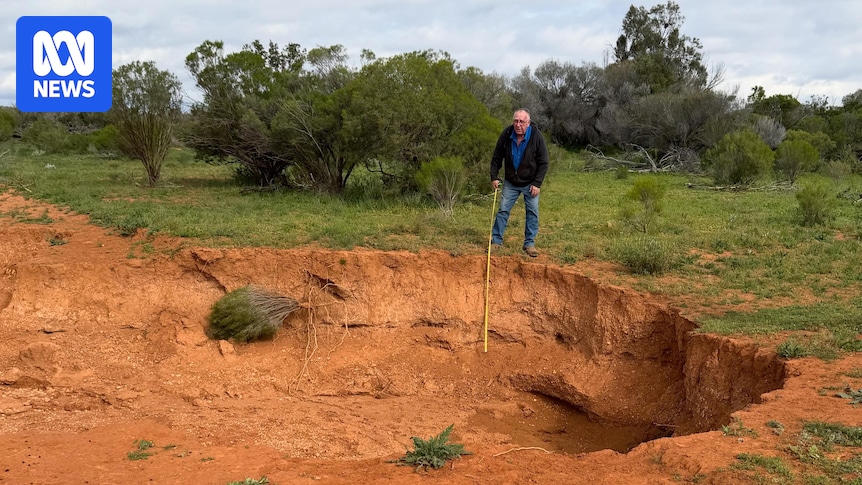
Damage to South Australia’s network of outback roads is isolating remote communities, preventing children from getting to school, and slowing the restocking process for pastoralists recovering from drought.
Large parts of the Birdsville Track remain underwater. (Supplied: Department of Infrastructure and Transport)
There are 10,000 kilometres of outback roads in South Australia, and the transport department has placed closures, restrictions, or warnings in place for every single one.
Among those closed are parts of the Birdsville and Strzelecki tracks, two of the major outback paths.
On Wilpoorinna Station, Ellen Litchfield’s son usually attends preschool at Marree, about 50 kilometres away.
“I think he missed about six weeks of preschool in first term because of the road closures,”
Ms Litchfield said.
“They’ve just got to spend the day with us working on the station, so when you’re a four and two-year-old, that loses its shine pretty quickly.”
Ellen Litchfield has welcomed the rain, despite its challenges. (ABC News: Che Chorley)
Wilpoorinna has had a “record-breaking” rainfall year, recording about 330 millimetres already, 120mm of which fell on the same day.
The station’s annual average is 150mm.
Closed roads are shown as black marks, while red and yellow indicate the roads open to 4WD. Blue roads are open with warnings. (Supplied: Department of Infrastructure and Transport website)
“Obviously we love the rain, and it’s great to have,” Ms Litchfield said.
“But it does mean that there’s long stretches of time where the roads are cut off, where we can’t get basic supplies in, and sort of everything goes to a bit of a standstill.
“Most people pretty much de-stocked because it was so dry last year, so they were really trying to get livestock back onto the properties, which has been really hard with all the road closures and the poor condition of some of the roads.”
Cut off for months
In the state’s far east, about 200km east of Peterborough, the roads to Quondong Station have been hit hard.
Station owner MaryLou Bishop was unable to get back to Quondong for four months because of the roads.
Rain left Quandong Station totally inaccessible for months. (Supplied: Facebook/Quandong Station)
Beginning just outside Burra in the Mid North, the 220-km unsealed Eastern Road is one of many damaged. It leads the way to Quondong Station, and continues through to the New South Wales border.
“It’s only through the generosity of neighbouring stations that we can actually get in, because they allow us to access over their properties,” Ms Bishop said.
MaryLou Bishop and her husband Joe Verco, who bought the station in 2003. (Supplied: Quondong Station)
“We can access via Yunta [an additional 160km], and we can access via the Silver City Highway, but we cannot access directly.”
About 900km north of Quondong, at Cowarie Station, roads – including parts of the Birdsville Track – remain underwater.
“It’s about a metre-and-a-half deep on the road in places, and it’s very wet and very soft,” Sharon Oldfield from Cowarie Station said.
Leaving William Creek to continue along the Oodnadatta Track is not without risk. (ABC News: Che Chorley)
“It is a bit of a conundrum as to what to do to open the road. It would take a lot of work to actually make it usable for the public and to hold up to any volume of traffic at all.”
Long road ahead
Outback communities are “working collaboratively” with the Department of Infrastructure and Transport to reopen the state.
But it will take time.
“We’ve had widespread damage to more than 100 roads, and we’re able to get to about 98 of those roads,” said the department’s road maintenance director, Craig Eckermann.
Some restrictions remain in place along parts of Flinders Ranges Way. (Supplied: Department of Infrastructure and Transport)
“What we’re seeing is major washouts, damaged floodways to shoulders and culverts. We’ve had over 600 millimetres of rain over five weeks, and particularly in parts of the Birdsville Track.
“We have sections that are still underwater, in some places more than a metre deep.“
Flinders Ranges Way is a major route through the state. (Supplied: Department of Infrastructure and Transport)
Mr Eckermann said it was the most widespread damage he had seen.
“We’ve obviously been impacted quite a bit over the last several years, Cyclone Tiffany, and then inland floods, and now these events,” he said.
“It’s sort of been a little bit relentless, to be honest.“
The first step of the department’s response was to provide emergency access to those who had been cut off, opening single lanes where possible.
While the Oodnadatta Track has opened, it is not risk-free. (ABC Rural: Isabella Kelly)
“We’re sort of starting to now move into the recovery phase … but it’s going to take some time,” Mr Eckermann said.
“That relies on us being able to bring in road-building material and having it close to that flooded area, which can be a bit of a challenge.
“There have been some areas where we’ve been working and machinery is getting bogged.”
The Outback Highway has sustained significant damage about 15km north of Lyndhurst. (Supplied: Department of Infrastructure and Transport)
Mr Eckermann said it could be “anywhere up to 12 months” before the outback road network recovered, assuming there was no further damage.
That projection is in line with what landholders expect.
“The last time that area flooded like this, I believe was ’76, and the Eastern Road was closed for a year,” Ms Bishop said.
Old-fashioned country generosity
Some outback roads, like the Oodnadatta Track, have reopened to four-wheel drives. But, as the ABC found out the hard way, that does not make them risk-free.
About 130km out of William Creek, as the sun began to set on the red and green hues of the South Australian landscape, a four-wheel drive full of camera equipment and reporters met its match: an especially large puddle.
The generosity of strangers saved the ABC in its first-hand experience with damaged outback roads. (ABC Rural: Isabella Kelly)
With no option but to go straight through, the car was soon well and truly bogged.
Feeble attempts at digging were unsuccessful, but the tell-tale sound of an oncoming car lifted spirits.
Fast forward two hours, one cracked tyre rim, some very generous tourists and one much-better-prepared local later, the car was free.
William Creek visitors are met with a reassurance they are not the only ones to have lost a tyre to the Oodnadatta Track. (ABC Rural: Isabella Kelly)
After another flat tyre, the tourists’ this time, the William Creek Hotel welcomed five new visitors.
With a long road to recovery, it is such generosity that keeps the outback running, no matter the road damage.