






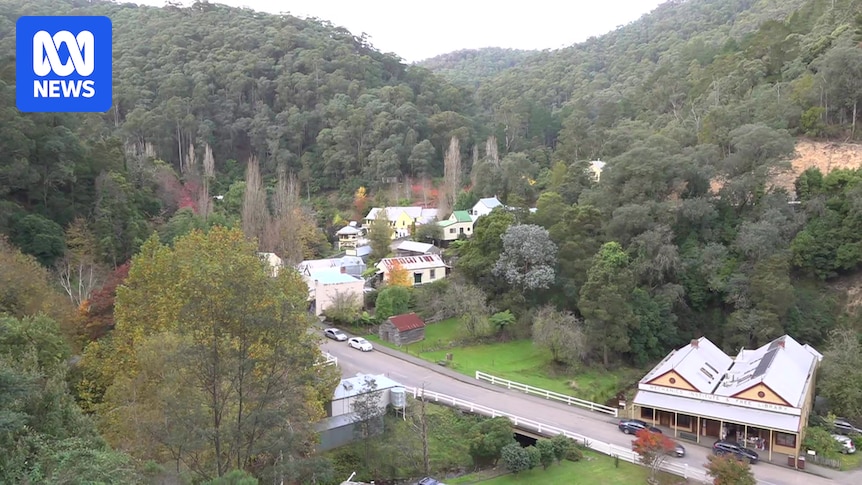
It is a sun-dappled day in Walhalla, and the Walhalla Goldfields Railway train is filling up with tourists.
As staff make the final checks before the rattling red carriages pull away, volunteer Victoria Whelan is scanning through passenger details and tickets.
Volunteer Victoria Whelan checks ticket details as the train fills up. (ABC News: Jack Colantuono)
It is not peak tourism season, but still the train is a key attraction for the town of just 20 permanent residents, about two and a half hours east of Melbourne.
Ms Whelan said the railway is becoming more popular thanks to social media.
“We have about 30,000 people a year … riding the train,”
she said.
“We’re seeing more consistency over the whole year.”
And it could become busier still, if a planned bid for World Heritage Listing for the Victorian goldfields is successful.
Boost would be welcome
Established in the 1860s, Walhalla was once a thriving gold-rush town of several thousand people.
The town’s Long Tunnel Extended Gold Mine produced almost 14,000 kilos of gold over its operation and was once the state’s highest-producing gold mine.
Walhalla’s historic Long Tunnel Extended Mine produced thousands of kilograms of gold. (ABC News: Jack Colantuono)
People have lived there continuously since the town was established, but nowadays most of its attractions are operated and managed by volunteers.
Many of the original buildings were demolished and have been replaced with carefully constructed replicas that capture the spirit of the originals.
But the parts of the town that are not meant to be historic are also starting to look rundown.
Broken, cracked and non-existent footpaths force tourists to share the road with four-wheel-drives, the town lacks reticulated sewerage, which forces businesses to cart sewage away in trucks, and there is a shortage of parking in peak times.
Visitors walk on the road around a broken footpath in Walhalla (ABC News: Jack Colantuono)
Meanwhile, some of Walhalla’s gold-era sites are also being overrun by vegetation, vandalism and deer.
Walhalla is part of the Victoria Goldfields World Heritage Bid, which aims to recognise the state’s historic gold mining towns, including around Castlemaine, Bendigo and Mount Franklin, and their global significance.
It’s expected that gaining World Heritage status would add 2.2 million visitors to the goldfields within 10 years of listing.
Rob Ashworth points at an old photo of Walhalla’s main street. (ABC News: Jack Colantuono)
Ms Whelan said she and her fellow railway volunteers believe that if the heritage bid is successful, it will bring more tourists to Walhalla and its railway, especially if a long-mooted extension to the nearby town of Erica gets up.
“We’re hoping it will increase our reputation internationally, so we might get a threefold increase or something, which would be fantastic,” she said.
But she said the town’s current infrastructure would not be able to handle those numbers.
“I think it’s a good time, with the World Heritage Bid, to really look at Walhalla as a unique place that we could make more of … as a real jewel in the mountains,”
Ms Whelan said.
Worry for wasted potential
Former Baw Baw Shire councillor Michael Leaney is the president of the Walhalla and Mountain Rivers Tourism Association and proprietor of Walhalla’s Star Hotel.
His business is one of those that carts its sewage out of town in a costly and time-consuming exercise.
Michael Leaney says a lack of reticulated sewerage is one of the things holding Walhalla back. (ABC News: Jack Colantuono)
Mr Leaney said the world heritage bid, while not explicitly designed to improve the town’s infrastructure, may nevertheless have the flow-on effect of encouraging much-needed investment in the systems that keep the town running.
“If we’re fair dinkum about Walhalla being a key tourist destination not only for Gippsland but the state and Australia, [there] are basic problems that need to be resolved,” he said.
“Putting a reticulated sewerage system in is not very exciting, nobody sees it, but it’s really necessary to have it happen otherwise all the potential of having a boom is simply not going to occur because we do not have the capacity to cope with it.
“It’s not about the 20 people who live here, it’s not about the 50 people who work here, it’s about the 100,000-plus who visit.“
Michael Leaney said the World Heritage Bid is about preserving Walhalla’s heritage. (ABC News: Jack Colantuono)
‘Tatty’ and ‘tired’
Rob Ashworth, president of the Walhalla Heritage and Development League, said the town needs to be revitalised.
“We’ve put up with decades where the town’s infrastructure is just getting worn down and tatty,” Mr Ashworth said.
“This is a World Heritage candidate location, and it’s looking pretty tired.”
Rob Ashworth said governments must be proactive in supporting Walhalla. (ABC News: Jack Colantuano)
He said he believes the heritage bid will be “transformational” for the town, if governments capitalise on it.
But without that investment, he said Walhalla runs the risk of becoming unappealing to visitors.
“I think the major thing the governments and councils need to recognise is that we’re getting to the stage now where there’s almost too much love for Walhalla, where Walhalla is effectively out of control during major public holiday periods,” Mr Ashworth said.
“It would be really good if governments could be proactive and say, ‘How can we help you, what do you need to position yourself to be regarded as a truly class act international destination?’“
Balanced support
Baw Baw Shire Council mayor Kate Wilson said the council is aware of the need to bring Walhalla’s infrastructure up to a standard that could sustain an increase in visitors.
She said the council is supporting Walhalla through the heritage bid with the creation of two working groups, one focused on business and tourism, and the other on infrastructure, to identify opportunities and deliver services.
Baw Baw Shire mayor Kate Wilson said the council is working with Walhalla’s stakeholders. (ABC News: Danielle Kutchel)
This includes working with the state government to fix the town’s footpaths, which she said needs to be balanced to respect heritage overlay requirements.
But there are no current plans to build a reticulated sewerage system in town.
“A feasibility study was undertaken by [the state government’s Department of Energy, Environment and Climate Action] previously that proved to be unfeasible for the retrofitting of a system like that,” Cr Wilson said.
“But we are working with our working groups to explore what kind of septic or sewerage solutions might be possible for Walhalla in future.”
A Department of Transport and Planning spokesperson said the government would work with councils and communities involved in the World Heritage Bid to plan for future tourism needs while protecting each town’s heritage.