







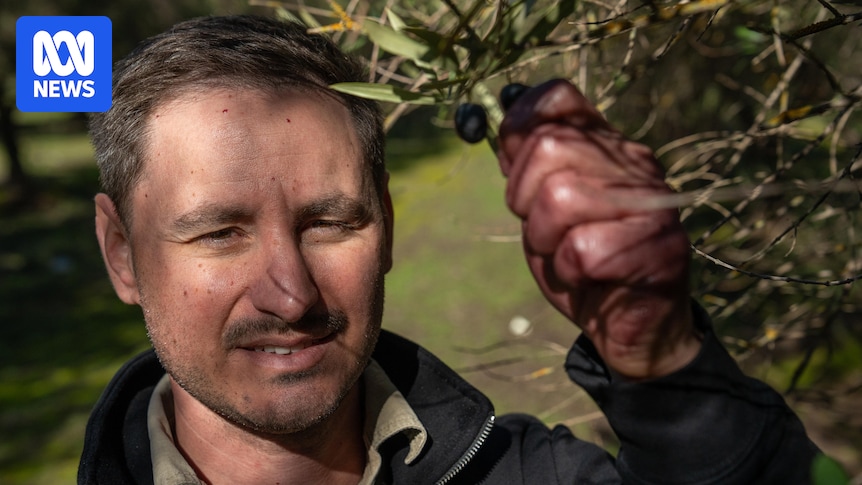
Third-generation olive producer Leon Bettio says the industry has never looked in better shape.
The 44-year-old, who manages his family’s expanded grove along South Australia’s lower River Murray at Mypolonga said consumer demand for olive oil had reached new heights.
It comes at the same time that wine grape growers have reached a crisis point, with farmers being encouraged to consider olives as a potential diversification or transitional option.
Mr Bettio said the demand for olive oil and increased interest in olive production had made it an exciting time to be growing the small fruit.
Recent rain has helped with this year’s olive harvest at Rio Vista’s grove in Mypolonga. (ABC Riverland: Jackson Byrne)
“I’ve never seen such buzz and enthusiasm within the industry,” Mr Bettio said.
“There’s a lot of grape growers asking, ‘How do I diversify?’“
Production boom possible
Australia produces about half of the olive oil it consumes, while the other half is imported mostly from Mediterranean markets like Spain, Greece and Italy.
The Australian Olive Association said the reliance on imported products had been highlighted during the global shortage of olive oil in 2022, when prices rose by more than 70 per cent.
“Prices a few years ago were pushed up when we had a drought in the northern hemisphere,” chief executive Michael Southan said.
Michael Southan says growers he has spoken to are feeling buoyed by this season’s harvest. (ABC Central West: Xanthe Gregory)
“When supply came back to normal, prices went down, but they didn’t go back to the level they were.”
Michael Esposito, who manages his family’s business on Kangaroo Island, also provides harvesting services for other growers across South Australia.
He said many olive growers still relied on outside help to get their fruit off the tree and onto supermarket shelves.
Michael Esposito says the growing popularity of the “Mediterranean diet” is driving demand for extra virgin olive oil. (ABC News: Daniel Taylor)
“Australia consumes approximately 40 million litres of extra virgin olive oil,” Mr Esposito said.
“There is a net deficit which we import to satisfy the current demand, which is growing.“
While yields are up this harvest, after years of drought, some olive growers have reported decreased oil production and will utilise supply from last season.
But Mr Southan said strong prices and continuing domestic demand meant the industry was well positioned.
He said it could expand but access to water remained the clinch point.
“If you have water for irrigation, olives are a very, very good option,” Mr Southan said.
Olives are processed all day during harvest at Rio Vista’s mill in Mypolonga. (ABC Riverland: Jackson Byrne)
“We have tremendous potential to absorb a lot more locally produced product.
“If you have a good quality product, the consumers will buy and they’ll buy at a price that keeps you sustainable.“
Oil like a fine wine
Mr Bettio said quality was always something his family had prioritised over quantity, referencing his Italian roots and the famous olive groves in the Mediterranean.
He said, fortunately, there had been a change in consumer perceptions of olive oil, meaning it was no longer viewed as just a kitchen staple.
Leon Bettio keeps a close eye on production. (ABC Riverland: Jackson Byrne)
“Before, it was literally just something to cook in but now people know what a good extra virgin olive oil can taste like,” he said.
“We’re pursuing different flavours … that no-one thought could be in an olive oil.
“People can nerd out on any kind of good, well-done ingredient or food.“
Despite feeling optimistic about the future of the industry, Mr Esposito said growing olives was like playing the long game.
This season’s olive harvest has been stronger than many thought it would be. (ABC News: Daniel Taylor)
“You plant a vineyard for your children and an olive grove for your grandchildren,” he said.
“From a financial point of view, it’s a 10-year return rather than a two or three-year return.”