








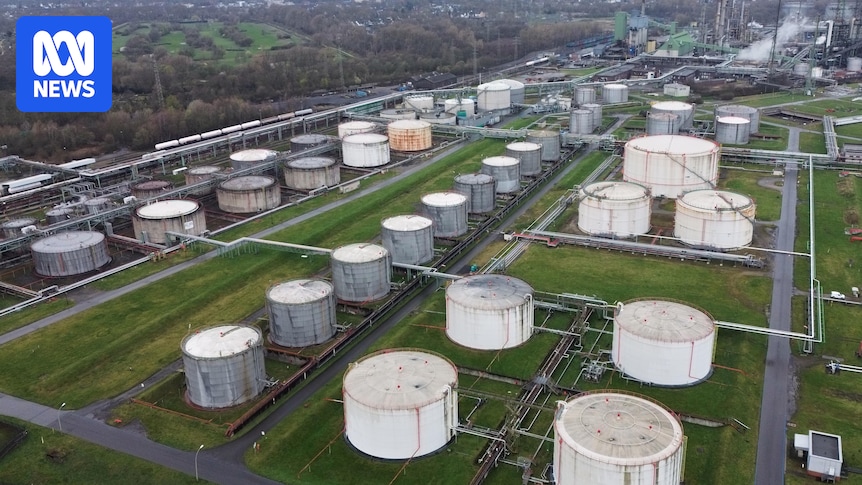
Depleted oil reserves have left economies vulnerable to soaring fuel prices as the US-Iran conflict resumes, the IMF has warned.
Before the war began, global oil supplies were at about 2 million barrels a day above demand.
The IMF said that prevented the global economy from experiencing bigger price shocks as the world dealt with the largest oil supply shock in more than five decades.
“That success, however, has a cost,” the IMF note read.
“With buffers now depleted, the system is more exposed if disruptions persist or escalate anew, and rebuilding stocks will keep the market tight even as supply recovers.”
Some experts said it could take about two months for the impact of the Strait of Hormuz closure to be felt in oil markets.
The oil price has increased by more than 10 per cent following the most recent closure of the strait.
How the oil shock was absorbed
Before the war started in late February about 20 per cent of the world’s oil supply transited through the Strait of Hormuz.
The IMF said three factors stopped the closure of one of the world’s busiest shipping lanes from causing even more harm to the global economy.
One factor was the slowing of demand, especially in Asia, where consumption changed as a result of higher prices and a move to alternative energies such as coal and renewables.
Oil production outside the Gulf rose after the US-Iran war, especially across the US, Venezuela, Guyana and Russia. (IMF blog)
The IMF also said oil production outside the Gulf increased to almost 2 million barrels a day above 2025 levels, largely from the US, Venezuela, Guyana and Russia.
But it said the rest of the shock was absorbed by reserve supplies.
“The estimated market deficit of about 4.0 million barrels a day in March–May was met almost entirely by drawing down global stocks,” the IMF said.
Oil reserves have been ‘spent’
The IMF the closure of the Strait of Hormuz had not led to a “full-blown price shock” because the reserves absorbed what the market could not.
It said that by the end of May oil reserves were estimated to be about 1.2 billion barrels, which was half the level prior to the conflict.
“That cushion, however, has been spent,” the IMF said.
“If the disruption were to persist at current rates, that lower bound would be reached by early 2027.
“Well before that point, prices would likely move sharply higher, as the market would effectively be operating without a safety net.”
The IMF said the estimated deficit in the market of about four million barrels a day between March and May was supplied almost entirely through oil reserves. (IMF blog)
Some analysts, including the Commonwealth Bank’s Vivek Dhar, said it would take about 10 weeks for the reduced oil output in the Gulf to be felt in markets.
He has warned oil prices may as high as $US150/bbl at the end of that period if the Strait of Hormuz remains closed, as this is the cost necessary to sufficiently cut demand across Asia to match reduced supply.
“Markets now have more of a reason to price in this scenario and suggests that, if the status quo persists, we could see Brent oil futures lift towards $US100/bbl in the next 10 days,” Mr Dhar said.
But Rabobank analysts have not changed their forecast of a $US80/bbl average between July and September and $US78/bbl for the end of the year.
“The oil market’s initially contained reaction to the renewed fighting in the Persian Gulf is a sign that the supply shock can be contained — at least for a while,” Rabobank said in its update.
It added that the market had been aided by oil reserves, smaller Chinese oil imports and different supply routes.
“This has created a form of geopolitical complacency, we do not see it as sustainable over the longer term,” it said.
Capital Economics’ Kieran Tompkins, a senior commodities economist, said investors had expected prices to increase somewhat.
The firm analysed investor perceptions of the oil price over the next three months.
“The main takeaway is that investors are swiftly pricing in the potential for further disruptions to global oil supplies,” Mr Tompkins said.
“Investors have become appreciably more uncertain about their expectations for the most likely outcome for oil prices.
“Given that the level of global oil inventories is now much closer to a ‘tipping point’ compared to a few months ago, there is less room to absorb a sustained loss of oil flows without prices rising sharply.”
Loading…