





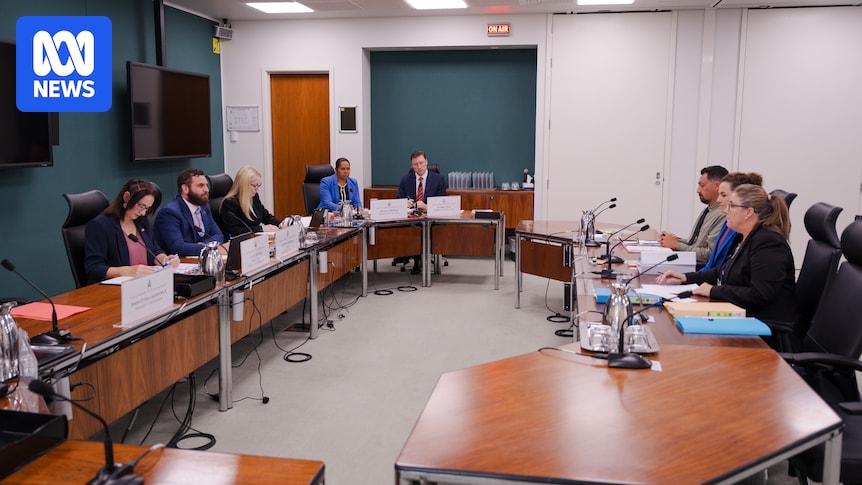
NT parliament has wrapped up its first week of senate estimates, hearing from the police minister, corrections minister and the treasurer.
While the CLP continues to enact its platforms of tough on crime and rebuilding the economy, in their second estimates they faced questioning over prison lockdowns, housing construction and police policy.
Here are the key takeaways from the week.
The CLP has remained firm in its tough-on-crime agenda, despite questioning over prison lockdowns and police policy. (ABC News: Michael Franchi)
Prison lockdown for staff breaks
The Northern Territory has the highest rates of repeat offending in the country and has had a steep increase in prisoner populations over the last two years.
At the time of estimates, there were 2,772 people in corrections.
During estimates on Thursday, NT Corrections Commissioner Matthew Varley admitted the Corrections Department had no evidence that current rehabilitation programs in prisons were reducing recidivism rates.
He said there were a range of programs available, and some had been successful interstate, but they were not working in the NT.
Matthew Varley conceded corrections had no evidence current rehabilitation programs were effective. (ABC News: Pete Garnish)
“The question in the second part is: are they proven to reduce recidivism? And the answer to that is no,” he said.
“Our recidivism rate obviously remains stubbornly high.”
Corrections Minister Gerard Maley faced questions on the number of lockdowns in youth justice facilities each month.
He said they experience an average of 35.8 rotational lockdowns due to a range of factors, including staffing.
Gerard Maley says the NT’s youth justice facilities experience regular lockdowns. (ABC News: Oliver Chaseling)
Deputy Youth Justice Commissioner Sasha Dennis confirmed the lockdowns mostly occurred in the evening, due to staffing constraints.
“The rotational lockdowns are no longer than 45 minutes, and often that is so that our staff can take our staff breaks when we do not have sufficient staff due to those operational impacts,” she said.
Police training gaps
On Tuesday, NT Police Commissioner Martin Dole faced questioning over the death of Kumanjayi White, who died while being restrained by two police officers at an Alice Springs supermarket in May last year.
He was 24 years old and was living with a disability.
Last month, the Department of Public Prosecutions confirmed it would not lay charges against the two police officers involved.
Under questioning, Commissioner Dole revealed NT Police did not have any dedicated training on how officers should interact with people with cognitive disabilities.
He said the force was considering changing that policy pending a coronial investigation into Kumanjayi White’s death, which is expected later this year.
“That’s something we’re looking at bringing to the coronial recommendation committee and looking at that policy and working on that,” he said.
Martin Dole says NT police was considering reviewing its policies in regard to officer training around disability. (ABC News: Pete Garnish)
Earlier that day, Police Minister Lia Finocchiaro was questioned about the rates of anti-racism training among police force members — a recommendation of the Kumanjayi Walker coronial inquest.
She said 78 per cent of members had completed the training.
“Every new police officer has it coming through the college, and then we have to do the backfill of existing members and we’ve targeted specific core groups within police to make sure they have had training,” she said.
She said the training rollout had focused on members of the Territory Response Group and senior sergeants.
Lia Finocchiaro says most NT police officers have completed anti-racism training. (ABC News: Michael Franchi)
New watchdog’s conflict of interest policy
In May this year, former Northern Territory Police Commissioner Reece Kershaw was appointed as chief executive to a new Office of the Integrity and Ethics Commissioner (OICE).
The new commissioner has replaced four integrity bodies, including the territory’s anti-corruption watchdog.
Reece Kershaw was selected in May this year to be the new Office of the Integrity and Ethics Commissioner in the NT. (ABC News: Ian Cutmore)
The appointment comes following a scandal last year, in which the former ICAC found in early 2024 former NT Police Commissioner Michael Murphy engaged in “improper conduct” by helping his good friend get a high-placed job in the police force, and sitting on the panel that hired him.
On Monday, the new commissioner revealed he had no specific policies on how he would deal with potential conflicts of interests during investigations into NT Police.
Instead, he will be expected to excuse himself from those investigations.
Regional housing rejected
On Wednesday, Housing Minister Bill Yan revealed that there had been little to no uptake of a housing scheme in regional areas.
A key CLP election commitment in 2024, the HomeGrown Territory grants scheme was introduced last year offering up to $50,000 for first home buyers building or buying a new home.
The policy is intended to boost new home builds across the territory, but the statistics showed the vast majority of the homes had been built in Darwin and Palmerston.
Bill Yan says finding builders to work on housing development in the NT has been difficult. (ABC News: Dane Hirst)
Mr Yan said only one grant had been awarded to Alice Springs.
“The difficulty has been finding builders,” he said.
“I know people have been looking to take up the grants and we’re struggling to find the builders to do the work.
“We’re certainly aware of the uptake in the regions and only having one in Central Australia is a concern to me.”
He also revealed power, water and sewage costs in the NT were expected to increase by 5.3 per cent as of July 1.
Mr Yan, who is also the Logistics and Infrastructure Minister, revealed the cost blowout of the Aboriginal and Torres Strait Islander Art Gallery of Australia (ATSIAGA) which was scrapped late last year.
Bill Yan says $23 million had already been spent on the now-scrapped ATSIAGA in Alice Springs. (Supplied)
The ATSIAGA was initially planned to be a joint-funded world-class gallery based in Alice Springs, but after the NT government announced a downsize, they failed to secure the financial commitment from the federal government.
Mr Yan said it was projected to go over budget by hundreds of millions of dollars and the government had already spent $23 million on the gallery when they decided to scrap the project.
Estimates are set to continue next week.