




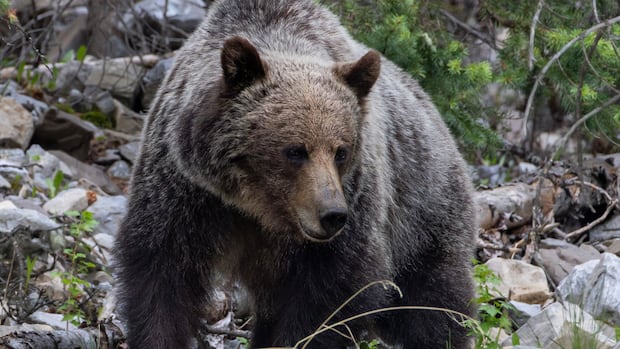
Amid calls for a grizzly bear hunting season in Alberta, the province says it’s not currently on the table.
“We have no plans right now of doing anything,” Forestry and Parks Minister Todd Loewen said in an interview.
“We’re looking at all the options that we have available to to us,” he said. “We want to make sure that any decisions we make are are made in the best interest of Albertans.”
Earlier this year, the Rural Municipalities of Alberta (RMA) committed to lobbying the provincial government for a grizzly bear hunting season. That decision was made after a motion put forward by Cardston County was carried by RMA membership during a meeting in March.
The RMA declined an interview request from CBC News.

Grizzly bear hunting has been banned in Alberta since 2006, with the exception of harvesting by Indigenous hunters for subsistence or cultural purposes.
The province also allows approved hunters to kill “problem” grizzlies on a case-by-case basis through the Wildlife Management Responder Network introduced in 2024.
Loewen said that while plans for a grizzly hunt are not currently in the works, his comments are not necessarily a direct response to the RMA’s motion. He said the province is still giving “full thought and consideration” to the motion.
He pointed to an earlier RMA motion passed in 2024 calling for the province to increase funding for management of grizzly bears, particularly “problem” bears. That lobbying was deemed unsuccessful by the group.
“We respect our rural people, the people that have to live with grizzlies right in their neighbourhood,” Loewen said.
Rural residents ‘worried’ about bears
Cardston County’s chief administrative officer Murray Millward said in an interview that if the province decides a hunt is not needed at this time, the municipality is not going to argue with them on that.
“The province has all the data, so they know what they’re doing, I guess,” Millward said.
He pointed to a specific incident in which a county staffer was chased by a grizzly bear last year.
The RMA’s advocacy stems from what Cardston County called “a significant increase in human-bear interactions” in southwestern Alberta, including a fisherman injured by a grizzly with cubs near the town of Cardston, about 20 kilometres north of the U.S. border, last summer.

WARNING: This story contains graphic images
A Calgary man is recovering from injuries after a dangerous encounter with a grizzly bear. Carmelo Silvestro spoke to the Calgary Eyeopener about what the experience was like and how it has affected him.
The majority of the RMA’s membership, which is made up of more than 60 rural Alberta counties and municipal districts, voted in support of the resolution.
“We’re all worried about our citizens, our cattle, our livelihoods and if the bears get too far out, that’s going to cause problems for us,” Millward said.
“We’re looking at the issues that we can resolve without the hunt,” Millward said. “I mean, if they don’t need a hunt, we don’t want to push a hunt, but we do want to make sure that our citizens are safe.”
Loewen said he’s well aware that many people are “concerned about safety and the loss of property that they experience in rural Alberta.”
“Grizzly bears are being photographed in areas where they have not been seen in possibly 100 or more years,” he said.
Loewen said that while he hasn’t seen the exact statistics on bear encounters this year, there has “definitely been a trend over the last few years” of increased grizzly bear activity and sightings in Alberta.
“Those are all things that we consider as we make decisions in government,” the minister said.
Groups working to raise awareness for Alberta’s grizzly bears
The Alberta government designated grizzly bears a threatened species in 2010, meaning there were believed to be fewer than 1,000 mature adults in the province. Adults make up roughly half of the grizzly population.
While there hasn’t been a provincial study on Alberta’s grizzly bear population since 2018, the province’s latest estimates peg the number of bears at over 1,000.

A campaign launched by the Exposed Wildlife Conservancy, alongside the Alberta Wilderness Association and Grizzly Bear Foundation, aims to provide education, highlight the status of grizzly bears, and ensure that educated decisions are being made regarding wildlife.
“This campaign feels very meaningful and very important because we want to make sure that we’re making educated decisions when it comes to wildlife,” said Maggie Spizzirri, executive director of Exposed Wildlife Conservancy.
She said that because grizzly bears are still listed as a threatened species, the public is highly passionate about the conservation campaign, as “they don’t want to see a species go extinct.”
“Our following is quite fired up,” she said. “It’s nice to see that grizzly bears are an important species and they’re cared for here.”

Some wildlife advocates say more information is needed for Alberta’s grizzly management program amid calls to reopen its grizzly bear hunt.
During an interview, Loewen pointed to the provincial government’s ongoing grizzly bear conservation measures, including the Spray Lakes West campground project, where vegetation was removed beyond the campground to create more suitable grizzly habitat and draw the bears away from camping areas.
The RMA is also calling for the province “to end the Grizzly Bear Recovery Plan,” which has been in place since 2008, “and implement a Grizzly Bear Management Plan.”
That plan includes protecting and restoring grizzly habitat in mapped-out bear management areas, working to minimize the risk of human-wildlife conflict and human-caused grizzly bear mortality, and raising awareness on bear coexistence through BearSmart programs across Alberta.