







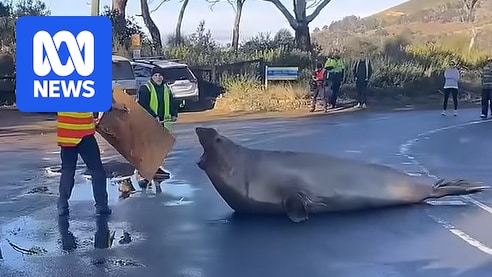
Tasmania’s Department of Natural Resources and Environment (NRE Tas) has defended using a padded pole and a board to coerce Neil the seal off a southern Tasmanian road.
A video posted online on Wednesday showed two NRE Tas staff members poking and hitting the 1,000-kilogram southern elephant seal with a pole and a board in an attempt to get him to relocate.
Neil clearly is unimpressed by what is going on. (YouTube: neiltheseal_316)
In a statement, NRE Tas said the methods were an “internationally recognised approach used by trained wildlife experts”, causing no harm to the animal.
Neil has become popular on social media for his appearances on land, which in the past have included chewing on traffic cones and lying in front of cars.
People use a pole and board in their attempts to coax Neil to safety. (YouTube: neiltheseal_316)
1,000-kilogram ‘teen’ spoiling for a fight
NRE Tas said Neil was born in 2020 in Salem Bay, on the Tasman Peninsula, and “was tagged on each tail flipper just prior to weaning”.
Neil “regularly hauls out in human-populated areas and may interact with people”, it said, adding that “elephant seals can be dangerous if approached and they may become habituated to people, which compromises their long-term survival”.
“They often appear cumbersome and indifferent to humans yet, despite their awkwardness, the speed with which they can move their bulk makes them potentially dangerous if harassed,”
NRE Tas said.
Neil eventually turns and heads for the grass, watched by a crowd of people. (YouTube: neiltheseal_316)
NRE Tas said moving Neil off the road was important in protecting the community and ensuring Neil’s safety.
“Male southern elephant seals naturally engage in play fighting, and without a colony in Tasmania, Neil can be drawn to busy areas in search of interaction,”
it said.
“As a subadult, his behaviour has changed, and techniques used during previous visits have been updated to ensure everyone’s safety.”
Subadult elephant seals like ‘teenage boys’
Ian Field has been researching elephant seals for 15 years, and spent four of them at Macquarie Island in the Southern Ocean.
Neil the seal with a tracking device attached by authorities to keep tabs on his movement in April 2023. (Supplied: Department of Natural Resources and Environment Tasmania)
Dr Field said juvenile and subadult elephant seals, like Neil, could be aggressive.
“They’re teenage boys. They’re getting bigger. They want to earn the right to reproduce. And to do that, they need to hone their skills of fighting and also interacting,” he said.
Dr Field said moving them on required a level of caution.
“If you do have to interact with them and you want to move them, then really you need to make yourself seem and appear bigger than they are. You need to have some sort of dominance,” he said.
“In terms of stature, in terms of noise, or in terms of something that he can feel so that you are proving to him that you’re the dominant and he needs to move along.”
Neil makes a nuisance of himself outside a real estate agency in Dunalley in December 2023. (Supplied: Facebook/Raine & Horne)
NRE Tas advises people in Tasmania to report southern elephant seal sightings to the Whale Hotline (0427 WHALES).
It also urges people not to disturb southern elephant seals resting ashore and to keep a 20-metre distance from seals.
People with dogs should keep their animals on a lead and at least 50 metres away from seals.